
Explore Prague
Prague Old Town
Old Town is where Prague's global image can become an obstacle to seeing the city itself. The square, clock and route to Charles Bridge attract enormous crowds, and a visitor moving only with that flow may conclude that the district is one long tourist corridor. Turn one street away and the geography changes: medieval plots become visible in narrow passages, university buildings interrupt shopping streets, Romanesque cellars sit beneath later houses and Baroque façades conceal older structures. The district is compact enough to walk without transport, which makes sequence important. Rather than racing between landmarks, use Old Town Square as an orientation point and then read the old city outward: east toward the Powder Tower, west toward the bridge, north toward Josefov and south toward the university and theatre districts. The best version of Old Town is not a list of fifteen things to photograph. It is a connected urban story.
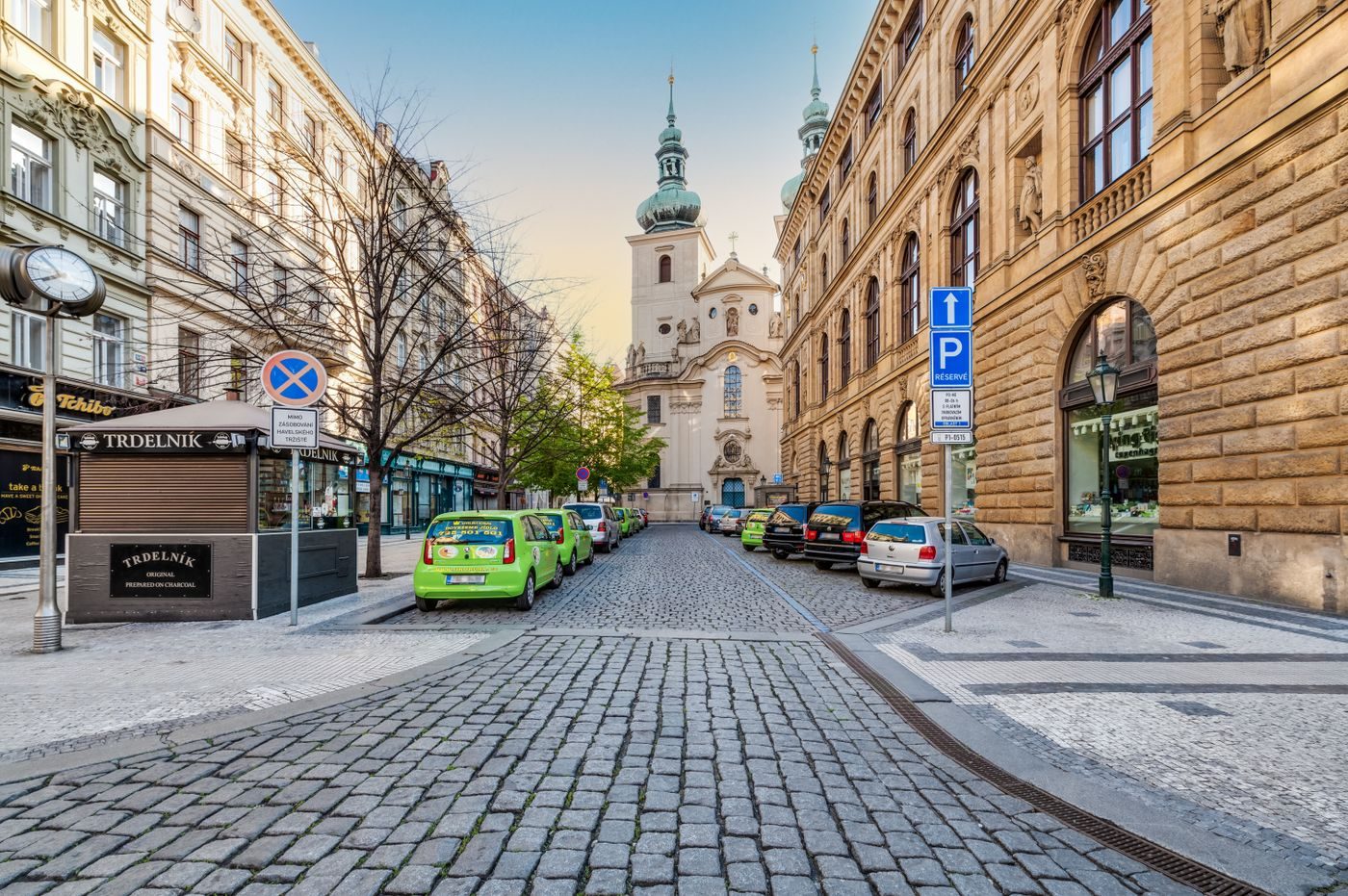
Prague Old Town (Staré Město) is the historic core east of the Vltava. Its principal core centres on the Astronomical Clock at Old Town Square; Charles Street, the Klementinum and the former medieval gates near the Powder Tower extend the story beyond that square. You can cross it in 20 minutes, but a useful first visit takes half a day because the interest is in the layers between headline sights: medieval street lines, house signs, courtyards, university buildings, churches, Baroque palaces and traces of former fortifications. Start early at Old Town Square, continue through quieter side streets, then choose either the Jewish Quarter edge or the river and Charles Bridge.
Old Town in one mental map
Staré Město grew on the right bank of the Vltava around trade routes, markets and river crossings. Old Town Square became its civic and commercial centre; the town hall embodied municipal government; churches signalled competing institutions and communities; and gates connected the walled town to roads beyond.
Today, three axes are especially useful. The first runs from the Powder Tower through Celetná Street to Old Town Square. The second continues from the square along Karlova toward Charles Bridge. Together they form part of the historic Royal Route used by coronation processions. The third is less ceremonial but just as important: a north-south web linking Josefov, the square, the university quarter and the Vltava.
Once you have those lines in mind, you do not need to follow a fixed itinerary. You can leave the crowd, explore a side street and still know how to recover the main route.
Old Town Square: market, stage and civic centre
The square developed as a marketplace on routes connecting Prague with the wider European trading world. Its irregular shape makes more sense when seen as an evolved commercial space rather than a geometrically planned plaza. Over centuries, the square accumulated institutions: the Old Town Hall, Týn Church, St Nicholas Church, merchant houses and aristocratic palaces.
Political memory is layered here too. Executions after the 1620 Battle of White Mountain are commemorated near the town hall. In the final days of the Second World War, fighting around the town hall during the city's May 1945 uprising caused severe damage. The astronomical clock survived, but parts of the town hall complex were destroyed and never rebuilt in their former extent.
Stand near the centre and rotate slowly. The façades do not belong to one era. Gothic, Renaissance, Baroque, Rococo and later rebuilding sit side by side, which is why the square is a better architecture lesson than a single monument.
The Astronomical Clock without the mythology
Prague's Orloj forms part of the Old Town Hall tower façade. Its astronomical mechanism dates to the early 15th century; documentary research associates the early mechanism with astronomer Jan Šindel and clockmaker Mikuláš of Kadaň. The famous legend in which Master Hanuš is blinded so he cannot reproduce the clock is not reliable history.
At the hour, visitors gather as the Apostles and other moving figures appear. The show is brief. Understanding the clock takes longer than the hourly spectacle: return to the dial once the crowd has thinned. Identify the astronomical dial, calendar elements and the relationship between astronomical information and civic timekeeping.
Current opening hours for the Old Town Hall and tower are published by Prague City Tourism and can change seasonally. Planning to include the tower? Check the official listing rather than assuming the hourly show and tower access follow the same schedule.
Charles Street and the Royal Route
Karlova Street is the obvious pedestrian connection from Old Town Square toward Charles Bridge. It is also one of the busiest pieces of Prague. Historically, it formed part of the coronation route leading from the old royal court near the Powder Tower through the Old Town, across the bridge and up to Prague Castle.
Before modern house numbering, façades and signs helped identify buildings. Some survive or have been restored, giving names and visual symbols to houses along this route and elsewhere in the centre. Those signs are more than decoration; they are a clue to how an address system worked before standardized numbers became normal.
For a calmer walk, do not feel obliged to remain on Karlova. Parallel streets such as Liliová and the lanes around Anenské náměstí offer alternate approaches to the bridge and reveal a less compressed version of the same district.
Klementinum: a city-sized institution
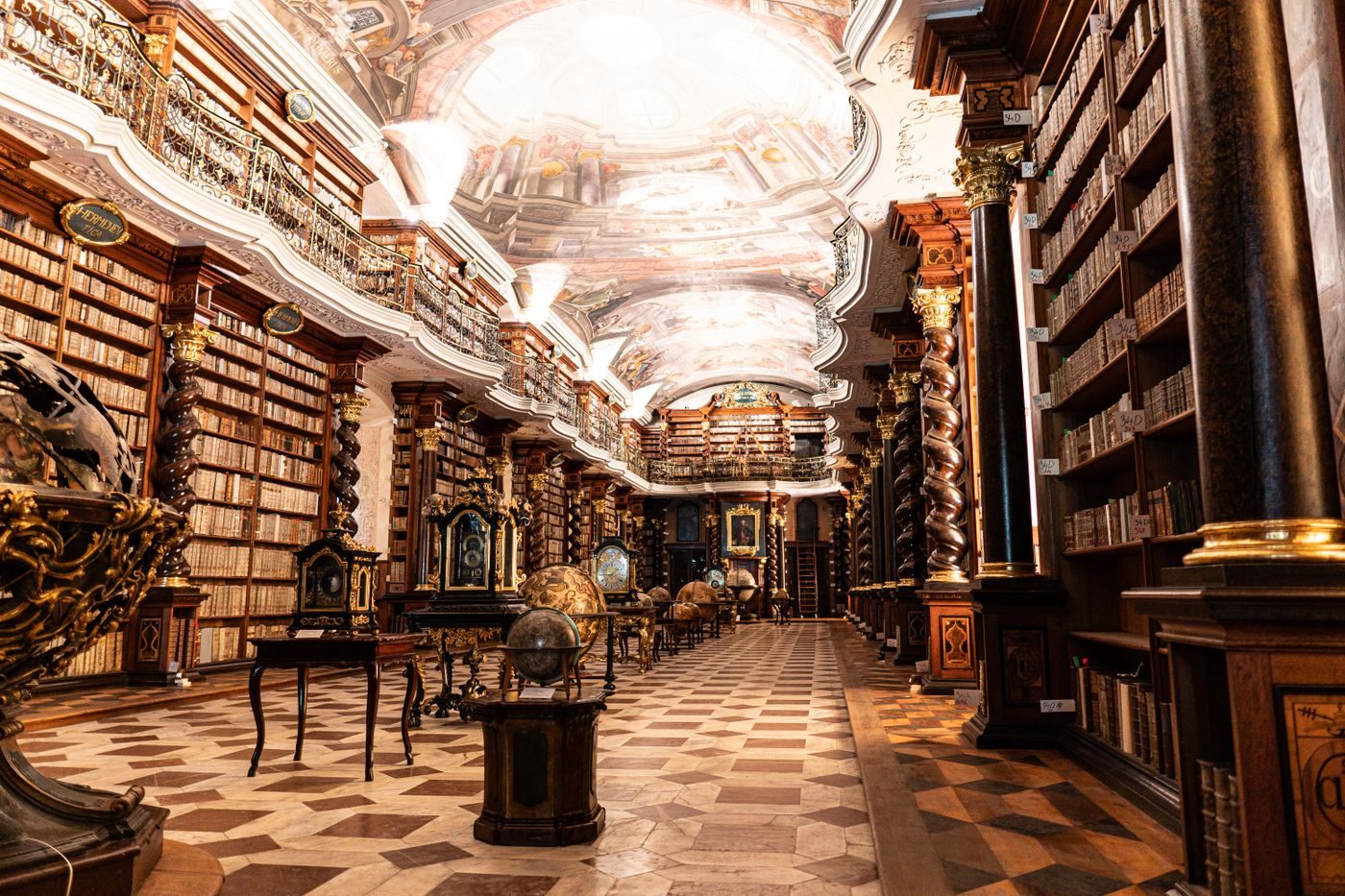
The Klementinum occupies a huge block close to Charles Bridge and records several chapters of Prague's intellectual and religious history. Jesuits developed the complex after their arrival in Prague, creating churches, classrooms, libraries, courtyards and an astronomical tower. It later became closely associated with the university and today houses the National Library of the Czech Republic in much of the complex.
Tour access focuses on specific historic interiors rather than opening the entire institution. The celebrated Baroque Library Hall is visually spectacular, but access conditions and the exact route can change. Tickets and tour times needs verification with the current operator.
Even without entering, walk through accessible courtyards when permitted and search the walls for sundials. The scale of the block becomes clearer from inside than from the narrow streets around it.
The northern edge: where Old Town meets Josefov
Old Town and Josefov are administratively distinct, but for a visitor their edges blur. Pařížská leads from Old Town Square toward the river through an area transformed by the clearance that reshaped Prague’s historic Jewish district around 1900. The synagogues that survived, together with the cemetery sit only minutes from the square.
If you plan to visit Jewish Museum interiors, treat Josefov as a separate historical visit rather than a quick detour. Saturdays and Jewish holidays affect openings, and the Pinkas Synagogue is a Shoah memorial deserving time and a different tone from ordinary sightseeing.
If you are only walking the edge, use it to read the sudden change in urban scale: narrow medieval fabric gives way to broad streets and large apartment houses. That shift is itself part of Prague's modern history.
Powder Tower and the old eastern approach
The Powder Tower stands near the Municipal House on the east side of Old Town. Its dark Gothic silhouette marks the area of one of the old city approaches and the beginning of the Royal Route. The present tower was begun in the late 15th century; its name comes from later use for gunpowder storage.
A different piece of the former fortification survives underground at Můstek. The Czech word means 'little bridge', and archaeological remains of a medieval bridge associated with the town defences can be seen within the metro environment. It shows that modern transport did not erase every earlier layer; sometimes it exposes them.
Walking from Powder Tower through Celetná to the square is therefore not merely a shopping street. You are moving from the former edge of the walled city toward its civic centre.
Old Town's historical layers in ordinary buildings
Prague façades often lie about the age of the structure behind them. A Baroque or 19th-century street front can cover a medieval core, cellar or portal. The Gothic Stone Bell House on Old Town Square is a particularly clear example of a building whose earlier character was recovered through restoration. The Golden Ring preserves another important Gothic portal.
Karolinum, the historic seat of Charles University, embodies institutional continuity rather than a single stylistic moment. The university was founded in 1348; the complex known as Karolinum developed around a town palace acquired for university use in the 14th century and was altered repeatedly afterwards.
Franz Kafka's birthplace near the Church of St Nicholas is another case where a famous association survives despite physical change to the building. These sites work best when they prompt two questions: 'What date is the façade?' and 'What may be older behind it?'
Small details that disappear at walking speed
Old Town has an enormous inventory of small objects: house signs, saints on corners, flood markers, stone portals, old shopfronts, courtyards and sculptures. These are not 'secret Prague'—many stand in public view—but they disappear when visitors navigate only from pin to pin on a map.
The district also accumulated ghost stories. Headless figures, cursed lovers and uncanny merchants attach themselves to streets and houses in later folklore. They are entertaining ways to remember a place, but their narrative status differs from building records or archival events. Spectrum's supporting ghost Stories keep that distinction explicit.
Try this instead: choose one block and inspect it slowly. Read plaques. Look above ground-floor signs. Check passageways that are clearly public. Old Town becomes much richer once the eye stops operating at shop-window height.
A half-day Old Town walking route
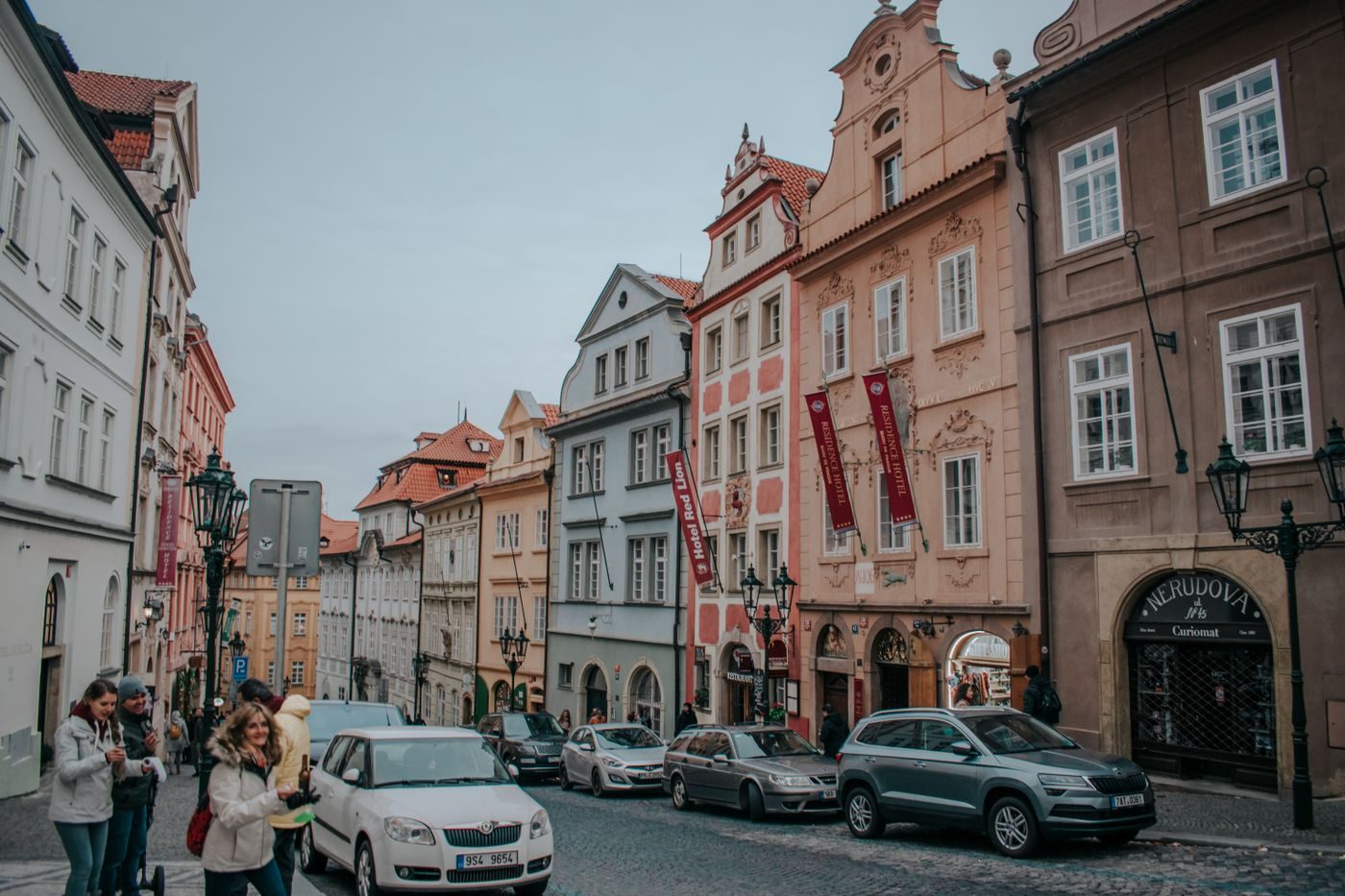
A useful first route begins at the Powder Tower before the centre becomes crowded. Walk Celetná to Old Town Square and spend time with the town hall and clock. From there, make a northern loop along the edge of Josefov if you are not doing the full Jewish Museum circuit, then return toward the Klementinum through side streets rather than taking only Karlova.
After the Klementinum, continue to the Vltava. You can finish at Charles Bridge, but consider viewing the bridge first from the riverbank or nearby streets before joining the pedestrian flow. This route is compact in distance and generous in content; three to four hours is realistic if you enter one or two interiors.
If the square is already packed, reverse the route. Prague has no rule requiring you to see the clock first. Early morning and later evening change the atmosphere dramatically, while midday works better for interiors and lunch.
Food and breaks: avoid choosing by proximity alone
Old Town contains excellent restaurants and cafés, but it also has the city's highest concentration of venues relying on captive foot traffic. A restaurant directly on the most crowded route may be charging for location as much as cooking. Walk two or three streets away, compare menus and check whether prices are clearly displayed.
Two foods need context. Prague ham has a genuine local history, yet some outdoor tourist stands have attracted criticism over confusing pricing by weight. Ask what a portion will cost before ordering. Trdelník, despite its visibility around Old Town, is not an ancient Prague pastry; its modern tourist association with the city is much stronger than its historical roots here.
For a quick break, traditional cafés, bakeries and pubs away from the busiest square frontage usually give you more time to sit without feeling that every table must turn instantly.
Old Town is a street network before it is a collection of monuments
Staré Město developed through trade routes, parish territories, markets, gates and property plots long before modern sightseeing routes existed. Its irregular lanes are therefore evidence of urban growth rather than poor planning. The useful way to navigate is to identify a few structural lines: the east–west Royal Route, the market space of Old Town Square, the river edge, the boundary toward Josefov and the former eastern gate marked by the Powder Tower.
With those anchors fixed, getting “lost” in side streets becomes less literal. Short passages reconnect with larger routes, and the changing width of streets often signals a former market, church forecourt or important approach. Building plots can preserve medieval logic even when façades are Baroque or nineteenth-century.
UNESCO’s description of Prague emphasizes the exceptional continuity of its medieval urbanism. That continuity does not mean every house is medieval. It means street pattern, parcel structure and monumental relationships survived without wholesale replacement on the scale seen in many European capitals. Old Town’s value is therefore partly in the spaces between famous buildings.
Walk one block without consulting a map and use towers as orientation. Týn, St Nicholas, the Town Hall, Clementinum towers and the Powder Tower create a visual network above street level. The exercise makes later route planning easier and reveals why Prague’s skyline historically functioned as navigation.
The Klementinum explains a different kind of Prague power
The Klementinum occupies a huge block near Charles Bridge and can be mistaken for one more Baroque attraction. Historically it was an institutional city within the city, associated with the Jesuit college, education, library collections, science and later national scholarly institutions. Its scale becomes obvious only when you walk around the perimeter rather than entering one photogenic room.
For visitors, the Astronomical Tower and Baroque Library are the best-known parts, but the larger lesson is how much land major religious and educational institutions could command inside the dense Old Town. The complex reshaped circulation between the square, bridge and river.
Scientific history also complicates the cliché of Prague as purely mystical. Astronomical and meteorological observation, university scholarship and learned networks formed part of the same city that produced legends and devotional art. The Klementinum’s long-running meteorological observations are often invoked in discussions of Prague climate history, while its library tradition connects the site to intellectual administration rather than royal ceremony.
Treat the Klementinum as a hinge in a walking route. Coming from Old Town Square, it marks the transition toward the river and bridge. Coming from Charles Bridge, its walls announce that the visitor has entered an institutional core of the Old Town, not simply a lane of souvenir shops.
Slow down at thresholds: courtyards, passages and church approaches
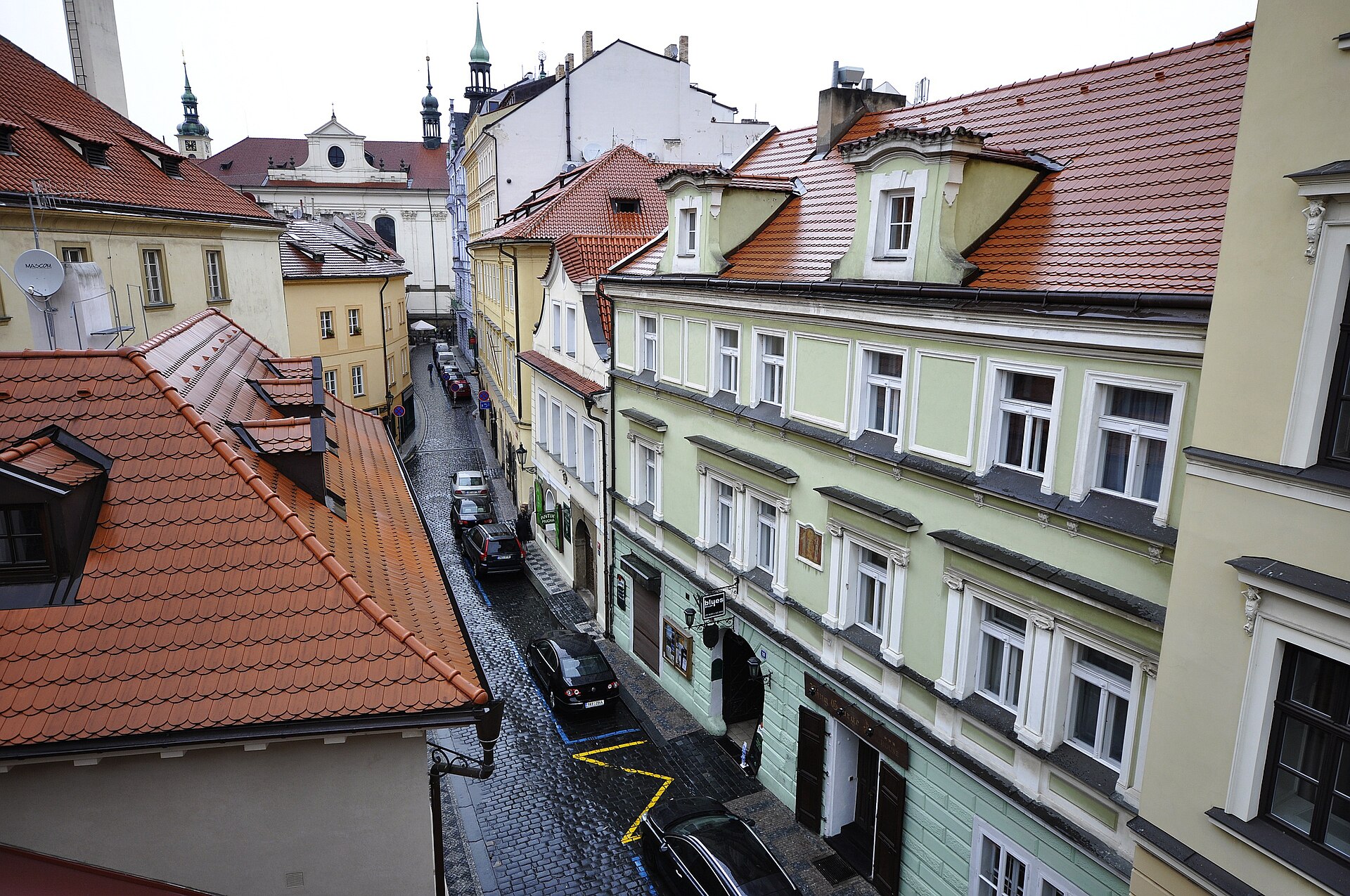
Old Town rewards attention to transitions. A street narrows before opening into a courtyard. A church façade appears at the end of an alley but the main entrance is somewhere else. A passage cuts through a block that looks solid on the map. These details tell more about how the city was used than a sprint from clock to bridge.
Týn Court is one example: the former customs environment sits just behind the square, showing how international trade required controlled space beyond the market itself. Around the Old Town Hall, basements and underground rooms preserve earlier ground levels and building phases. At the bridge approach, the Gothic tower on the Old Town bank turns an ordinary river crossing into a gate.
Such thresholds are also good places to escape crowd flow without hunting for a supposedly secret attraction. Moving twenty metres sideways can change the acoustic and spatial character of the district. Exclusivity is irrelevant; many of these places are well known. It is to experience Old Town as a three-dimensional urban fabric rather than a queue connecting four icons.
Respect private access. A courtyard visible through an open passage is not automatically public, and residential doors do not amount to invitations. Prague’s centre remains lived-in despite tourism. Curiosity works best when paired with ordinary urban manners.
One route for visitors who dislike crowds
Old Town cannot be made empty on demand, but crowd exposure can be reduced by changing sequence. Start at the Powder Tower early, use Celetná before tour groups thicken, reach Old Town Square before the main midday flow, then move north or toward the river rather than following the entire Royal Route at peak hour. Return to the bridge later from a side approach.
This is not a hunt for secret alleys. It is a timing strategy. The famous streets are famous because they connect important places, so avoiding them completely often removes historical logic. The better solution is to use them when they are readable and spend the busiest periods in interiors, courtyards or parallel streets.
Even in high season, a one-block deviation can reduce noise sharply. Keep orientation with towers and the river. Old Town is dense enough that detours rarely add much distance, but they can change the quality of a half-hour walk.
Old Town works differently before shops open
An early walk through Staré Město reveals service functions that disappear under daytime crowds: deliveries, cleaning, market preparation and residents moving to work. The famous lanes feel wider because fewer people stop in the centre of them, and architectural sightlines are easier to hold.
This is also when the difference between tourist frontage and the underlying city becomes visible. Souvenir shops are still closed, but church entrances, house portals, street widths and tram or vehicle access remain. The district reads as infrastructure before it reads as retail.
Use early hours for exterior orientation, then return for interiors when they open. That sequence makes the later crowd easier to tolerate because the mental map is already fixed.
The old city wall survives mostly as a line in the city rather than a wall
The name Old Town encourages visitors to imagine a neatly bounded medieval enclosure, but most fortifications disappeared or were absorbed as Prague expanded. The former limits survive more clearly through gates, street changes and relationships with New Town than through a continuous wall.
The Powder Tower is the most obvious eastern marker. Moving south toward the New Town reveals a different urban scale created by Charles IV’s fourteenth-century expansion. North toward Josefov, nineteenth-century clearance makes the boundary harder to read because entire blocks were remade.
Thinking in former edges helps orientation. Old Town is not “everything historic east of the river.” It is one historical municipality whose relationship with New Town, Lesser Town and the Jewish Town changed repeatedly before Prague’s towns were administratively unified in 1784. That distinction explains why nearby streets can have different origins even when modern tourism markets them simply as central Prague.
Frequently asked questions
How much time do I need for Prague Old Town?
A half-day works well for the main streets and one or two interiors. A full day is easy to justify if you include the Old Town Hall tower, Klementinum or a detailed Jewish Quarter visit.
Is Old Town the same as Prague 1?
No. Prague 1 is a larger administrative district that also includes places such as Lesser Town, Hradčany and parts of New Town. Old Town is one historic quarter within it.
When is Old Town least crowded?
The quietest window is generally early morning around Old Town Square and Charles Street. Later evening can also be calmer after day visitors leave, though nightlife adds a different kind of activity.
Can I walk from Old Town Square to Charles Bridge?
Yes. The direct route is short, roughly ten to fifteen minutes without stops, but the surrounding streets reward a slower detour.
Is the Astronomical Clock show worth waiting for?
It is brief and historically interesting, but the mechanism itself deserves more attention than the few minutes of movement. Avoid sacrificing a large part of your visit just to secure the closest position.
Where should I start an Old Town walk?
Powder Tower is a strong starting point because it lets you follow the historic approach through Celetná to Old Town Square, then continue toward the Vltava.
Sources & further reading
- Prague City Tourism — Old Town Square — Prague City Tourism
- Prague City Tourism — Old Town Hall with Astronomical Clock — Prague City Tourism
- Jewish Museum in Prague — Jewish Town — Jewish Museum in Prague
- Prague City Tourism — Monuments & Architecture — Prague City Tourism
- UNESCO World Heritage Centre — Historic Centre of Prague — UNESCO World Heritage Centre
- Prague City Tourism — Charles Bridge — Prague City Tourism