
Legend Variants
Who Was Headless Laura? Prague’s Versions Do Not Agree
Václav Cibula preserves Krásná Laura as one of Prague’s memorable headless women, but later retellings disagree about her murderer, location and circumstances. The instability is not a problem to hide — it is the story.
Old Town, Prague — exact localization varies

Laura’s missing head is more stable than her biography. That makes her a useful case study in how a striking supernatural image survives while the person around it keeps changing.
Cibula preserves the core image
Václav Cibula’s Pražské pověsti includes O krásné Lauře bez hlavy. The shared core is easy to recognize: a beautiful woman is murdered or beheaded and returns without her head. Some versions add a jealous husband. The apparition therefore belongs to the broad headless-revenant family, but its emotional register differs from the headless knight. Laura’s identity is shaped through gender, beauty, intimate violence and the contrast between an admired face and the body from which that face is missing.
The biography changes more than the apparition
Later retellings do not necessarily agree on who killed Laura, exactly where the death occurred, why she was murdered or how she appears. Those disagreements should not be solved by blending the most dramatic details into one composite narrative. If we did that, the resulting story would sound authoritative while belonging to no source. The more revealing approach is to show the instability. The headless woman survives as a recognizable figure precisely while the explanations around her keep changing.
A missing head turns identity into the problem
For a headless male warrior, decapitation often immediately suggests battle or punishment. With Laura, the missing head also destabilizes identity itself. The legend insists that the apparition is a particular woman while removing the feature by which a person is most easily recognized. That contradiction may help explain why the name remains so memorable. The story says ‘Laura’ with confidence even when the details needed to reconstruct Laura as a historical person are uncertain.
Why Laura has no single definitive address
Laura’s location varies across later retellings, so no single Old Town building can be treated as the definitive site. The broader Old Town setting is more accurate and preserves an important feature of the tradition: the place changes even while the headless figure remains recognizable.
The disagreement is part of the legend
Krásná Laura shows how folklore can survive without a single canonical script. Names, motives and addresses can drift while one visual core stays intact. Comparing versions is therefore more revealing than hunting for one supposedly authentic site. Cibula provides a strong anchor for the named headless woman, while later variation shows Prague repeatedly rewriting her identity.
Reviewed visuals
See the story
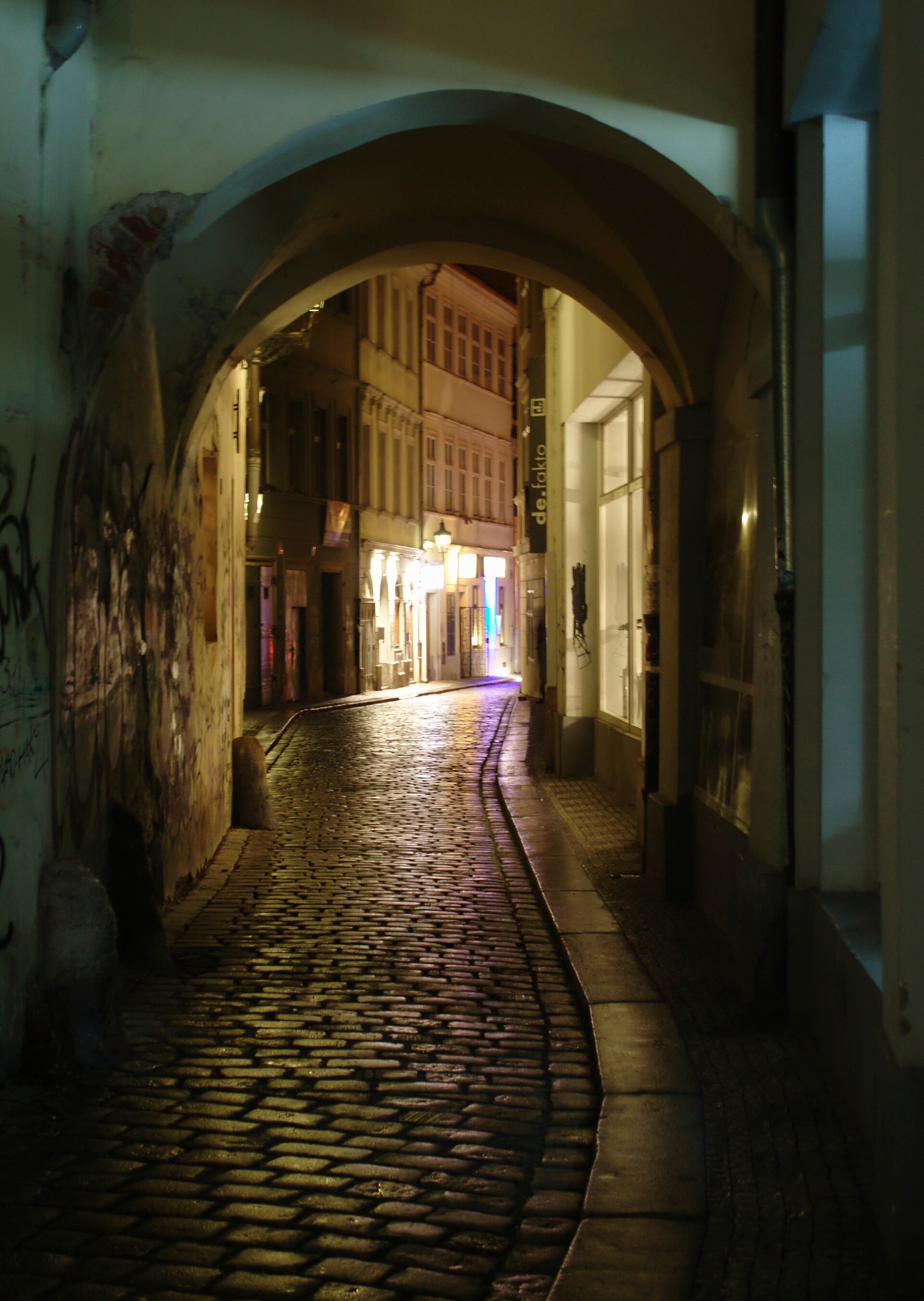
Supporting images selected in the Prague Stories visual review. Context images are labeled so they are not mistaken for documentary proof of the exact subject.
Quick facts
- Václav Cibula records O krásné Lauře bez hlavy in Pražské pověsti.
- The stable core is a beautiful woman who is murdered or beheaded and returns without her head.
- Some retellings add a jealous husband.
- Later versions can differ over the killer, motive, location and form of the apparition.
- Later retellings do not preserve one stable Old Town location for Laura.
- The headless form belongs to the wider headless-revenant motif family.
Questions
Was Laura a documented historical person?
The sources used here establish a named Prague legend, not a securely reconstructed historical biography.
Where exactly does Laura haunt?
The localization varies between later retellings, so no single address can be treated as definitive.
Why do conflicting versions matter?
Because the changing versions reveal how folklore preserves a strong image even while identity, motive and geography shift.
Sources & further reading
- Pražské pověsti — O krásné Lauře bez hlavy — Václav Cibula
- Pražské pověsti (1983) — bibliographic contents listing — Václav Cibula / Databáze knih