
Explore Prague
Old Town Square
Old Town Square is not a preserved medieval room. It is a public space repeatedly rebuilt, monumentalized, stripped of monuments and given them back. Merchants used it, condemned nobles died at the Town Hall, nineteenth-century nationalism reinterpreted it, fighting damaged the Town Hall in 1945, and the Marian Column returned in 2020 after having been torn down in 1918. That history of argument is visible if you know where to stand.
Old Town Square is the civic centre of medieval Prague's Old Town and a compact map of the city's political, religious and architectural history. Allow at least an hour outside, longer if you enter the Old Town Hall. The square is most rewarding when you read its competing monuments — Town Hall, Týn, Jan Hus, Marian Column and the 1621 memorial stones — as layers rather than as one harmonious period scene.
What to see before walking to the clock
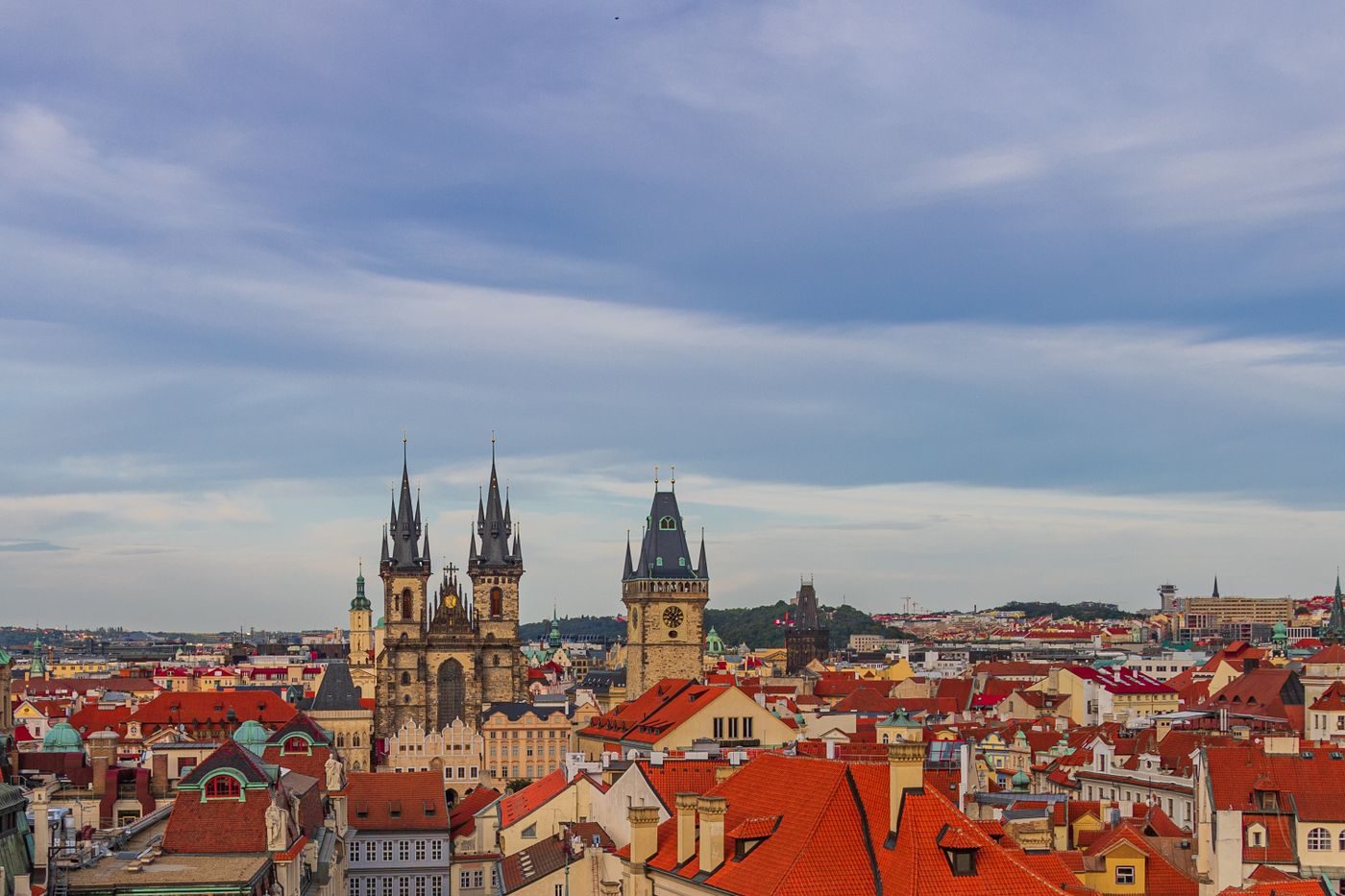
Turn in a full circle before walking anywhere. The Old Town Hall occupies the southwest side; the Church of Our Lady before Týn rises behind the eastern house fronts; St Nicholas marks the northwest; Kinský Palace and the House at the Stone Bell show different architectural layers; the Jan Hus Monument dominates the open centre; and the reconstructed Marian Column stands nearby.
The square's visual force comes from mismatch. Gothic towers rise behind Baroque and Rococo façades. A fifteenth-century religious reformer is commemorated by an early-twentieth-century monument. A seventeenth-century Marian column, destroyed after the birth of Czechoslovakia, has a modern reconstruction. The pavement itself carries memorial markers and the Prague meridian.
Old Town Hall and its astronomical clock
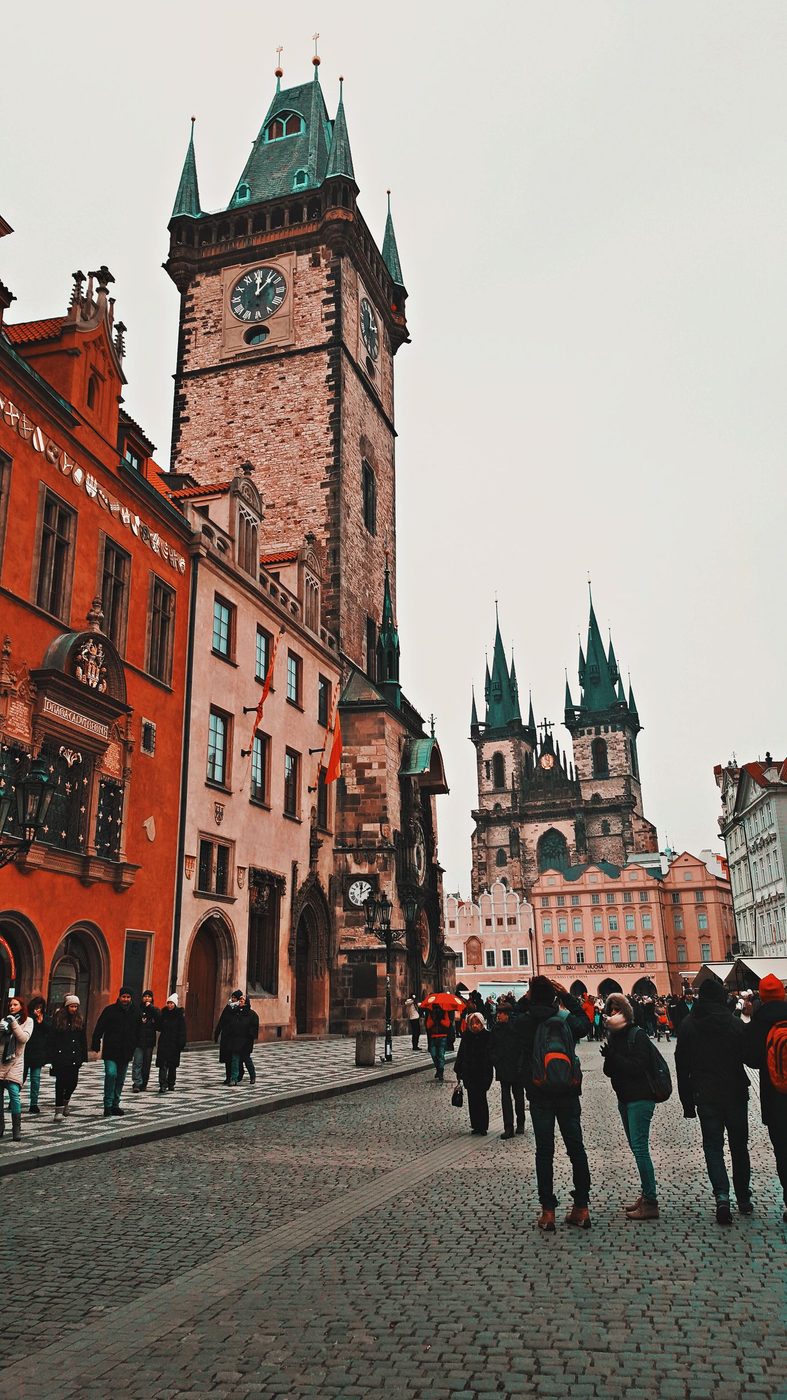
Old Town Hall was established in 1338 as the municipal seat of the Old Town. The complex grew by absorbing adjoining houses, which explains its uneven arrangement rather than a single symmetrical town-hall plan. The astronomical mechanism arrived in 1410 and was altered and expanded by later generations.
Current city visitor information has the Apostle procession running once each hour, beginning at 08:00 and ending at 23:00. The performance is short. To read the instrument itself, move back until the astronomical dial below the windows is fully visible, then return after the crowd disperses. The Town Hall visitor route adds the tower, historical rooms, chapel and underground spaces.
The eastern Neo-Gothic wing of the Town Hall was destroyed in the May 1945 Prague Uprising and never rebuilt. The resulting gap is part of the square's modern history, not an unfinished restoration.
Church of Our Lady before Týn
Týn Church's towers are among Prague's most recognizable Gothic silhouettes, but the church is partly hidden behind the houses of the square. That preserves a medieval urban relationship more complex than an isolated cathedral on an open plaza. The church became associated with the Hussite and Utraquist tradition before returning to Catholic control after the defeat of the Bohemian Estates.
Inside is the tomb of astronomer Tycho Brahe, who worked at the court of Rudolf II. Access depends on liturgy and church hours. Treat it as an active church rather than another municipal attraction.
Jan Hus Monument
The large monument to Jan Hus was unveiled in 1915, five hundred years after his death at Constance. Hus was a religious reformer, preacher and university master whose execution in 1415 became central to Czech historical memory. Ladislav Šaloun's sculpture is not a medieval object; it is an early-twentieth-century statement about national history, religious dissent and identity.
Reading it alongside the Baroque Marian Column is far more useful than treating either as decoration. They represent different historical memories placed into the same civic space at different moments.
The Marian Column: 1648, 1918, 2020
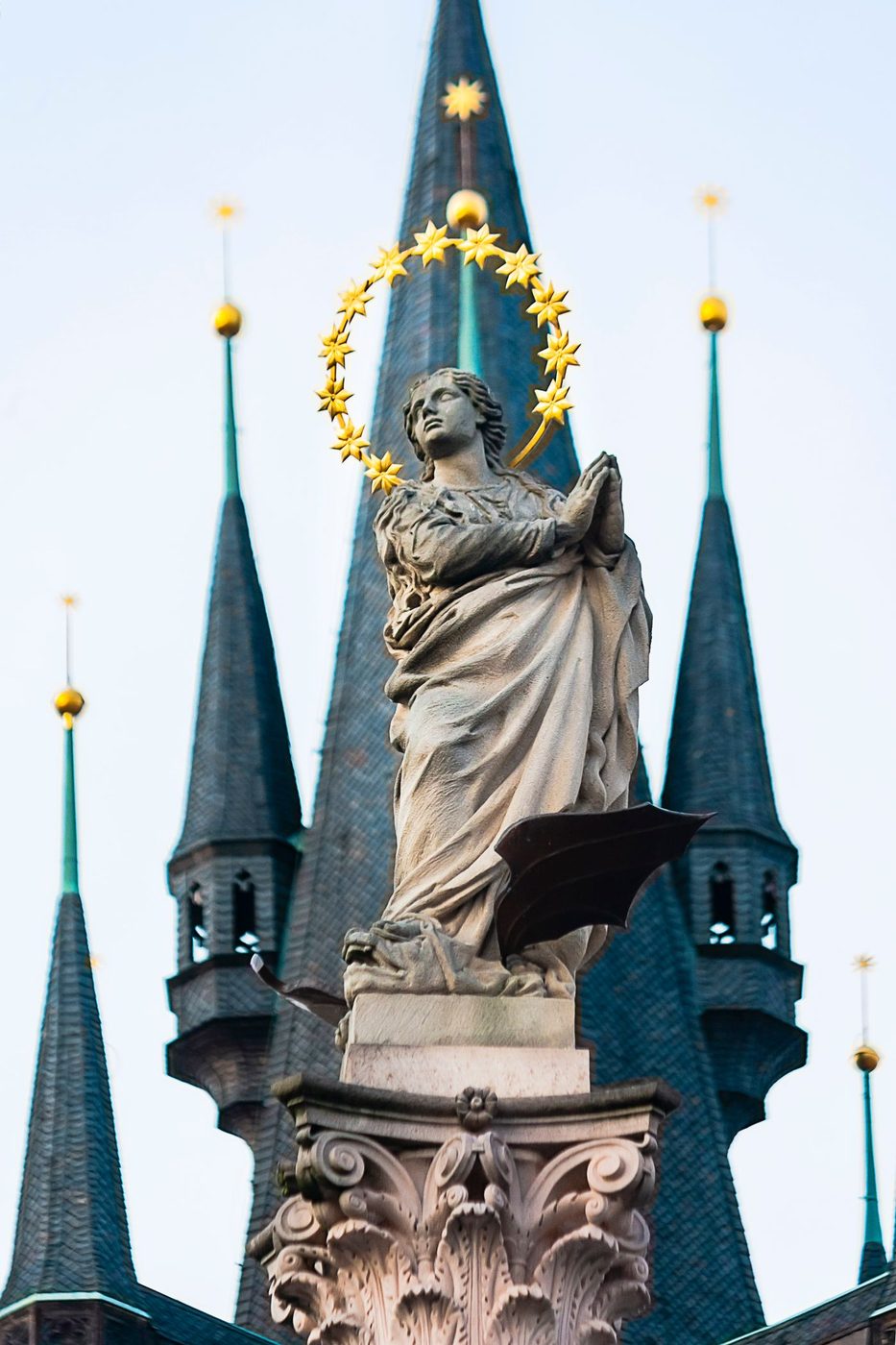
The original Marian Column was erected in 1650 in thanks for Prague's defense against Swedish troops during the closing phase of the Thirty Years' War. Over time, however, the monument also became associated in public memory with Habsburg Catholic rule. In November 1918, soon after independent Czechoslovakia was proclaimed, a crowd led by Franta Sauer pulled it down.
The present column is a reconstruction erected in 2020 after decades of debate. It is therefore both a reference to a seventeenth-century monument and a twenty-first-century act of remembrance. Reducing the story to either thanksgiving or oppression misses why the column remained controversial for so long.
The 1621 executions
On 21 June 1621, twenty-seven leaders and participants in the Bohemian Estates' revolt were executed in front of the Old Town Hall after the Habsburg victory at White Mountain. Their deaths became one of the strongest episodes in Czech political memory. White crosses set into the pavement near the Town Hall mark the event.
The memorial is easy to miss when the square is crowded. Stories of the executed men's ghosts returning to the square belong to folklore; the executions themselves are documented history. Keep those categories separate and both become more interesting.
From marketplace to national stage
The site functioned as a marketplace at the junction of long-distance trade routes, with the Týn or Ungelt customs court nearby. Commerce explains the square's early importance more directly than tourism ever could. Municipal government, churches and wealthy houses then accumulated around that economic centre.
Later centuries changed not only façades but uses of the space. Ceremonies, executions, political gatherings, monuments and seasonal markets each rewrote how the square was read. The broad Pařížská axis created after the clearance of much of the old Jewish Town altered movement north from the square. Modern crowd control, outdoor dining and mass events continue to change its everyday geometry.
Details worth ten extra minutes
Find the Prague meridian marked in the pavement; it recalls the time when the shadow of the Marian Column helped indicate local noon. Study the House at the Stone Bell, whose Gothic fabric emerged from later alterations and restoration — a reminder that façades can conceal older structures. At the Town Hall, compare the mismatched joined houses. In the pavement near the tower, find the memorial crosses to 1621.
Then walk through the Týn courtyard. The customs complex behind the church explains why foreign merchants and goods belonged to this area. The square becomes less theatrical once you connect it to the service spaces behind the façades.
Best time to visit
Early morning gives you room to look at pavement and façades. Use daylight for interiors and for seeing the square in full civic use. Evening emphasizes the lit towers and restaurant terraces but can be busy well past dinner. In December, the Christmas market fundamentally changes circulation and sightlines.
If the Astronomical Clock is your priority, watch one hourly performance and then stay after the crowd moves away. The easiest moment for studying the dial may be the few minutes immediately after the apostles disappear.
A marketplace came before the ceremonial square
Old Town Square makes more sense as a product of movement and exchange than as a space designed for monuments. Its early importance grew from trade routes, markets and the customs functions around Týn Court, also known as Ungelt. Merchants needed places to unload goods, pay duties, find lodging and connect with local buyers. The square’s irregular shape reflects that gradual urban development better than the geometry of a planned royal plaza would.
That commercial origin helps explain the concentration of power around it. Where money, goods and people gather, municipal authority follows. The Old Town Hall was established in 1338 as the administrative seat of the Old Town, but the institution expanded through adjoining houses rather than arriving as one purpose-built civic palace. The resulting complex is architectural evidence of a town government that grew inside an existing urban fabric.
Religious institutions occupied the same stage. The Church of Our Lady before Týn became a dominant eastern silhouette, while St Nicholas represents a later Baroque presence on the northern side. Houses around the square changed façades repeatedly while preserving older cores. This is one reason a quick style label fails: a Baroque or Rococo exterior may sit above medieval cellars or earlier structural fabric.
The square’s modern openness can hide how densely the medieval city worked. Imagine market stalls, animals, carts, goods, temporary structures, processions and public announcements competing for room. The square was never merely a scenic void between landmarks. It was urban machinery. Today’s cafés and seasonal markets continue the commercial function in altered form, while public commemorations and political gatherings keep the civic one alive.
Once that is understood, the individual monuments stop floating independently. The Town Hall belongs to municipal power, Týn to religious and mercantile life, Ungelt to trade, and later monuments to the political arguments of newer generations. Their coexistence is the subject.
The square is a map of Czech public memory
Several monuments on Old Town Square are difficult to understand if they are treated only as art objects. They were erected, removed or restored because different generations wanted the centre of Prague to tell different stories about religion, nation, monarchy and political legitimacy.
The Jan Hus Monument, unveiled in 1915, places the reformer and the legacy associated with him at the centre of Czech national memory during the final years of the Habsburg monarchy. The Marian Column belonged to another commemorative tradition, connected with the defence of Prague’s Old Town from Swedish forces in 1648 and with Catholic visual culture. Its destruction in 1918 was itself a political act; its reconstruction and return in 2020 produced a new round of debate. You need not adopt one side of that debate to understand that the column’s biography is part of the square’s history.
The twenty-seven pavement crosses near the Old Town Hall mark the execution of leaders of the Bohemian Revolt on 21 June 1621 after the defeat at White Mountain. Here again, the physical memorial dates centuries after the event. The square holds both the site of violence and subsequent choices about how that violence should be remembered.
The missing eastern wing of the Old Town Hall adds the twentieth century to the same conversation. It was destroyed during the Prague Uprising in May 1945 and not rebuilt. The gap is architectural absence functioning as memory. Visitors who focus only on the astronomical clock can stand metres from this evidence without recognizing it.
Seen together, these elements make the square less tidy but more intelligible. Prague’s central civic space is not a single national story carved in stone. It is a place where competing interpretations have repeatedly been made visible, erased, repaired and argued over.
Read the perimeter house by house
The square’s skyline rewards distance, but its perimeter rewards slow inspection. A first lap should identify the big anchors; a second can focus on façades, arcades, portals and rooflines. The House at the Stone Bell is especially useful because its Gothic form demonstrates how radically a building can be altered and later restored. Kinský Palace represents an eighteenth-century Rococo intervention on the square. Týn School and surrounding houses show how civic, educational and residential functions pressed against monumental churches.
The most important habit is to distrust façades as complete biographies. Prague buildings were renovated constantly. Owners modernized street fronts while retaining older walls, basements, plot boundaries or interior structures. This helps explain why Old Town can contain Romanesque cellars, Gothic cores, Renaissance details and Baroque surfaces within the same block. UNESCO’s assessment of the historic centre emphasizes this long continuity of urban development rather than a frozen medieval appearance.
Look upward as well as forward. Týn’s twin towers are not simply identical Gothic spikes; their massing and smaller pinnacles create a much more complicated silhouette. The Old Town Hall tower has accreted meanings from civic administration, astronomical technology, wartime destruction and tourism. Baroque St Nicholas changes the eastern and northern spatial balance in a way that becomes clearer when viewed from several corners rather than from the centre.
Commercial signs and temporary installations can make careful observation difficult, especially during markets. That is another reason to return outside peak hours. At dawn or later evening the empty ground plane reveals the perimeter as a continuous room. At midday, the same square functions more like a transport and gathering node. Both states are historically appropriate; the place has always changed according to use.
From 1621 to 1945: two events that changed how the square is seen
The execution of 1621 and the destruction of the Old Town Hall in 1945 belong to different centuries, regimes and conflicts, yet both are essential to the square because they transformed it from a backdrop into evidence.
After the Bohemian Revolt collapsed at the Battle of White Mountain in 1620, twenty-seven men associated with the uprising were executed outside the Town Hall the following year. The episode became one of the central reference points in later Czech historical memory. Modern retellings can oversimplify the religious, constitutional and social complexity of the revolt, so the safest visitor interpretation begins with the documented event: people were publicly executed here by Habsburg authority after a defeated rebellion. The pavement crosses are a later memorial, not surviving marks made in 1621.
In May 1945, fighting during the Prague Uprising damaged the Town Hall complex severely. The eastern Neo-Gothic wing burned and was later demolished rather than reconstructed. Photographs of the pre-war square show how much that loss changed the spatial enclosure. Today the open area beside the Town Hall can appear normal because generations have grown up with it. Knowing what stood there makes absence visible.
These events also show why Old Town Square is not best understood through a list of architectural dates alone. Political history physically altered the site. Memorial practices then changed it again. The square visitors see in 2026 includes medieval plots, Baroque and Rococo architecture, nineteenth-century nationalism, twentieth-century war damage and twenty-first-century reconstruction decisions. No single date represents it.
A thirty-minute circuit that is better than standing in the middle
Begin at the southwest corner near the Old Town Hall rather than under the clock. Look first at the missing wing and the memorial crosses in the pavement. Then move far enough into the square to see how the tower, Týn Church and St Nicholas compete for vertical attention. Only after that return to the astronomical clock. The hourly figures make more sense when the clock is understood as one instrument attached to a civic building with a much larger history.
Continue clockwise toward the north and the Baroque church. From there, look back across the open space toward the Town Hall; the asymmetry of the square becomes obvious. Move east toward the Jan Hus Monument and then to the Týn side, where the narrow approaches reveal how the church is embedded behind a line of houses rather than standing free in a cathedral plaza. Detour through Týn Court when accessible, provided it suits your route.
On the south side, read the façades rather than hurrying toward Celetná. This edge demonstrates how much of Old Town is made of buildings with multiple chronological layers. End by returning to the Town Hall tower or one of the corners from which the square can be seen obliquely.
This loop can take thirty minutes without any interior. Add the Town Hall tower and historical rooms and the visit becomes much longer. Add Týn Church access, a museum or a meal and the square can occupy half a day without requiring artificial filler. The key is to move around the perimeter. Old Town Square is too spatially complicated to understand from the crowd gathered beneath the clock.
What changes after dark and what does not
Old Town Square at night loses some of its daytime commercial noise but gains stronger architectural contrast. Illuminated towers and façades separate more clearly from the sky, while details in pavement and lower building levels become harder to read. The square is therefore worth seeing twice if it already lies on your route: once when memorials, portals and inscriptions are visible, and again when the spatial composition is easier to perceive.
Do not confuse “after dark” with “empty.” Evening density depends on season, weather and events, and the square remains part of Prague’s nightlife geography. Late-night visitors should also remember that the surrounding Old Town contains housing, hotels and working institutions. Loud group behaviour carries through narrow streets far more than it does across an open plaza.
If photography is the purpose, corners usually give more information than the geometric centre. From the Town Hall side the Týn towers are framed by the eastern houses; from the north the missing Town Hall wing and broad south façade become legible; from the Týn side the civic tower dominates. Changing position produces genuinely different readings rather than fifteen versions of the same frontal image.
Markets and events can temporarily rewrite the square
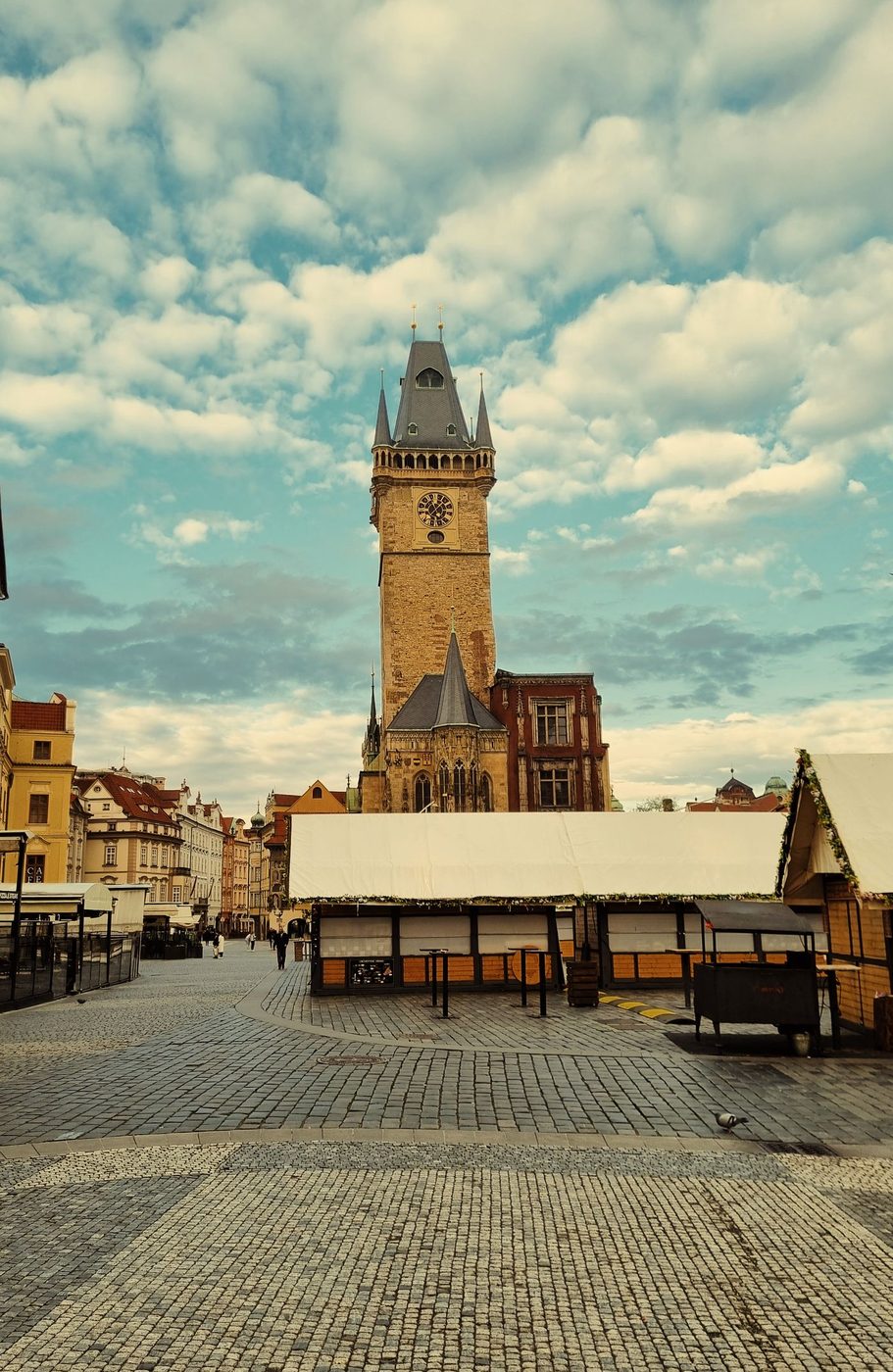
Old Town Square changes significantly during Christmas and Easter markets, major public commemorations, demonstrations and city events. Stalls can obscure lower façades, crowd flow can become directional and sound changes how the space feels. None of this is historically alien to a square that existed as a market and public stage, but it does change the sightseeing strategy.
If an event is the purpose, accept that architecture becomes secondary. If architecture is the purpose, return early in the morning or after the infrastructure has been removed. Temporary stages and security barriers can make exact viewpoints impossible for a period; rigid photography plans are therefore fragile.
The event calendar is another freshness issue. Do not hard-code annual market dates into evergreen copy without a maintained data source. Keep the historical explanation stable and let current event modules supply dates separately.
The square extends into streets with different historical jobs
Old Town Square is not an isolated plaza. Celetná carries the old eastward royal approach toward the Powder Tower. The lanes around Týn connect the market with the former customs court. Pařížská cuts north through a much later urban fabric created after the clearance of Josefov. Melantrichova channels heavy pedestrian movement south-west toward Wenceslas Square.
Walking one street in each direction shows how sharply the city changes outside the open space. Medieval irregularity, nineteenth-century intervention and modern tourist flows meet over a very short walk.
This is a better ending than simply leaving for the next landmark. Choose the exit according to the history you want next: trade and the Royal Route toward Celetná, Jewish Town history north, river and Klementinum west, or New Town south.
Frequently asked questions
How long do you need at Old Town Square?
Allow at least one hour outside. Add one to two more hours if you visit the Old Town Hall tower, historical interiors and underground.
What time does the Astronomical Clock show run?
The latest city listing gives an hourly Apostle display from eight in the morning through eleven at night. Check for maintenance or exceptional changes.
What do the 27 crosses by the Town Hall mean?
They commemorate the twenty-seven men executed there on 21 June 1621 after the defeat of the Bohemian Estates revolt.
Is the Marian Column original?
No. The original 1650 column was torn down in 1918. The present reconstruction was erected in 2020.
Is Old Town Square free to visit?
Yes, the public square is free. The Old Town Hall visitor route and tower have separate admission.
Sources & further reading
- Prague City Tourism — Old Town Square — Prague City Tourism
- Prague City Tourism — Old Town Hall with Astronomical Clock — Prague City Tourism
- UNESCO World Heritage Centre — Historic Centre of Prague — UNESCO World Heritage Centre
- Prague City Tourism — About the Old Town Astronomical Clock — Prague City Tourism
- Prague City Tourism — Charles Bridge — Prague City Tourism