
Memory After Execution
The 1621 Execution Is History; the Return of the Dead Is Prague’s Second Layer of Memory
Václav Cibula records the later tradition in which the executed men return to Old Town Square. The execution belongs to history; the ghost procession belongs to the way Prague kept retelling that history.
Old Town Square

Few Prague ghost stories sit on top of such a powerful historical place. The key is to keep the documented event and the later supernatural memory visibly separate.
First comes the execution
The story begins with a historical event: the execution associated with twenty-seven Czech lords on Old Town Square in 1621. That fact gives the later ghost tradition a weight that an invented haunted location could never provide. The square already carries political and memorial significance before a single apparition is introduced. The execution belongs to the historical record; the legend grows out of that event as a later layer of memory.
Then the dead return in Cibula’s Prague
Václav Cibula includes O sedmadvaceti popravených in Pražské pověsti. In the legend, the executed return to the place of death, either individually or as a group or procession. Later versions can become more precise and add particular times at which the apparitions are expected. Those details are part of the ghostlore, not documentary additions to the execution record. Their value lies elsewhere: they show how memory can make the dead literally present in the place where a city already remembers them historically.
A procession turns memory into movement
A single ghost usually preserves one private tragedy. A group of executed men creates a different kind of supernatural image. The return becomes collective, almost ceremonial. That form fits a public square because the event being remembered was public too. The legend converts a civic place into a recurring stage, making historical memory move across the same ground again. Whether the revenants appear one by one or as a procession, the underlying idea is similar: the past has not finished with the place.
Later details reveal how legends accumulate precision
Specific times of apparition are particularly useful for understanding how the tradition grew. A time can make a legend feel testable — come to the square at the right hour and perhaps something will happen — but that apparent precision should not be mistaken for older or stronger evidence. Such times are best understood as later folklore rather than part of the documented 1621 event.
Stand where history and ghostlore overlap
Old Town Square allows a rare on-site experience: the visitor can stand in a place whose historical significance is real and then hear how later Prague imagination made the executed return. The physical setting does not prove the ghosts; it makes the memory legible. Prague can hold two truths in the same square — an execution documented by history and a supernatural procession documented as folklore. The second does not need to be literal to reveal how the first continued to live in the city’s cultural memory.
Reviewed visuals
See the story
Supporting images selected in the Prague Stories visual review. Context images are labeled so they are not mistaken for documentary proof of the exact subject.
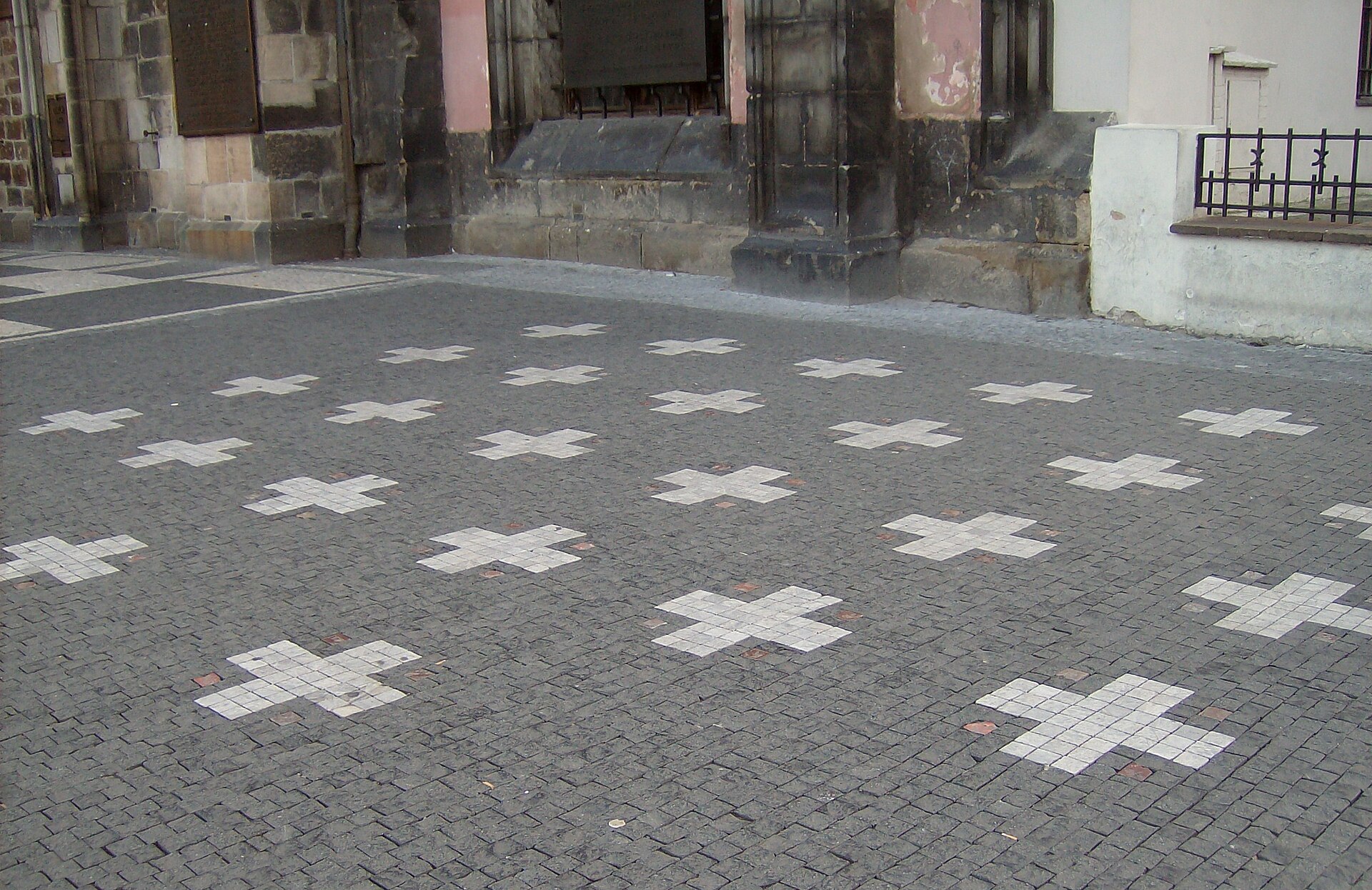
Begin with the physical memorial landscape of Old Town Square before introducing the revenant tradition.
Quick facts
- The 1621 execution on Old Town Square is a historical event.
- Václav Cibula records the later ghost tradition in O sedmadvaceti popravených.
- The executed may return individually or as a group or procession in the legend.
- Later retellings can add specific times of apparition.
- Those supernatural returns belong to folklore and literary memory, not the documentary record of the execution.
- The same square therefore holds a historical layer and a later ghost-memory layer.
Questions
Did the execution really happen here?
Yes. The execution is historical; the supernatural returns are the later legendary layer.
Do the specific apparition times come from 1621?
No. Exact times belong to later versions of the ghost tradition.
Why is the procession important?
It turns a collective historical trauma into collective supernatural memory, matching the public scale of the square itself.
Sources & further reading
- Pražské pověsti — O sedmadvaceti popravených — Václav Cibula
- Pražské pověsti (1983) — bibliographic contents listing — Václav Cibula / Databáze knih