
Medieval layers
The House at the Stone Bell Hid Its Gothic Identity Behind a Baroque Facade
Prague City Tourism says this major Gothic building was hidden for years behind a Baroque facade before reconstruction restored its Gothic appearance.
Old Town Square, Prague

A Baroque-looking surface once concealed one of Prague’s important Gothic buildings.
A facade is a layer, not a birth certificate
Historic Prague rewards caution when a building seems to announce its age at a glance. The House at the Stone Bell is a strong example. Prague City Tourism calls it an important work of Gothic architecture, yet also says it spent many years hidden behind a Baroque facade. That sequence breaks the simple assumption that the visible face of a building must belong to its earliest phase. What you see may be a later intervention, a restoration decision or a deliberate recovery of an older layer.
Read shape before decoration
When trying to identify Gothic character, step back from surface ornament and look for the larger geometry: vertical emphasis, openings, roofline, stone structure and the proportions of the facade. Then compare those cues with neighboring buildings whose surfaces come from different periods. The exercise is not about producing a perfect date. It is about learning to separate style clues from the history of alteration. The Stone Bell story makes that distinction unusually concrete because the Baroque covering is documented.
Use restoration as part of the story
Restoration can make an old building look more stylistically coherent than it appeared during another period of its life. That is not a reason to distrust the building; it is a reason to ask what changed. At the Stone Bell, the reconstructed Gothic appearance reflects a decision to reveal an earlier architectural identity. The visible result is therefore both historic fabric and a modern act of interpretation. That tension is worth carrying to other Prague facades that look surprisingly complete.
Reviewed visuals
See the story
Supporting images selected in the Prague Stories visual review. Context images are labeled so they are not mistaken for documentary proof of the exact subject.
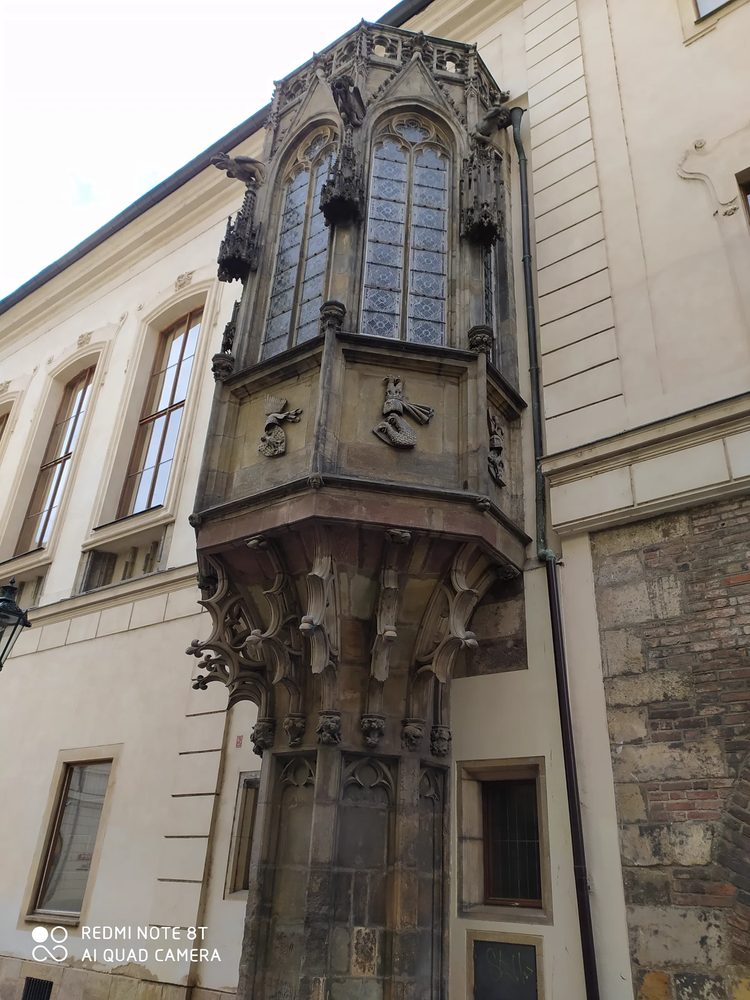
Approved close architectural view of a tall historic Prague building with steep roof/gable and detailed facade.
Quick facts
- The House at the Stone Bell stands on Old Town Square.
- Prague City Tourism identifies it as Gothic architecture.
- The building was hidden behind a Baroque facade for many years.
- Its later reconstruction restored a Gothic appearance.
Questions
Was the House at the Stone Bell always visibly Gothic?
No. Prague City Tourism says it was hidden behind a Baroque facade for many years.
Why does that matter for visitors?
It shows that a facade can represent one layer in a longer building history rather than the whole story.
Sources & further reading
- Prague City Gallery — House at the Stone Bell — Prague City Tourism