
Explore Prague
Lesser Town Prague
Malá Strana looks coherent because so much of its visible architecture is Baroque, but the district is older and more complicated than the façades suggest. Medieval routes climb from the river toward the Castle. Renaissance and Baroque nobles assembled palaces from earlier houses. Gardens reshape the slope into terraces. Embassies occupy aristocratic residences, while Kampa and the Čertovka channel create a quieter river edge only minutes from Charles Bridge. The district is best walked downhill. Starting near Prague Castle or Pohořelec reduces climbing and gives the streets a natural narrative: from royal and aristocratic Hradčany through Nerudova and Malostranské náměstí to Kampa and the bridge. If you prefer to begin at the river, reverse the sequence—but keep enough energy for the ascent.
Lesser Town (Malá Strana) lies between Prague Castle and the Vltava on the west bank. It is an unusually walkable historic district of Prague, known for Baroque palaces, St Nicholas Church, Nerudova Street, Kampa, Wallenstein Garden and the approach to Charles Bridge. A first visit takes about three to four hours without the Castle; combine it with Prague Castle and it becomes a route that easily fills half a day and can extend much longer. The steep upper streets and garden opening seasons matter more here than distance on the map.
What Malá Strana is
Malá Strana, literally the 'Lesser Town', developed beneath Prague Castle on the left bank of the Vltava. Its position gave it a distinctive relationship with the royal seat: nobles, church institutions, craftsmen and foreign representatives all had reasons to live close to the Castle.
Fires and political change repeatedly altered the district. After the Bohemian Estates' defeat at White Mountain in 1620, and throughout the Baroque era, aristocratic families expanded residences and gardens, often combining multiple earlier properties. This is why the neighbourhood feels both intimate and monumental: narrow medieval street lines can suddenly open onto a vast palace façade or church dome.
For visitors, the key zones are Malostranské náměstí, the climbing streets toward Hradčany, Kampa by the river, and the palace-and-garden belt below the Castle. They are close together but operate at different rhythms.
Nerudova Street: the old climb to the Castle
Nerudova is the classic uphill street from Lesser Town toward Hradčany. The street lay on the Royal Route and preserves a collection of historic house signs from the period before standardized numbering became the normal way to identify addresses. Eagles, keys, suns and other symbols made houses memorable in a city where names and signs could carry practical meaning.
The street is named after the 19th-century Czech writer Jan Neruda, who lived in the district and wrote about its inhabitants. Literary association, architecture and tourist traffic now overlap here. In the busiest hours, the gradient and crowds can make the walk feel more like a corridor than a neighbourhood.
Move early or later in the day if possible, and raise your eyes above the souvenir level. Portals, signs and upper façades tell more of the street's story than shop displays. Local ghost tales, including headless apparitions, belong to folklore rather than the documentary history of the houses.
St Nicholas Church and the Baroque centre
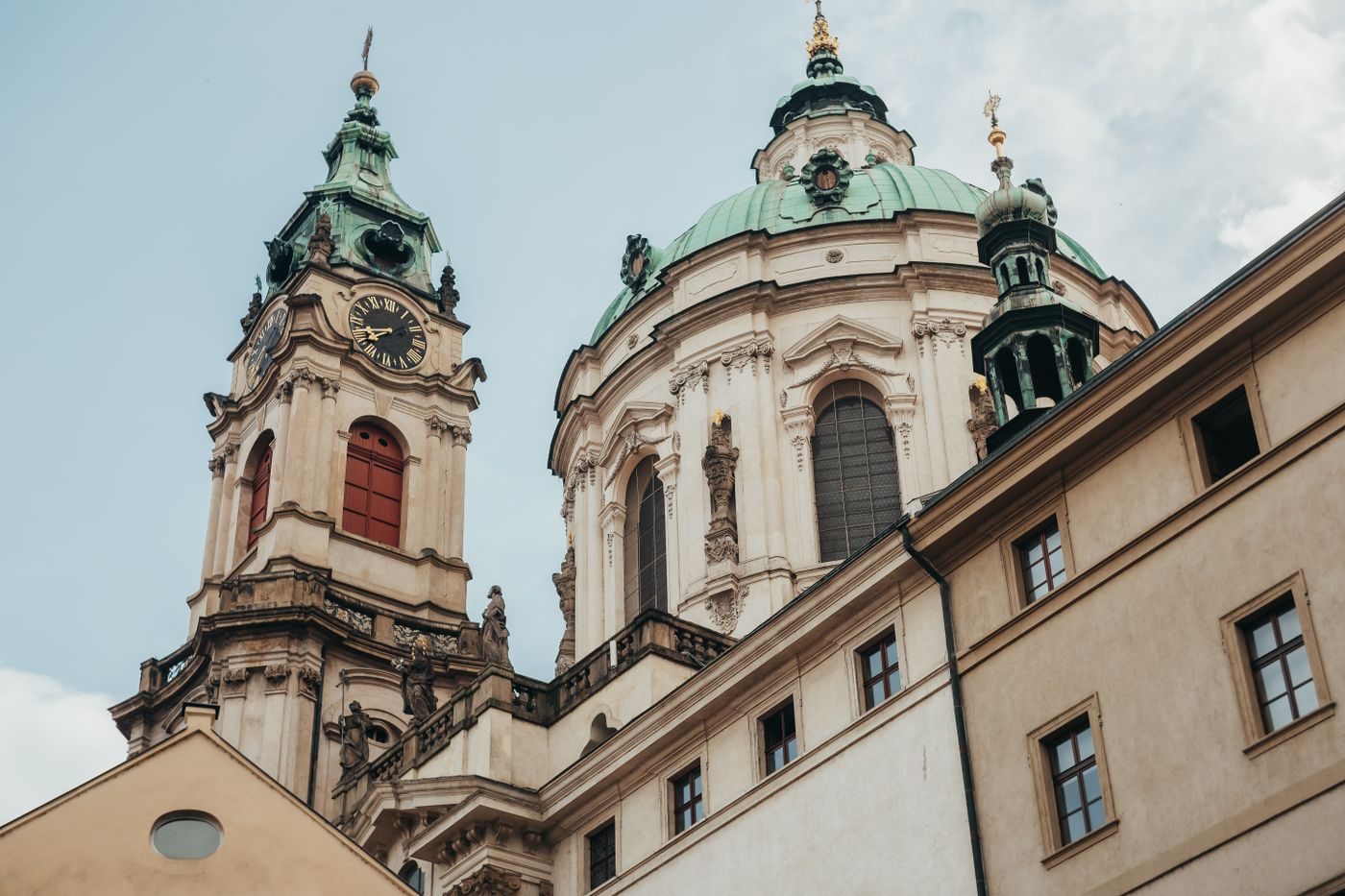
St Nicholas Church dominates Malostranské náměstí with a dome and bell tower that define the district's skyline. The present Baroque church is associated with the Dientzenhofer family of architects and belongs to the great wave of Catholic building after the recatholicization of Bohemia.
Inside, architecture, fresco painting and stucco are designed as one theatrical system. Curving walls and layered spaces make the church feel unlike the linear Gothic logic of St Vitus Cathedral. If you visit both on the same day, the contrast is useful: two sharply different concepts of sacred space separated by several centuries.
The neighbouring bell tower has its own civic and later surveillance history and should not automatically be conflated with the church institution. Spectrum's supporting Story on the secular bell tower explores that distinction.
Kampa and the Čertovka channel
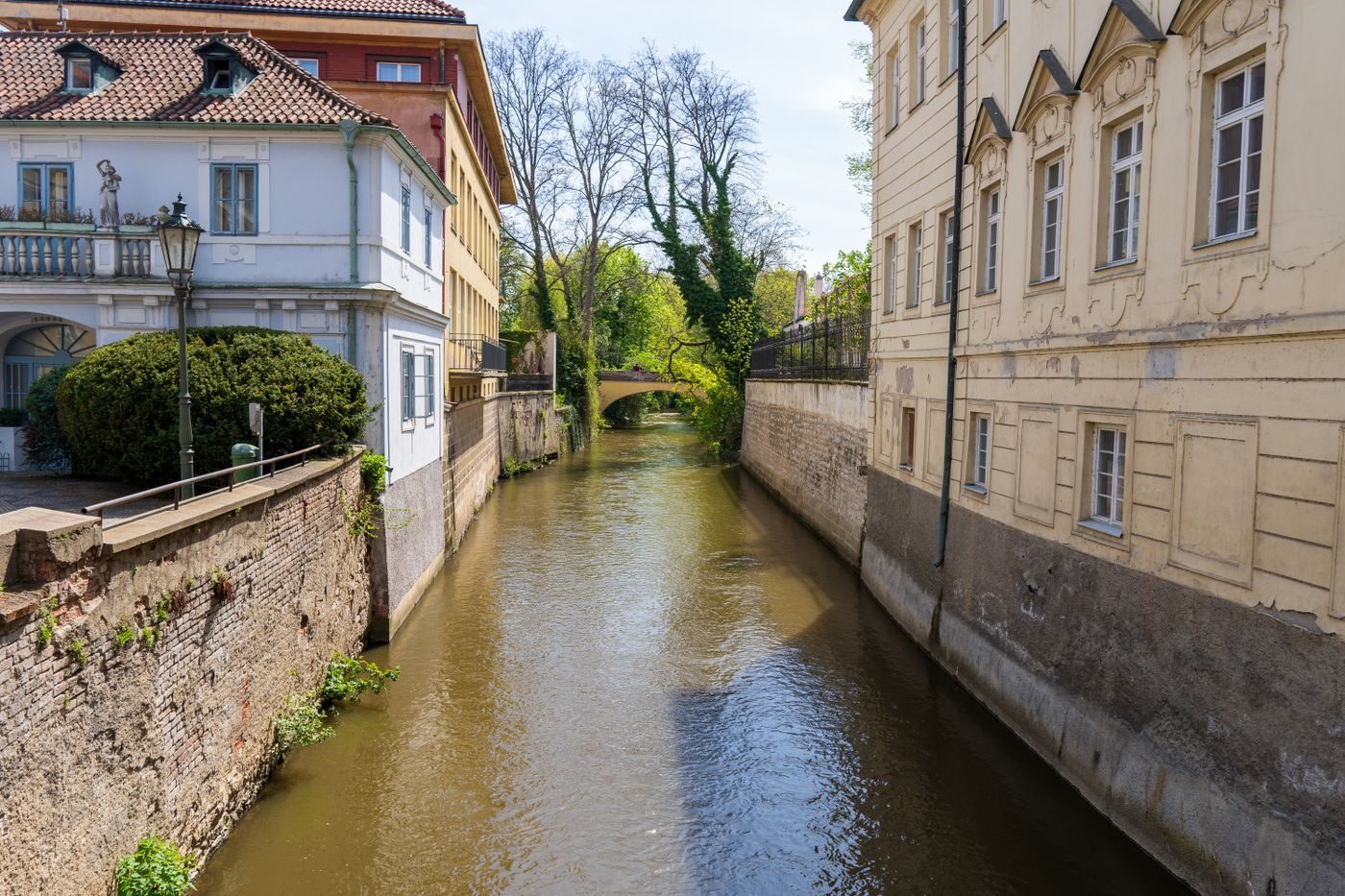
Kampa is commonly called an island, and the Čertovka side channel separates it from the rest of Lesser Town. The channel's relationship with former mills explains much of the landscape. Water power, mill buildings and later adaptation shaped this river edge long before it became one of Prague's favourite walking areas.
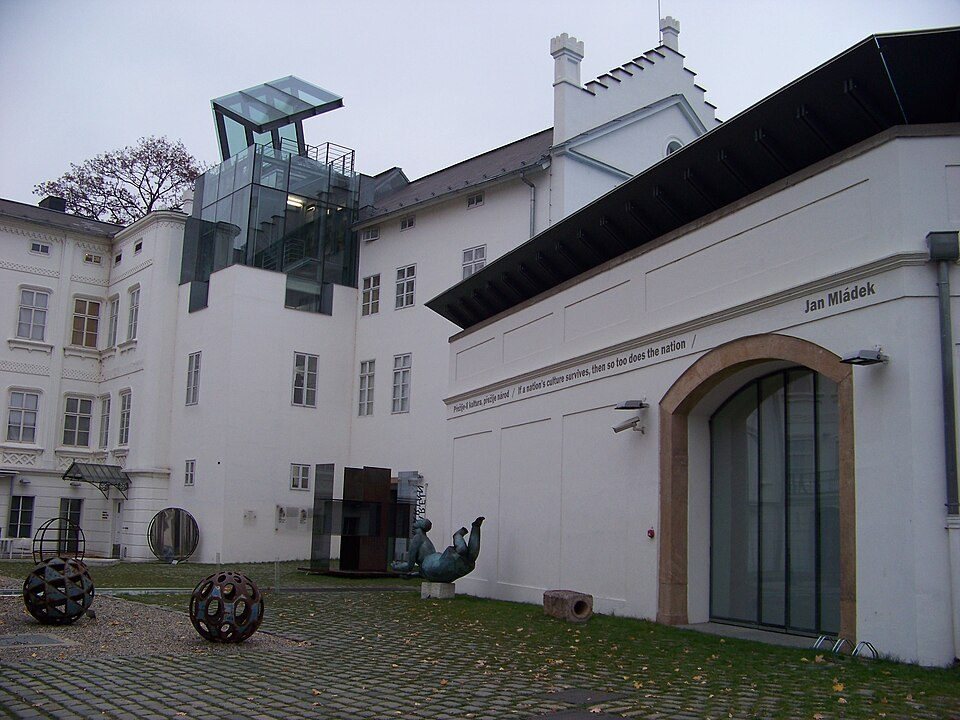
Museum Kampa occupies the converted Sova Mills and focuses on modern Central European art, giving the district a cultural institution that is not tied to palaces or churches. Nearby parkland opens broad views toward the Old Town bank and Charles Bridge.
The area is busiest near the bridge and the so-called 'Venice of Prague' viewpoints. Walk farther south through Kampa Park and the mood becomes noticeably calmer. The river setting is attractive without requiring exaggerated comparisons with another city.
Wallenstein Palace and Garden
Wallenstein Palace demonstrates how aristocratic construction could remake an existing neighbourhood. Albrecht von Wallenstein assembled a vast palace complex in the early 17th century, absorbing numerous earlier properties. Today the palace is used by the Senate of the Czech Republic.
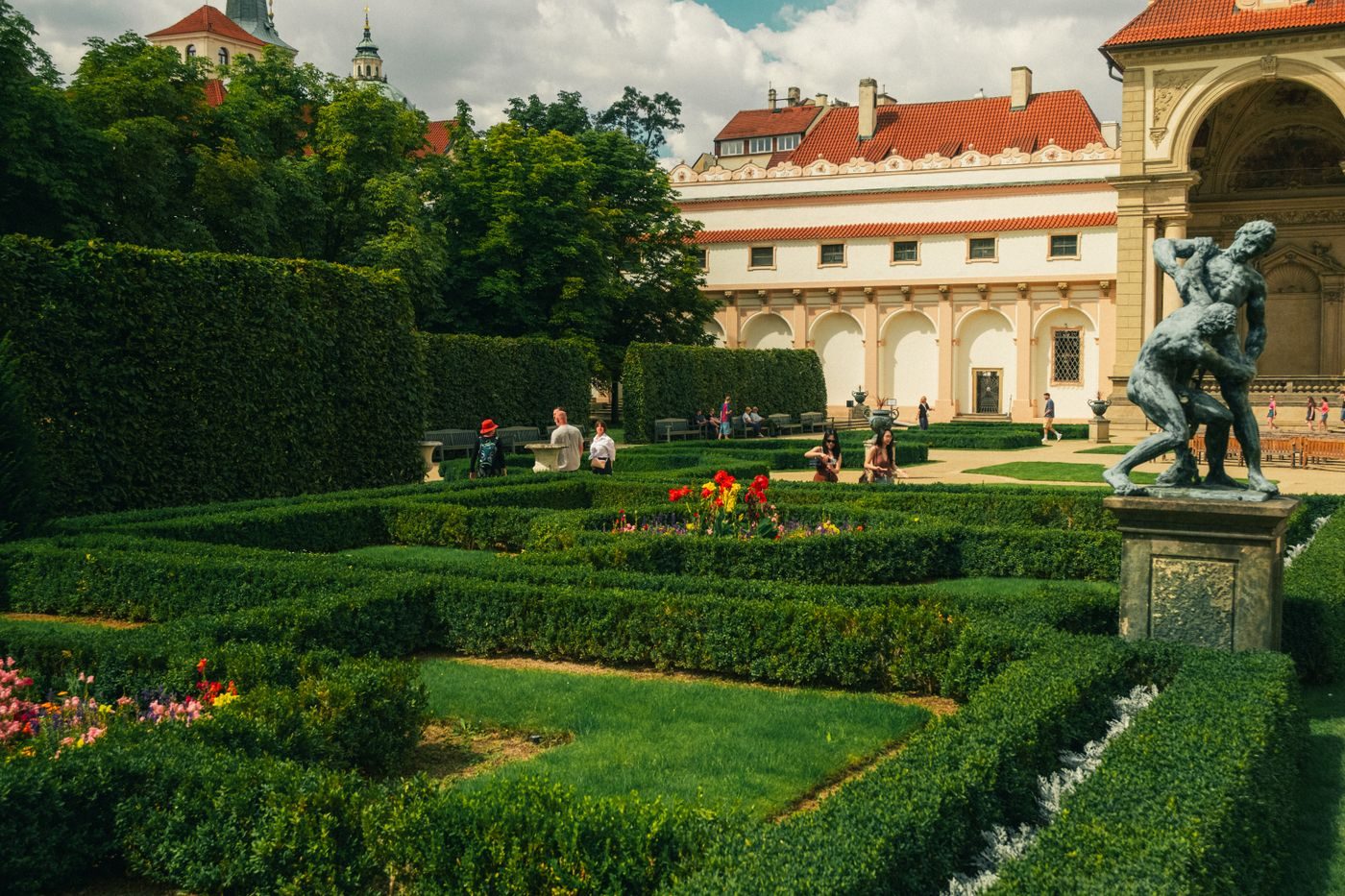
The garden, when open, ranks among the most dramatic public spaces in Lesser Town: formal geometry, sculpture, a large sala terrena and an artificial grotto wall create a carefully staged environment below the Castle. Peacocks have become a familiar sight, but the architecture deserves equal attention.
Because this is a functioning state complex, access can be seasonal or affected by official events. Check current Senate information before making the garden a fixed part of a tight itinerary.
Lennon Wall: political expression, tourism and reinvention
The Lennon Wall near Kampa developed its modern reputation during communist Czechoslovakia, when messages, lyrics and political expressions appeared despite repeated repainting by authorities. John Lennon became a symbol within a broader field of youth dissent and aspirations for freedom.
The wall has continued to change since 1989. Layers of paint, tourism, vandalism debates and curated interventions mean there is no single 'original' surface waiting to be preserved. That mutability is part of the object. Visit it as a living public canvas shaped by successive political and tourist contexts, not as a static monument frozen in the 1980s.
It sits in a residential and diplomatic quarter. Keep noise down, particularly with groups, and remember that the narrow lane has to function for people who live and work there.
Palaces, embassies and the diplomatic district
Lesser Town's proximity to Prague Castle made it a natural home for noble palaces, many of which later became government buildings or embassies. Walking through the district therefore means passing architecture that is often visually public but functionally restricted.
The value is in reading façades and urban scale rather than expecting every palace to offer interiors. Large portals were designed for carriages, heraldic devices identify owners, and gardens climb behind walls where the street reveals almost nothing. Some buildings open for exhibitions or special events; others remain working institutions.
That living state role explains why security barriers, police presence or temporary closures can appear with little relation to ordinary tourism. Do not interpret a closed gate as a failed attraction. In many cases, the building is simply doing its current job.
Gardens on the slope below Prague Castle
The steep terrain between the Castle and Lesser Town was transformed into a series of terraced gardens. These spaces solve a practical topographical problem—how to inhabit and cultivate a slope—while producing some of the district's strongest views.
The palace gardens below Prague Castle are generally seasonal. Stairs can be steep, surfaces uneven and access points less obvious than on a flat city map. When open, they are best used as a route as much as a destination: moving horizontally and vertically through terraces reveals rooflines, towers and the river in changing combinations.
Do not build a winter itinerary around summer garden access. Prague's gardens follow their own calendars, and maintenance or weather can alter opening with little warning.
A strong first-time walking route
Take tram 22 or another suitable connection toward the Castle area and begin high, either near Pohořelec or Prague Castle. Walk through Hradčany, descend Nerudova, pause at Malostranské náměstí and St Nicholas, then make a short detour to Wallenstein Garden when open.
Continue through the lower streets to Kampa and the Lennon Wall, loop along the river and finish at Charles Bridge. This sequence keeps most of the route downhill and lets the skyline unfold gradually. Without major interiors it takes roughly three hours at a comfortable pace; with St Nicholas, a garden and museum stop, allow more.
When the district is paired with Prague Castle, treat the Castle as the morning anchor and Lesser Town as the afternoon descent. The contextual Prague Castle & Lesser Town tour linked here fits that geography, but the article does not imply that every site named above is included on every tour departure.
Where to pause for food or coffee
Malá Strana has excellent cafés, pubs and restaurants, but prices vary sharply between heavily trafficked approaches to Charles Bridge and quieter side streets. As in Old Town, check menus before sitting down and avoid assuming a historic-looking interior guarantees historic cooking.
For a short break, the streets below Nerudova and around Újezd provide more options than the most compressed bridge corridor. Kampa works well for an outdoor pause, while Malostranské náměstí is convenient if you are combining transport, church visits and the Castle route.
The district is small enough that a five-minute detour can change both price and atmosphere. That is usually a better strategy than searching for a single supposedly definitive 'local' restaurant.
Malá Strana was rebuilt by catastrophe, aristocratic ambition and court proximity
Lesser Town’s visual coherence can make it appear older and more untouched than it is. The district’s medieval origins are real, but fires, wars, property consolidation and Baroque rebuilding changed it profoundly. After Habsburg power became firmly established and aristocratic families competed for residences near the Castle, large palaces absorbed smaller plots and reshaped the streetscape.
That political geography is still visible. The Castle rises directly above the quarter; major palaces occupy strategic sites; gardens climb the slope behind walls; foreign embassies later reused buildings created for elite residence. Malá Strana therefore differs from Old Town not merely because it has quieter lanes. Its historical economy was tied more closely to court, church and aristocratic representation.
The Baroque dominance around St Nicholas should be read against older layers rather than as proof that the district was built in one period. Medieval street alignments, Renaissance elements and surviving fragments coexist with the later palatial city. Nerudova’s house signs preserve a pre-numbering way of identifying properties even though the façades around them have changed.
This layered reconstruction also explains why the district works so well on foot. Walls and palace fronts create long narrow corridors, then gardens or squares open unexpectedly. The experience is spatially controlled in a way that differs from the broader commercial openness of Old Town Square.
Kampa is useful because it reveals the river’s hidden geometry
Kampa is commonly described as an island, but the important feature is the narrow Čertovka channel that separates it from the Lesser Town bank. Without recognizing that side channel, visitors may walk across Kampa without understanding why mills, water edges and small bridges appear where they do.
The Grand Priory Mill wheel is a visible reminder that water was productive infrastructure. Channels powered mills, shaped property boundaries and influenced flood risk. The modern park occupies only part of a much longer history of river use.
Walk from Charles Bridge down to Kampa rather than treating the island as a separate attraction. The vertical transition is revealing: the monumental bridge carries the main cross-river route overhead, while below it the channel and riverside spaces operate at a smaller scale. From the park, the bridge becomes an engineered object with piers and arches instead of a crowded promenade.
Kampa also gives Malá Strana breathing room. Palace streets and church interiors can be visually dense; the river opens the horizon. In good weather this makes the island an intelligent rest point, not because it is “hidden” but because its landscape performs a different function from the surrounding quarter.
Palace gardens are not decorative extras
The gardens below Prague Castle and around major Lesser Town palaces turn steep terrain into architecture. Terraces, retaining walls, staircases, fountains, sculpture and framed views all solve the same problem: how to convert a difficult slope into controlled elite space.
Wallenstein Garden is the largest and most politically legible example because it belongs to the palace now used by the Czech Senate. Its monumental loggia, formal garden, pond and artificial grotto wall express seventeenth-century aristocratic ambition on a scale that competes with royal space. Public opening is seasonal and institutional, so access should always be checked rather than assumed.
Other gardens on the Castle slope are smaller or governed by separate admission. Their value lies partly in perspective. From terraces, Malá Strana’s roofs flatten into patterns and the city’s vertical relationship with the Castle becomes obvious. From street level, those same gardens are largely hidden behind walls.
Do not build a winter itinerary around garden access. In the colder season, treat gardens as optional rather than foundational. In spring and summer they can justify slowing the district down by an hour or more. The practical payoff is substantial: one garden can explain Baroque landscape design, aristocratic residence and Prague topography simultaneously.
Two walking lines through Lesser Town, depending on your knees and your interests
The classic route descends. Start near the Castle or Hradčany, follow Nerudova toward Malostranské náměstí, spend time around St Nicholas, then choose between Kampa and the direct line to Charles Bridge. Gravity is on your side, the sequence follows historical movement from court district to river crossing, and the changing views keep orientation easy.
The second route begins low. Start around Malostranská, Wallenstein Garden when open, then walk through the quieter northern streets before reaching the square and climbing selectively. This route suits visitors who care more about palaces, gardens and urban form than about reproducing the Royal Route. It can also be adapted to reduce the steepest continuous descent, though Malá Strana remains a district of slopes and uneven surfaces.
Add the Lennon Wall only if its modern political and cultural history interests you; it is not necessary for understanding the quarter’s older architecture. Add Petřín if you want landscape and views, but treat it as another topographical commitment rather than a tiny detour.
Whichever line you choose, avoid repeatedly climbing and descending the same slope. Malá Strana looks small on a map, yet the legs register every metre of elevation. A good route uses that verticality to tell a story once.
Malá Strana after the day-trip buses leave
Early evening is especially useful for revisiting Lesser Town. Castle-bound day visitors thin, churches and gardens may be closing, and the district shifts from attraction corridor toward residential and diplomatic quarter. The change is most noticeable away from the direct bridge-to-Castle line.
This is a good period for a slower meal, Kampa walk or river view, but current opening hours still matter. Garden gates can close before sunset and churches can have services or concerts. Do not assume “evening” means every interior remains available.
The visual advantage is strong: low light catches palace façades and the Castle slope, while the narrow streets gain depth without requiring fabricated ghost-story language. Malá Strana does not need to be empty to feel different; it only needs the daytime through-traffic to ease.
St Nicholas is an urban landmark from several directions
The great dome and bell tower of St Nicholas do more than mark Malostranské náměstí. They orient walkers descending from the Castle, appear above Kampa-side streets and form part of the skyline seen from the opposite bank. The church therefore helps visitors read the quarter even when they are not entering it.
Inside, the Baroque strategy is almost the opposite of Gothic restraint. Curved forms, painted illusion, sculpture and controlled light create movement across surfaces. The neighbouring bell tower is architecturally connected to the ensemble but has its own civic history, including use as a fire-watch tower and, much later, surveillance by the communist security apparatus.
Treat church and tower as related but distinct stories. One centres on Baroque religious architecture; the other adds municipal infrastructure and twentieth-century political history.
The district is quietest where transit and sightseeing routes stop overlapping
Malá Strana can feel intensely busy on the line between Charles Bridge, Malostranské náměstí, Nerudova and the Castle. A few turns away, the pedestrian pressure changes because the street no longer serves as through-route between headline monuments.
This is not evidence that one lane is “authentic” and another spoiled. It is traffic geometry. Tourist groups, delivery vehicles, trams, residents and embassy security all concentrate along different corridors. Read those flows and the quarter becomes easier to navigate.
North of the main square, streets toward Valdštejnská and Klárov connect palaces with transport and government institutions. South toward Kampa, the river and Čertovka shape movement. West and uphill, the slope controls everything. Each direction has a different urban reason for being busy.
A useful visit therefore includes one major axis and one secondary route. The contrast reveals how compact historical quarters can contain several movement systems at once. It also creates natural pauses without sending visitors on a forced search for “secret” places.
Frequently asked questions
What amount of time works for Lesser Town?
Three to four hours covers the principal streets, Kampa plus a small number of interiors. Combine it with Prague Castle and plan at least half a day, often longer.
Is Lesser Town the same as Malá Strana?
Yes. Malá Strana is the Czech name; 'Lesser Town' or 'Lesser Quarter' are common English translations.
Should I walk Lesser Town uphill or downhill?
For most visitors, starting near the Castle and walking downhill is easier. The reverse route is perfectly possible but includes a sustained climb.
Is Kampa really an island?
It is separated from Lesser Town by the Čertovka side channel and bordered by the Vltava, so it functions geographically as an island in the city landscape.
Is Wallenstein Garden open all year?
No. Access is seasonal and can also be affected by official use of the Senate complex. Check current official information.
Can I combine Lesser Town with Charles Bridge?
Yes. The district’s east side meets Charles Bridge, making the bridge a natural beginning or end to a Malá Strana walk.
Sources & further reading
- Prague City Tourism — Sites — Prague City Tourism
- Prague City Tourism — St Nicholas Church at Malá Strana — Prague City Tourism
- Senate of the Parliament — Seat of the Senate / Waldstein Palace — Senate of the Parliament of the Czech Republic
- Prague City Tourism — Kampa / Lesser Town listings — Prague City Tourism
- UNESCO World Heritage Centre — Historic Centre of Prague — UNESCO World Heritage Centre
- Prague City Tourism — Kampa — Prague City Tourism