
Explore Prague
Jewish Quarter Prague
Josefov can be visually misleading. Wide streets and grand apartment houses make it look like another elegant central Prague district, yet fragments of a much older Jewish city sit inside that urban fabric. A Gothic synagogue still serves a living community. A cemetery contains layers of burials compressed into a small plot. A Renaissance synagogue became a memorial inscribed with the names of Shoah victims from the Czech lands. Nearby, museums preserve objects that survived owners who often did not. The district deserves a different pace from a conventional sightseeing checklist. Some spaces are active religious sites; others are places of mourning; still others interpret centuries of Jewish scholarship, family life and persecution. Legends such as the Golem belong to Prague's cultural memory, but they should not displace the documented history of the people who lived here. This guide keeps those categories separate while showing how they overlap in the streets of Josefov.
Prague's Jewish Quarter, Josefov, is best understood as a surviving network of religious, communal and memorial sites rather than as an intact medieval ghetto. Most of the old dense neighbourhood was demolished during the clearance and redevelopment spanning the end of the 1800s and the opening years of the 1900s, while key monuments survived: the Old-New, Pinkas, Maisel, Klausen, Spanish and High synagogues, the Old Jewish Cemetery and the Jewish Town Hall. The Jewish Museum circuit connects several of these places. Allow at least two to three hours if you want to visit the principal interiors and cemetery without rushing, and check closures for Saturdays and Jewish holidays before you go.
What Josefov is — and what it is not
Josefov is Prague's smallest cadastral district, adjoining the Old Town. It developed from the city's historic Jewish settlement and was known as the Jewish Town before taking the name Josefov in the 19th century. Jewish life in Prague reaches back roughly a millennium, and the community became a major Jewish centres in Central Europe.
The streets you walk today are not a preserved medieval ghetto. By the late 19th century, the old quarter had severe sanitation and housing problems, and a vast clearance project transformed the district. Most houses and lanes disappeared. The surviving synagogues, cemetery and town hall therefore function almost like islands from the earlier Jewish city, surrounded by later urban blocks.
That distinction matters because it prevents a common mistake: imagining today's polished district as the environment in which medieval and early modern Jewish Prague existed. To reconstruct that world, combine the surviving monuments with museum displays, historical maps and photographs of the clearance period.
The Old-New Synagogue: continuity in stone
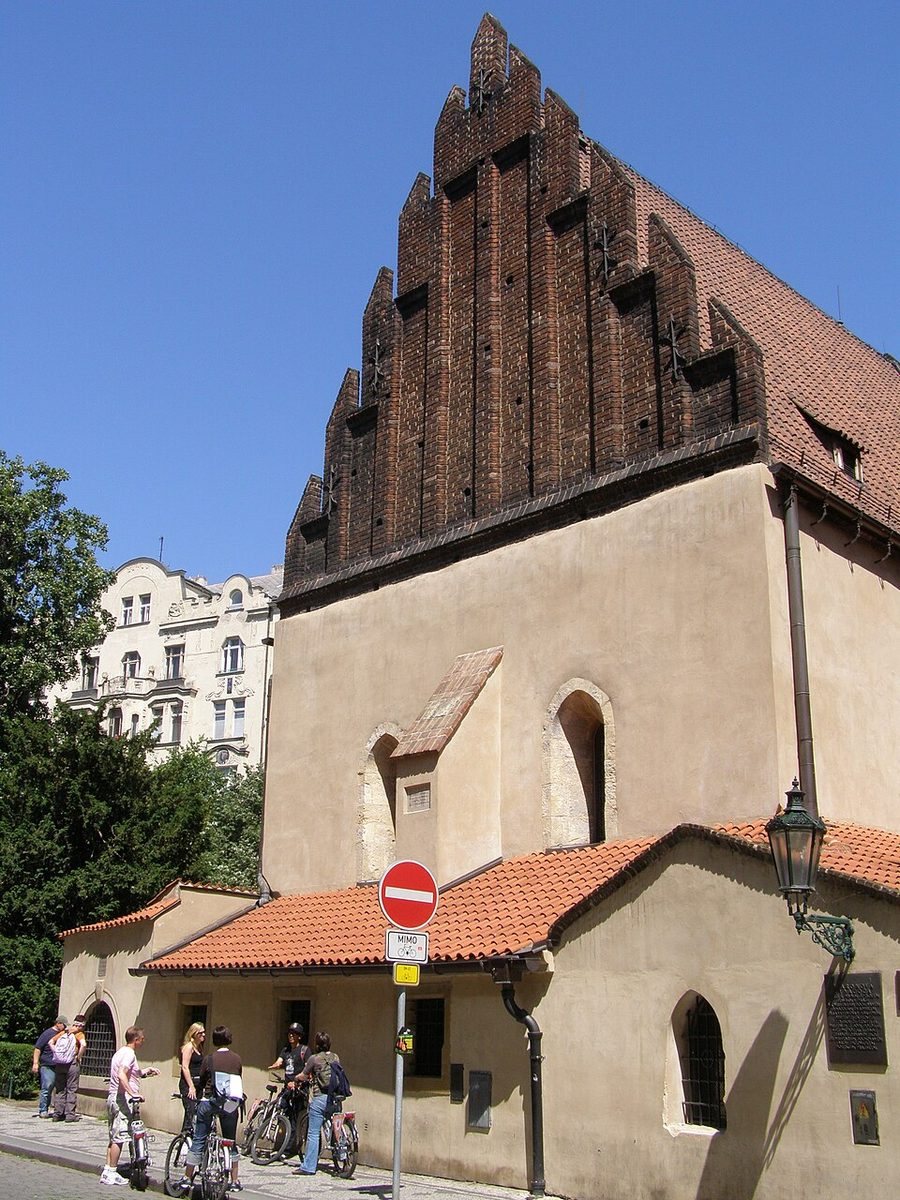
The Old-New Synagogue is the oldest surviving synagogue in Prague's Jewish Town and is described by the Jewish Museum as the oldest extant synagogue in Europe. Built in the last third of the 13th century by masons connected with the royal building workshop, it has served Prague's Jewish community for more than seven centuries.
Its architecture is restrained compared with later synagogues. A two-aisled Gothic interior, ribbed vaults and a central bimah create a room shaped around communal worship rather than theatrical display. The synagogue remains a religious site under the administration of the Prague Jewish Community, so visitor access follows both museum-style opening arrangements and the rhythm of Jewish religious life.
The building is also inseparable from the Golem legend, which later tradition connected with the Maharal of Prague, whose full name was Judah Loew ben Bezalel. The legend is culturally important, but no historical evidence demonstrates that a clay Golem was hidden in the synagogue attic. Treating that story as legend makes the real history more, not less, interesting.
The Old Jewish Cemetery: reading a crowded landscape
The Old Jewish Cemetery is instantly recognisable within Josefov because its tombstones appear to press against one another in dense layers. Burials took place here for centuries under severe spatial constraints. Jewish religious practice places strong importance on the permanence of graves, so when room became scarce, soil was added and new burials were made above older ones. The visible density is therefore only part of the cemetery's vertical history.
Famous figures buried here include Rabbi Loew and the philanthropist and communal leader Mordechai Maisel. Yet the cemetery is not best approached as a hunt for celebrity graves. Hebrew inscriptions, symbols associated with names or lineage and changing styles of stone carving turn the site into an archive of family and communal memory.
Move quietly and respect any instructions about dress and photography. It is still a cemetery, not a theatrical backdrop. A slower circuit also helps because the meaning lies in accumulation: hundreds of stones, repeated names and compressed generations rather than a single monument.
Pinkas Synagogue: names instead of statistics
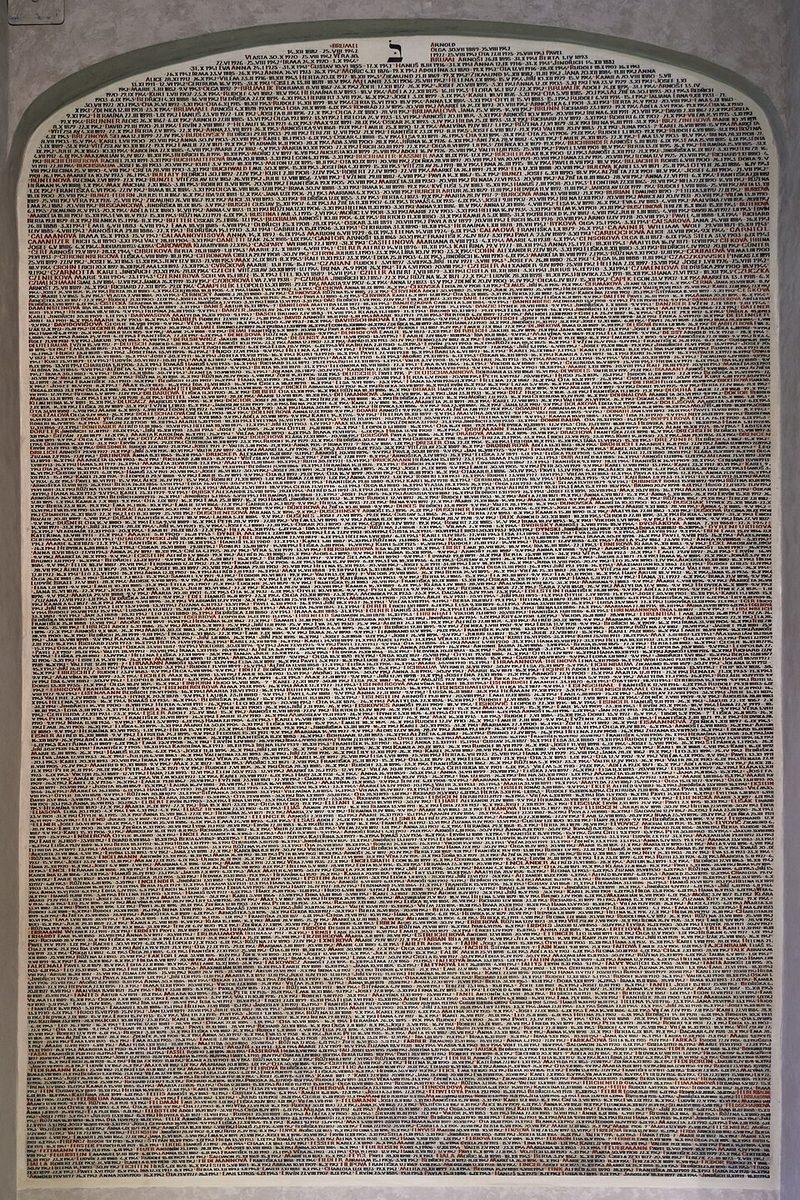
Pinkas Synagogue dates to the early 16th century, with the present building associated with Aaron Meshulam Horowitz and completed in 1535. Today its defining function is the Memorial to the Jewish Victims of the Shoah from the Czech Lands. Names written across the walls turn an enormous death toll into individual identities connected to towns, families and communities.
The Jewish Museum describes the memorial as commemorating more than 78,000 victims from the Czech lands; other museum visitor texts round the number to about 80,000. That difference is a reminder to avoid treating memorial numbers as decorative trivia. The names are the substance of the place.
Pinkas also carries the physical history of Josefov's relationship with the Vltava. Flooding repeatedly damaged the low-lying building. The 2002 flood again reached the synagogue and forced restoration. A supporting Story traces the high-water mark and what it means for the site's conservation.
This is one of the spaces where a sightseeing voice should become quieter. Build time into the visit rather than squeezing the memorial between photo stops.
Maisel Synagogue and the age of Rudolf II
Mordechai Maisel, a wealthy financier and leader of Prague's Jewish community, commissioned the Maisel Synagogue in the late sixteenth century. His career belongs to the period of Emperor Rudolf II, when Prague was an imperial centre and Jewish intellectual and communal life entered one of its most consequential phases.
The present appearance of the building reflects later rebuilding, so its present form is not an untouched Renaissance interior. Its value also comes from the exhibitions it houses, which place Jewish Prague in a longer historical frame. Maisel's patronage also helps correct a flattened image of the ghetto as only a place of exclusion. It was certainly constrained by discriminatory law and violence, but it was also a community capable of major scholarship, philanthropy, commerce and architectural ambition.
Klausen Synagogue, ceremonial life and the cemetery edge
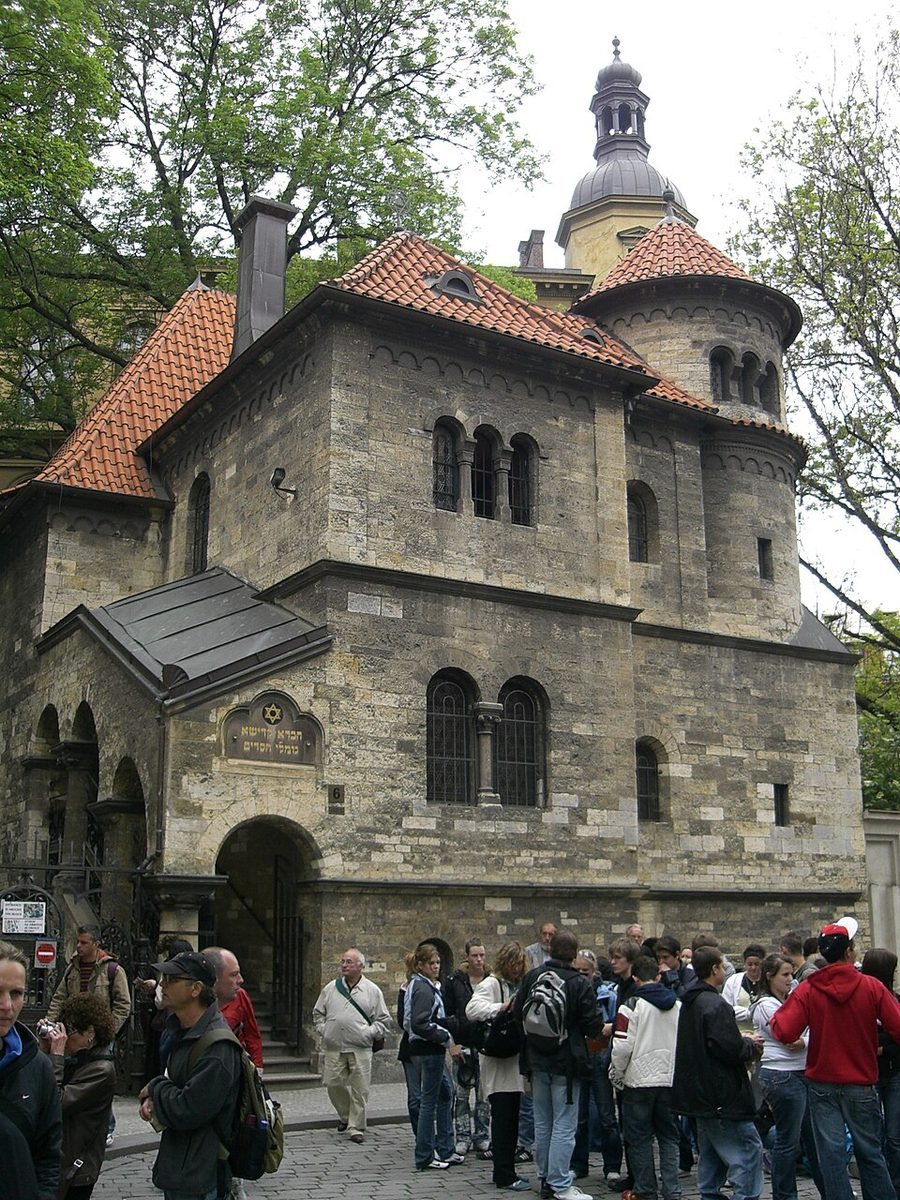
Klausen Synagogue stands beside the Old Jewish Cemetery and is closely connected with interpretation of Jewish religious customs. The neighbouring Ceremonial Hall was built for Prague's Burial Society and once formed part of the practical infrastructure surrounding death, washing and burial.
These buildings make the cemetery easier to understand because they restore ritual context. Cemeteries do not operate in isolation: communities organise care of the deceased, mourning and burial according to religious law and custom. Museum exhibitions here can therefore answer questions that the stones outside cannot.
The architecture itself is later than the medieval Old-New Synagogue. Reading the district chronologically, rather than treating every synagogue as interchangeable, reveals several different Jewish Pragues occupying the same few streets.
Jewish Town Hall and the clock that runs differently
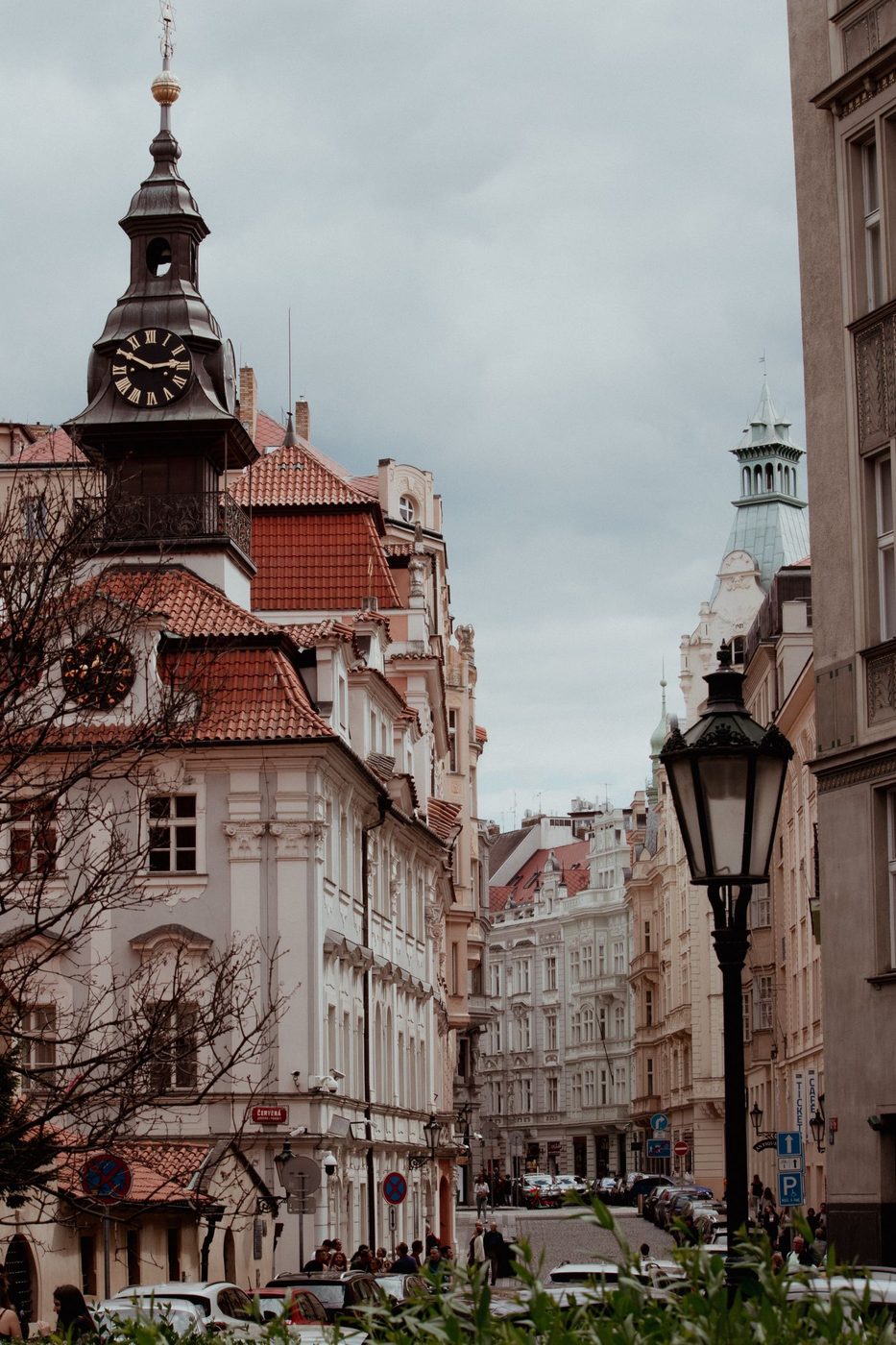
The Jewish Town Hall remains one of Josefov's most distinctive secular communal buildings. Its tower clock uses Roman numerals in the conventional direction, while another clock on the façade uses Hebrew characters and its hands move counter-clockwise, following the right-to-left direction of Hebrew writing as a visual conceit.
Next to the town hall is the High Synagogue, historically associated with the communal complex. Neither detail should be reduced to novelty. The town hall represents Jewish self-administration within the constraints imposed by the surrounding city and state. The clocks are memorable because they sit on a building tied to that institutional life.
The Golem: Prague's most famous Jewish legend
The Golem story has become globally associated with Prague: Rabbi Loew forms a human-like being from clay, animates it through sacred knowledge and eventually deactivates it. Versions differ on almost every important detail, including the Golem's purpose, behaviour and fate.
What can be documented is Rabbi Loew himself, a major rabbinic authority working in Prague in the late 1500s who lived and worked in Prague. Prague’s familiar Golem narrative took its developed form well after his lifetime. No physical evidence establishes that a Golem existed or that remains were stored in the Old-New Synagogue attic.
The legend remains culturally useful. It tells us how later generations imagined power, protection, danger and Jewish Prague. Presenting it as an event with the same evidential status as synagogue construction or the documented dates of the ghetto clearance would blur legend and history. Spectrum's Golem Story follows the legend while clearly marking where the historical record ends.
From ghetto clearance to modern Josefov
By the 1880s, municipal authorities had decided to redevelop the old Jewish Town and adjacent parts of the Old Town. The project demolished a maze of narrow streets and houses, raised ground levels in places and inserted broad avenues and modern apartment buildings. From the 1890s into the years leading up to 1914, the physical setting of Jewish Prague changed beyond recognition.
The project can be described simultaneously as sanitation reform, speculative urban redevelopment and destruction of historic fabric. Those interpretations are not mutually exclusive. Contemporary conditions in parts of the district were poor; the intervention also erased a unique urban environment. Surviving synagogues and the cemetery gained a new relationship to streets that had not existed when they were built.
Historical photographs are particularly useful here. Compare the Pinkas Synagogue before and after surrounding houses disappeared: the same building reads differently once the street network around it is gone.
The Shoah and the museum's wartime collections
The Nazi occupation shattered Prague's Jewish community through persecution, deportation and murder. During the war, objects from dissolved Jewish communities were concentrated in Prague. The history is sometimes simplified into the phrase 'museum of an extinct race', a formulation that can distort what actually happened and obscure the role of Jewish professionals forced to catalogue confiscated material.
After the war, many original owners could not reclaim those objects because they had been murdered. The Jewish Museum therefore became custodian of collections carrying both artistic and deeply personal histories. The Pinkas memorial and the Stolpersteine set into Prague pavements return attention from anonymous mass victimhood to names, addresses and lives.
Visitors should resist the temptation to make Josefov solely a Holocaust district. The Shoah is central and unavoidable, but the quarter also documents centuries of religious practice, learning, trade, family life and cultural production before 1939.
How to visit respectfully in 2026
The Jewish Museum circuit currently includes several synagogues and the Old Jewish Cemetery, while the Old-New Synagogue is administered by the Prague Jewish Community. In 2026, museum venues are closed on Saturdays and designated Jewish holidays; hours vary by season. The Old-New Synagogue also closes in relation to the beginning of Shabbat. Check the official Jewish Museum opening-hours page for your exact date.
A single circuit can involve far more emotional and historical material than its small geography suggests. Two to three hours is a sensible minimum for the principal sites; longer is justified if you read exhibitions closely. Dress respectfully, follow rules in active religious spaces and keep voices down in the cemetery and memorial areas.
If you are visiting with children, prepare them for the Pinkas memorial and Shoah material rather than presenting the route as a collection of unusual buildings. If your main interest is the Golem, still devote time to documented history. The legend becomes more meaningful when placed beside the real intellectual world of Rabbi Loew and the community around him.
The museum circuit is a sequence of different institutions, not one exhibit
Josefov’s surviving Jewish monuments sit close together, but they should not be mentally merged. The Old-New Synagogue remains an active synagogue with a history reaching back to the thirteenth century. The Pinkas Synagogue functions as a Shoah memorial. The Maisel and Klausen synagogues present museum exhibitions. The Old Jewish Cemetery is a burial place. Their proximity comes from the compressed geography of the former Jewish Town; their meanings are distinct.
That distinction changes behaviour. A cemetery is not a backdrop for playful photographs. A functioning synagogue has religious rules that differ from a secular gallery. A memorial built from tens of thousands of names asks for a different pace than an exhibition of ritual objects. The Jewish Museum’s combined visitor circuit makes practical sense, but a combined ticket does not make the sites interchangeable.
Plan enough time to reset between them. Moving directly from the Pinkas Memorial into the cemetery can be powerful because the spaces are historically connected, but it can also encourage visitors to treat both as one undifferentiated “tragic” attraction. The cemetery predates the Holocaust by centuries and documents the long life of Prague’s Jewish community. Maisel’s world of Rudolfine Prague belongs to another chapter again.
The strongest visit therefore alternates object, building, biography and urban history. That method protects Josefov from a common distortion: reducing a millennium of Jewish life either to the Golem legend or to twentieth-century persecution.
Clearance destroyed much of the ghetto and helped create the museum
Modern Josefov looks more spacious and architecturally nineteenth-century than many visitors expect from the word “ghetto.” That is because the medieval and early modern district was radically transformed during the sanitation and redevelopment campaign around the turn of the twentieth century. Streets and housing were demolished on a large scale; new apartment buildings and boulevards replaced much of the old fabric.
The clearance had multiple motives, including sanitation, infrastructure and urban modernization, but its cultural cost was enormous. Synagogues, houses and the physical pattern of centuries of Jewish life disappeared. The Jewish Museum in Prague was founded in 1906 in direct response to this loss, initially collecting objects from synagogues demolished during the redevelopment. Its origin therefore belongs to urban preservation history as much as to museum history.
This relationship is visible on foot. The Old-New Synagogue and cemetery survive as older anchors inside a district whose surrounding façades often belong to a later city. Pařížská and adjacent streets express a modern metropolitan ambition very different from the cramped settlement documented in older plans and images.
Calling present-day Josefov “the old Jewish ghetto” without qualification hides this transformation. The quarter is a palimpsest: fragments and monuments of the historic Jewish Town embedded in a rebuilt urban district. Understanding the clearance also makes the museum’s collections more legible. Preservation began, in part, because people could see that physical heritage was disappearing in front of them.
The Pinkas Memorial turns archival data back into individual lives
The power of the Pinkas Synagogue does not come from an abstract statistic. Names, dates and communities cover the walls, restoring individuality to people who were deported and murdered. The memorial was created in the 1950s by artists Václav Boštík and Jiří John and opened in 1960. After the Soviet-led invasion of 1968, it was closed for more than two decades; restoration and renewed access followed after the end of Communist rule.
The Jewish Museum continues to maintain and correct the underlying information as documentation improves. That matters because memorialization is not a one-time act. Names must be researched, spellings verified, family relationships reconstructed and records connected with deportation histories.
Upstairs, drawings made by children in the Terezín ghetto create a very different kind of testimony. They should not become decorative evidence of “hope” detached from the children’s fates. The collection survives because educators and archivists preserved work produced under persecution; many of the children did not survive.
There is no requirement for a respectful visitor to perform visible grief. Quiet attention is enough. Read a small number of names. See how communities are organized on the walls. Allow the scale to emerge gradually. Then carry that specificity into the rest of Josefov, where synagogues, ritual objects and cemetery inscriptions document a community that existed for centuries before the Shoah and continues in Prague today.
Practical respect includes the calendar
Jewish sites do not follow the same weekly rhythm as ordinary museums. The Jewish Museum closes on Saturdays and on Jewish holidays according to its published calendar, and operating hours change seasonally. That is not a minor scheduling quirk; it reflects the religious context of the institutions and sites.
Check the official calendar before fixing a Josefov morning around a specific date. If the museum circuit is closed, the district can still be walked, but the experience is fundamentally different because the synagogues, cemetery and exhibitions carry most of the historical depth.
Dress and conduct should fit religious and memorial spaces. Staff instructions at individual sites take priority over generic advice. Photography rules can vary. Head coverings may be required in active synagogue contexts. The respectful default is simple: follow posted rules, lower your voice where the setting asks for it, and never treat worshippers or memorial visitors as scenery.
Do not let Kafka erase the rest of Josefov
Franz Kafka was born near the edge of the Old Town and Jewish Quarter world and remains central to Prague’s literary identity, but modern tourism can over-project him onto every street in Josefov. The surviving synagogues and cemetery have histories extending far beyond Kafka’s lifetime, while the district’s major redevelopment was already transforming the environment around him.
Use Kafka as one nineteenth- and twentieth-century layer, not as the narrator of a millennium of Jewish Prague. His family background, German-language writing and relationship to the city are worth exploring on their own terms.
That separation benefits both subjects. Jewish heritage is not reduced to a famous secular writer, and Kafka is not turned into a mascot pasted onto unrelated monuments.
Frequently asked questions
Is the Prague Jewish Quarter the same as Josefov?
Josefov is the modern district that contains the principal surviving monuments of Prague's historic Jewish Town. Most of the old ghetto fabric disappeared in the clearance and redevelopment spanning the late 1890s and early 1900s.
Is the Jewish Quarter open on Saturday?
The Jewish Museum's sites are closed on Saturdays, and Jewish holidays also affect opening. Always check the official 2026 calendar before visiting.
How much time should I allow for the Jewish Quarter?
Two to three hours is a useful minimum for several principal sites and the cemetery. A careful museum visit can easily take half a day.
Is the Golem story true?
The Maharal, Rabbi Loew, is firmly documented as a historical figure, but the clay Golem narrative is a legend whose developed forms postdate his lifetime. No evidence proves a Golem was hidden in the Old-New Synagogue.
Can I visit the Old-New Synagogue?
Yes, when open to visitors, but it remains an active religious site and follows schedules connected with Shabbat and Jewish holidays.
Is the Old Jewish Cemetery still used for burials?
The historic cemetery is no longer the ordinary burial ground of Prague's Jewish community. It is preserved as a major historic and religious site.
Sources & further reading
- Jewish Museum in Prague — Jewish Town — Jewish Museum in Prague
- Jewish Museum in Prague — Old-New Synagogue — Jewish Museum in Prague
- Jewish Museum in Prague — Pinkas Synagogue — Jewish Museum in Prague
- Jewish Museum in Prague — Opening Hours — Jewish Museum in Prague
- Jewish Museum in Prague — Pinkas Synagogue — Jewish Museum in Prague
- Jewish Museum in Prague — visit and monument overview — Jewish Museum in Prague
- Jewish Museum in Prague — History of the Museum — Jewish Museum in Prague
- Jewish Museum in Prague — Memorial to the Victims of the Shoah from the Czech Lands — Jewish Museum in Prague