
Jewish civic life
The High Synagogue Is Part of Prague’s Jewish Town Hall Story
Prague City Tourism describes the High Synagogue as a sixteenth-century town-hall synagogue and connects the synagogue and town hall with their foundation by Mordechai Maisel.
Jewish Town Hall / High Synagogue, Josefov

The synagogue is not an isolated monument: Prague City Tourism explicitly describes it as a town-hall synagogue.
A synagogue tied to civic government
The High Synagogue is easy to file mentally under “religious monument,” while the Jewish Town Hall beside it goes into a separate civic category. Prague City Tourism complicates that split by describing the High Synagogue as a sixteenth-century town-hall synagogue and discussing the synagogue and town hall together in connection with Mordechai Maisel.
Two functions share one institutional setting
That relationship makes the tight cluster in Josefov easier to read. Civic administration and religious life were not isolated worlds that happened to occupy adjacent plots. The city’s description invites a connected reading: town hall and synagogue belonged to the institutional fabric of the same community.
Do not let the famous clock consume the Town Hall
The Hebrew clock attracts attention because it is visually unusual, but it can reduce the building to one photogenic detail. The synagogue connection restores a broader picture. This was not simply a facade with an interesting clock; it was part of a civic-religious complex with a long communal role.
Use proximity as historical evidence—carefully
Buildings next to each other are not always historically connected, so proximity alone proves little. Here, however, the official description supplies the connection. Once that evidence is in place, the short distance between synagogue and town hall becomes meaningful. The architecture can be read as a cluster rather than a collection of unrelated sights.
Reviewed visuals
See the story
Supporting images selected in the Prague Stories visual review. Context images are labeled so they are not mistaken for documentary proof of the exact subject.
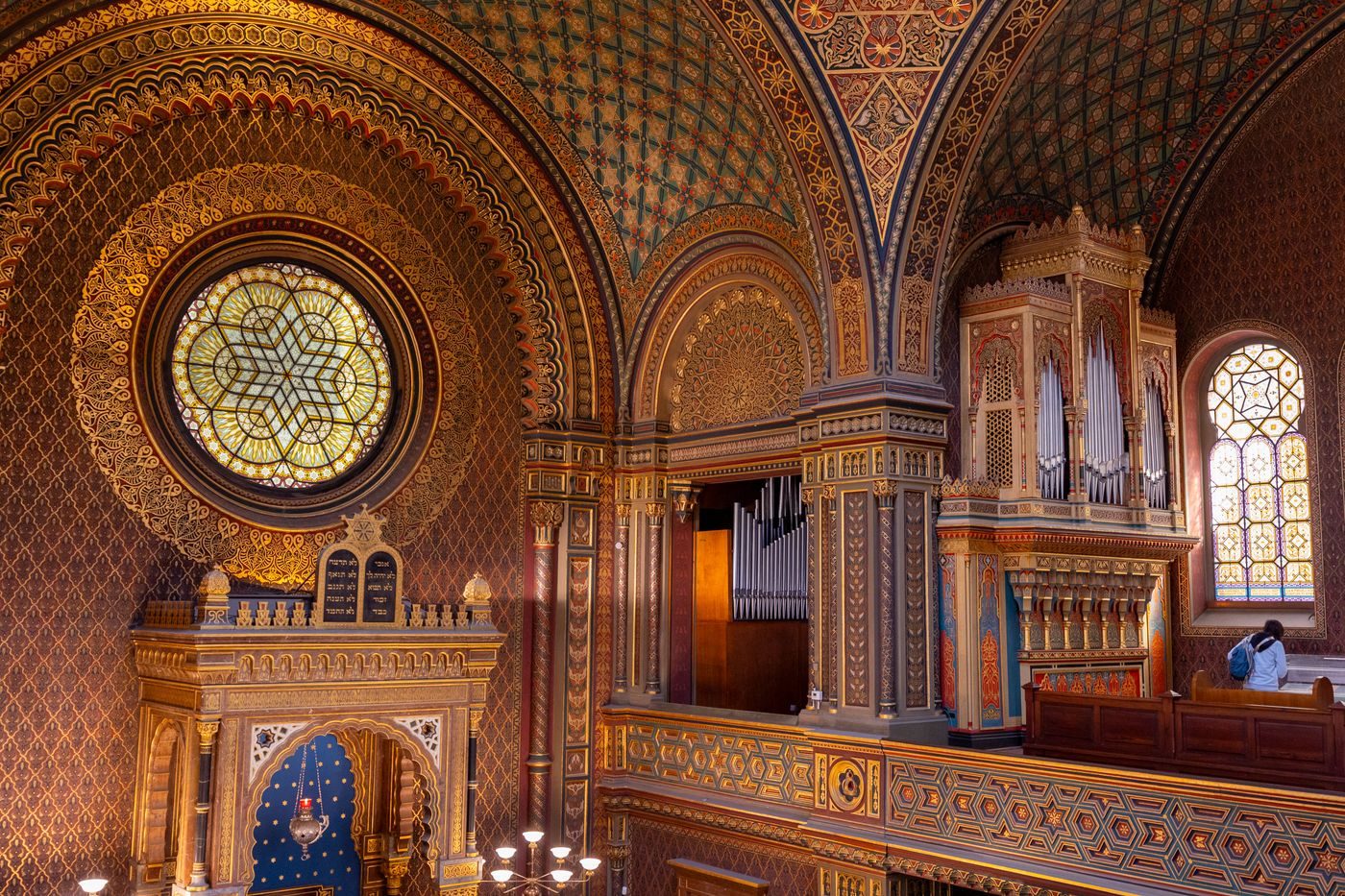
Exact Josefov synagogue interior visibly represents religious life in the district.
Quick facts
- Prague City Tourism describes a town-hall synagogue.
- The source places that synagogue in the sixteenth century.
- The page discusses the synagogue and town hall together.
- It connects their foundation with Mordechai Maisel.
Questions
Why is it called a town-hall synagogue?
Prague City Tourism uses the Czech phrase “radniční synagoga,” meaning a town-hall synagogue.
Who does the source connect with their foundation?
Mordechai Maisel.
Sources & further reading
- Radnice Židovské obce Praha a Vysoká synagoga — Prague City Tourism