
Psychological Folklore
Prague Had Doppelgängers Long Before Modern Science Fiction
Václav Cibula connects Prague’s double tradition with Karlovo náměstí and a story of a cut-up image. The unsettling part is not a monster’s face, but the possibility that your own face can exist independently of you.
Karlovo náměstí / New Town

The doppelgänger is less a single ghost than a type of event: the living person encounters an autonomous copy, often carrying the force of an omen.
Cibula gives Prague its doubles
Václav Cibula’s Pražské pověsti contains O dvojnících a rozřezaném obrazu. The material connects the doppelgänger motif with Karlovo náměstí and the New Town. Unlike a conventional revenant, the double does not need scars, chains or a transparent body. Its horror comes from perfect resemblance. A person’s own identity appears outside the person, creating the sense that the boundaries of the self have failed.
The double can be an omen
In the Prague tradition summarized through Cibula, the doppelgänger can be associated with foreknowledge of death or with a divided identity. That is why the phenomenon is more psychologically disturbing than a generic haunting. A stranger can be avoided; a second self cannot be dismissed so easily. The image suggests that something which should be unique has been duplicated, and that the duplicate may know or announce something the original person does not.
The cut image belongs to the same world of divided identity
Cibula links the doubles with a story involving a cut-up image. Even without forcing every version into one literal mechanism, the association is revealing. The image and the doppelgänger both turn identity into something that can be separated, copied or damaged outside the body. That makes the story complex more than a simple ‘ghost at Karlovo náměstí’. It belongs to a wider imaginative problem: what happens when a representation of a person begins to behave as if it has consequences for the person represented?
There is no need to invent one named creature
The doppelgänger is better understood as a recurring type of event than as one resident ghost with a fixed biography and address. Cibula’s Prague material gives it a local anchor, but the exact function varies: sometimes the double is an omen, sometimes an expression of split identity. The multiplicity matters because there is no single canonical ‘Doppelgänger of Karlovo náměstí’ with one stable biography.
Use Karlovo náměstí as a frame for an idea
Karlovo náměstí and the New Town provide the Prague geography in which Cibula places the story complex. The reader can stand in a real place while thinking about a very old supernatural anxiety: meeting a person who is you and is not you. The square is best understood as the urban frame for a Prague version of the double motif rather than one exact apparition point.
Reviewed visuals
See the story
Supporting images selected in the Prague Stories visual review. Context images are labeled so they are not mistaken for documentary proof of the exact subject.
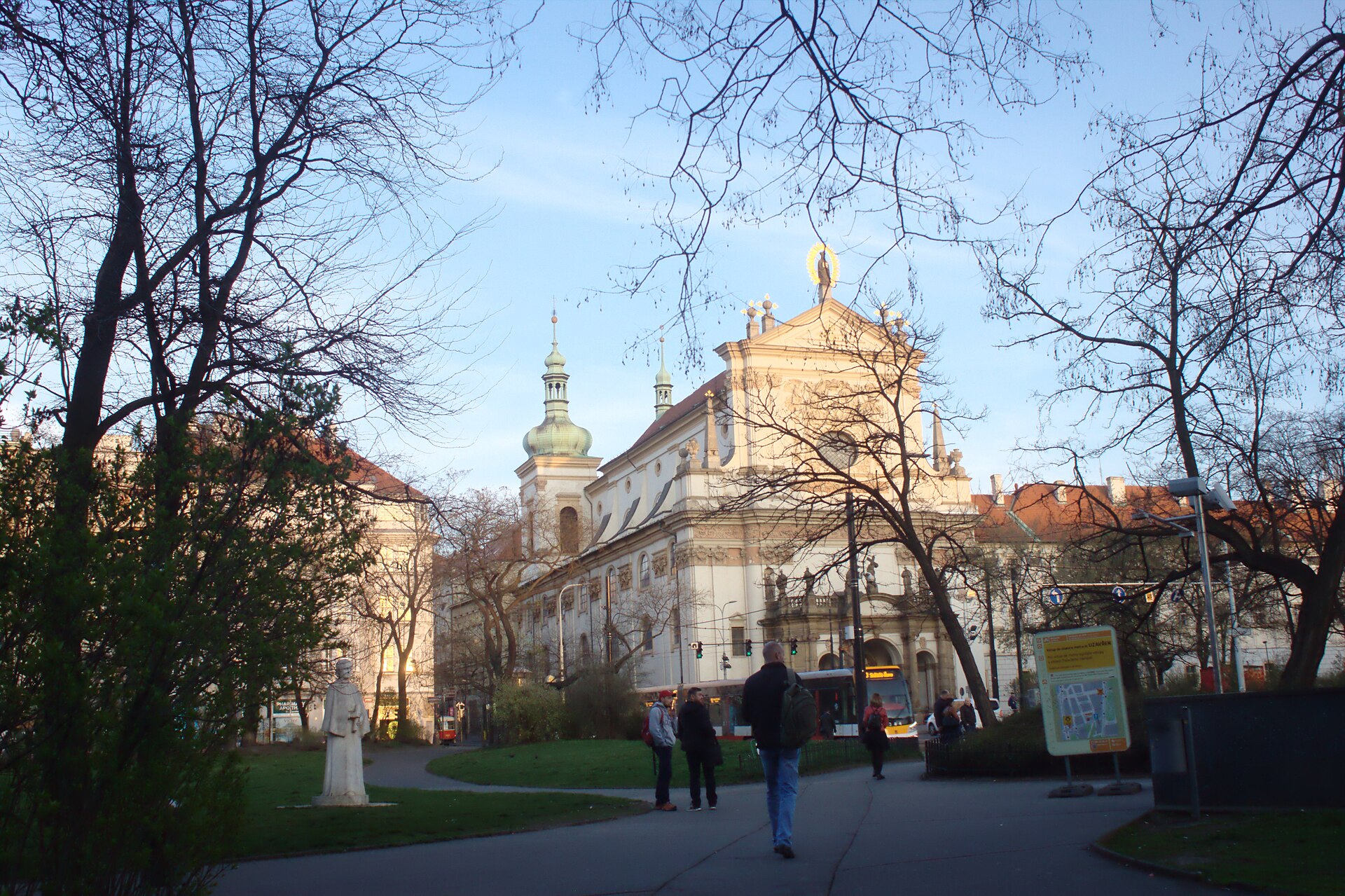
Use Karlovo náměstí as the topographical frame only as far as Cibula’s Prague version supports it.
Quick facts
- Václav Cibula records O dvojnících a rozřezaném obrazu in Pražské pověsti.
- The Prague doppelgänger tradition is associated with Karlovo náměstí / New Town.
- The double can function as an omen of death.
- It can also represent a divided or destabilized identity.
- Cibula connects the theme with a cut-up image.
- The doppelgänger is a type of phenomenon rather than necessarily one named supernatural being.
Questions
Is the doppelgänger a ghost of a dead person?
Not necessarily. The defining feature is an uncanny copy of a living person, often functioning as omen or identity disturbance.
Is there one official Doppelgänger of Karlovo náměstí?
No. The source tradition is better understood as a Prague localization of a recurring phenomenon than as one fixed creature.
Sources & further reading
- Pražské pověsti — O dvojnících a rozřezaném obrazu — Václav Cibula
- Pražské pověsti (1983) — bibliographic contents listing — Václav Cibula / Databáze knih