
Prague Stories · Czech Food
Trdelník Is Everywhere in Prague — but Its Tradition Does Not Begin Here
That cinnamon-scented spiral may feel inseparable from a walk through central Prague, but the documented tradition behind it points elsewhere. Knowing that does not ruin the pastry; it makes the version in your hand easier to read.
Old Town and Malá Strana, Prague

Walk through the busiest parts of Prague and trdelník announces itself before the sign does: warm dough, caramelising sugar, cinnamon, sometimes a cloud of vanilla from soft-serve pushed into the hollow centre.
Start with the smell, then separate place from tradition
It is brilliant street theatre. A cylinder of dough turns over the heat. Sugar catches the light as the surface browns, and the shape is unusual enough to become a photograph before it becomes a snack. That visibility creates an easy assumption: if a food is sold every few metres in Prague, it must be an old Prague speciality. The evidence asks for a more careful reading. The best-documented protected tradition is Skalický trdelník from Skalica in present-day Slovakia. Its European registration describes a hollow cylinder of yeast dough wound around a roller and baked. The documented local tradition is tied to Skalica, not Prague. So the useful distinction is not “real versus fake”. It is between the historical geography of a pastry tradition and the modern geography of tourism.
The roller is older than the Prague souvenir image
The name itself points toward the tool. In the Skalica tradition, strips of risen dough are wrapped around a cylindrical roller called a trdlo, then baked while turning. The protected specification describes a crisp baked surface and a softer interior, with the finished pastry remaining hollow. Nuts may be part of the coating in that tradition, alongside the sugar that helps create the familiar burnished crust. The historical trail is Central European and tangled, which is exactly why a single dramatic origin claim should make you suspicious. The Skalica documentation connects the local custom to the early nineteenth century and preserves a story involving a cook associated with Count József Gvadányi who came from Transylvania. That is valuable evidence for how the pastry was remembered and localized; it is not permission to declare one modern country the sole inventor of every spit-baked cake in the region. Food travels with people, courts, markets, languages and borders. Trdelník makes more sense when you allow that complexity to remain visible.
Prague turned a regional form into a tourist icon
Prague's contribution is much more recent than the pastry's older regional history. Radio Prague says trdelník shops became ubiquitous in the city centre over roughly the past couple of decades. CzechTourism now describes the pastry as especially common in city centres, tourist zones and markets. That is the useful timeframe: an early-21st-century Prague tourism phenomenon, not a centuries-old Old Town institution. Why did it spread so effectively? The product is almost engineered for a sightseeing economy. The appeal is easy to see. Visitors watch the dough turn over the heat, smell cinnamon and caramelising sugar from down the street, and walk away with a hollow spiral that photographs well and is easy to carry. CzechTourism even points to its social-media appeal and the proliferation of colourful, heavily filled versions. Repetition then does the rest. See the same object beside the city's headline sights and the city begins to feel like its natural home. That is how a modern tourism association can become stronger in memory than culinary geography.
The ice-cream cone is a clue that you are looking at a new chapter
The modern Prague version is often split, filled or topped in ways that move it far beyond the simple hollow pastry described in the protected Skalica specification. Soft-serve, whipped cream, chocolate spread, fruit and elaborate toppings transform the cylinder into something closer to an edible cup. It is visually clever and commercially effective because the hollow centre stops being empty space and becomes the feature. The ice-cream-filled version is best understood as a contemporary dessert, not proof of an old Prague custom. Traditional foods are not damaged by adaptation, and new foods do not become dishonest merely because tourists love them. The problem begins only when a modern combination is presented as proof of an ancient local custom. If you want the older logic of the pastry, order a simpler, freshly baked cylinder and pay attention to the dough, sugar, nuts and texture. If you want ice cream inside it, order that too — just know which story you are tasting.
If you want a more locally rooted Czech sweet, change the question
Instead of asking a vendor to prove that trdelník is “authentic”, ask what kind of Czech baking you want to explore. Prague bakeries and pastry shops offer a much wider view of Czech sweets: koláče with poppy seed, tvaroh or plum filling, choux pastries such as větrník, plus seasonal buns, cakes and regional specialties. Those foods have their own variations and arguments, but they do not need Prague's souvenir economy to explain why they are on a Czech table. That shift also makes travel more generous. You do not have to shame a popular snack in order to discover something older. Eat the trdelník if it looks good. Then notice what the bakery two streets away is selling to people who are not posing with it. Prague becomes more legible when “What is famous here?” and “What grew from here?” are allowed to have different answers.
Reviewed visuals
See the story
Supporting images selected in the Prague Stories visual review. Context images are labeled so they are not mistaken for documentary proof of the exact subject.
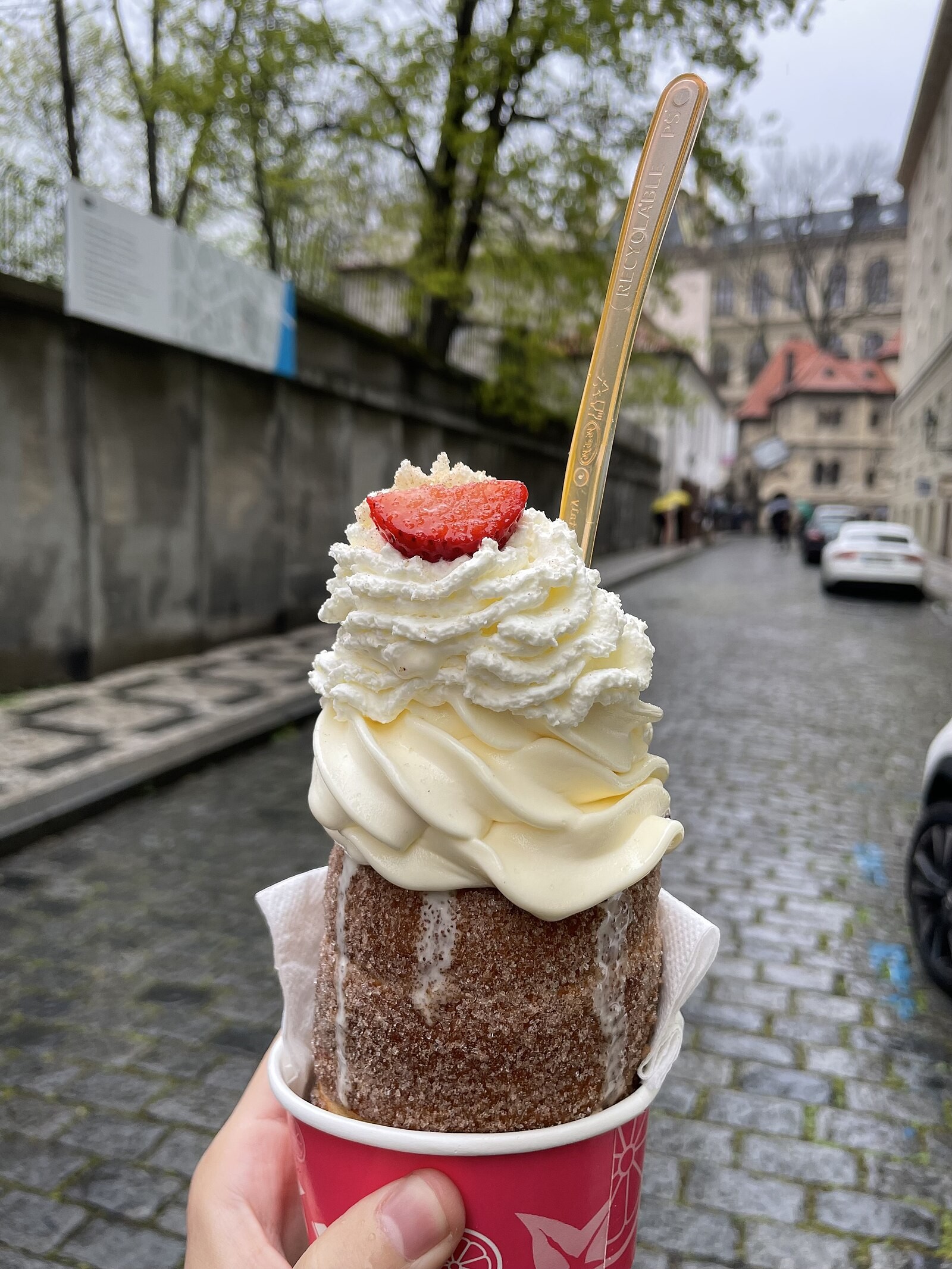
Trdelník pastry close-up showing the cylindrical spit-baked form.
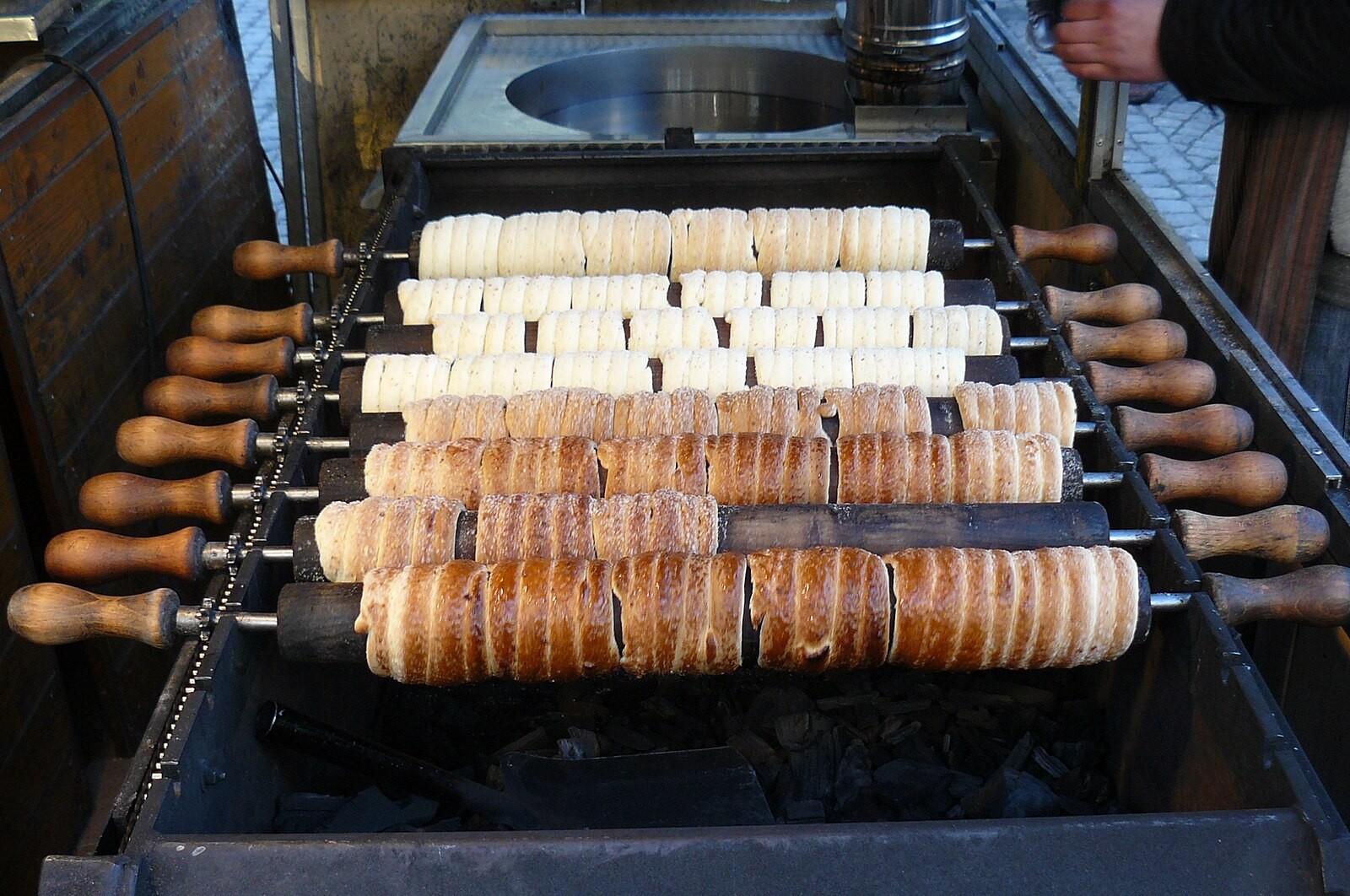
Trdelník photographed in Prague, directly representing its tourist-market presence.
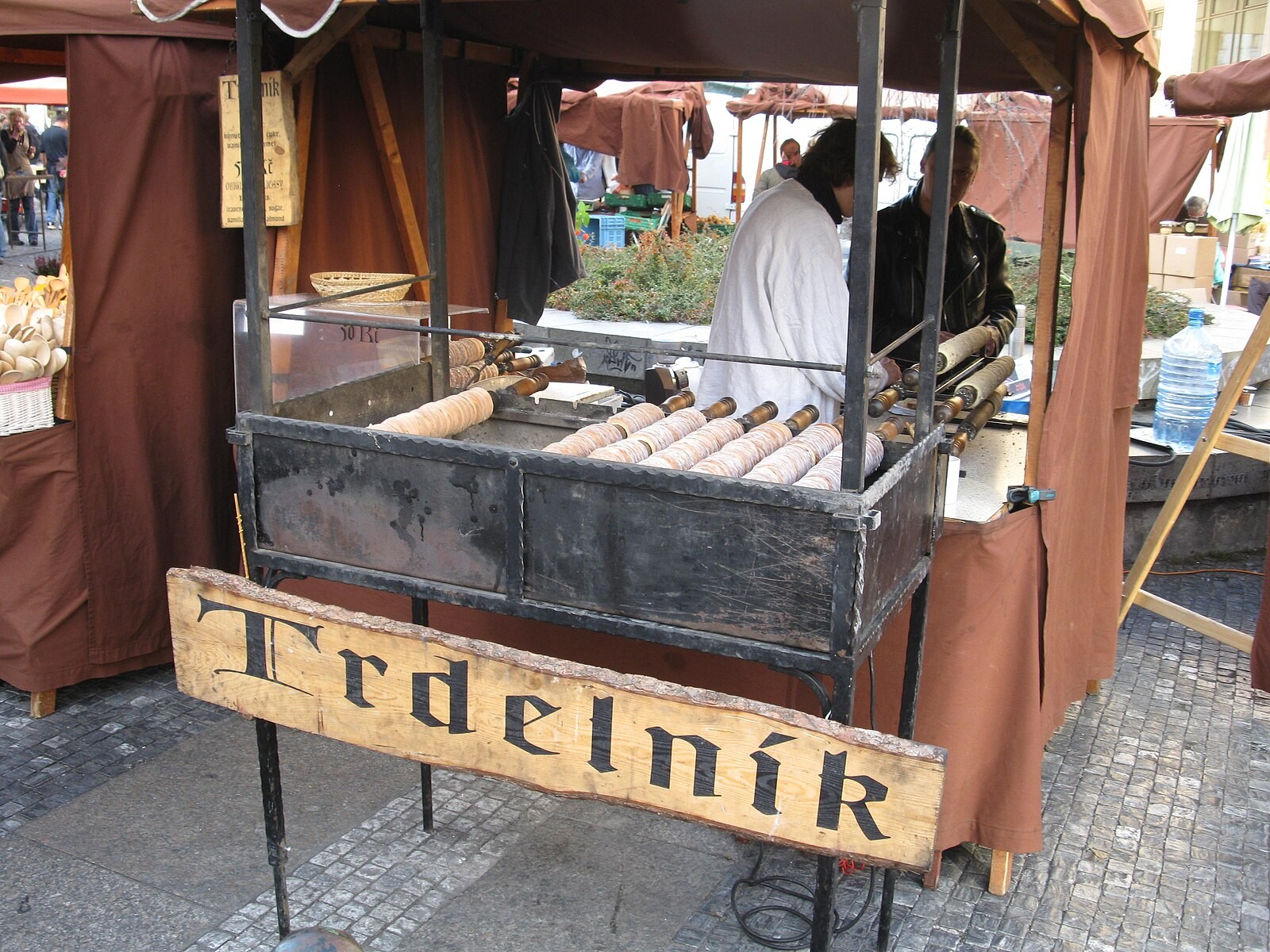
Trdelník stall/product at Náměstí Republiky in Prague.
Quick facts
- Trdelník is a hollow yeast-dough pastry baked around a cylindrical roller.
- The EU-protected Skalický trdelník tradition is tied to Skalica in Slovakia, not Prague.
- The Skalica specification records a local tradition reaching back to the early nineteenth century.
- Modern Prague versions are often filled with ice cream, cream, chocolate or fruit; those fillings are a contemporary presentation rather than part of the protected Skalica specification.
- Trdelník's ubiquity in central Prague is an early-21st-century tourism phenomenon rather than evidence of a centuries-old Old Town tradition.
Questions
Is trdelník Czech?
It is better described as part of a broader Central European family of spit-baked pastries than as a uniquely Czech invention. The best-documented protected trdelník tradition is Skalický trdelník from Skalica in Slovakia.
Is trdelník traditional in Prague?
It is now a highly visible Prague tourist food, but that visibility should not be confused with evidence of a long historic Prague pastry tradition.
What is the ice-cream-filled version?
It is a modern dessert format that uses the pastry's hollow centre as a cone or cup for soft-serve and toppings. It is not part of the protected Skalický trdelník specification.
What Czech sweet should I try instead if I want something more locally rooted?
Try a Czech bakery or cukrárna and look for koláče, větrník or other Czech pastries. The best choice depends on the shop and season, but these lead you deeper into Czech baking culture.
Sources & further reading
- Publication of an application: Skalický trdelník — EUR-Lex / European Union
- Skalický trdelník — Tourist Information Centre Skalica
- Trdelník: The Beloved Chimney Cake and Its Journey to Czechia — VisitCzechia
- Video highlighting fake Czech trdelník tradition draws attention to Prague tourist blight — Radio Prague International