
Explore Prague
St Vitus Cathedral
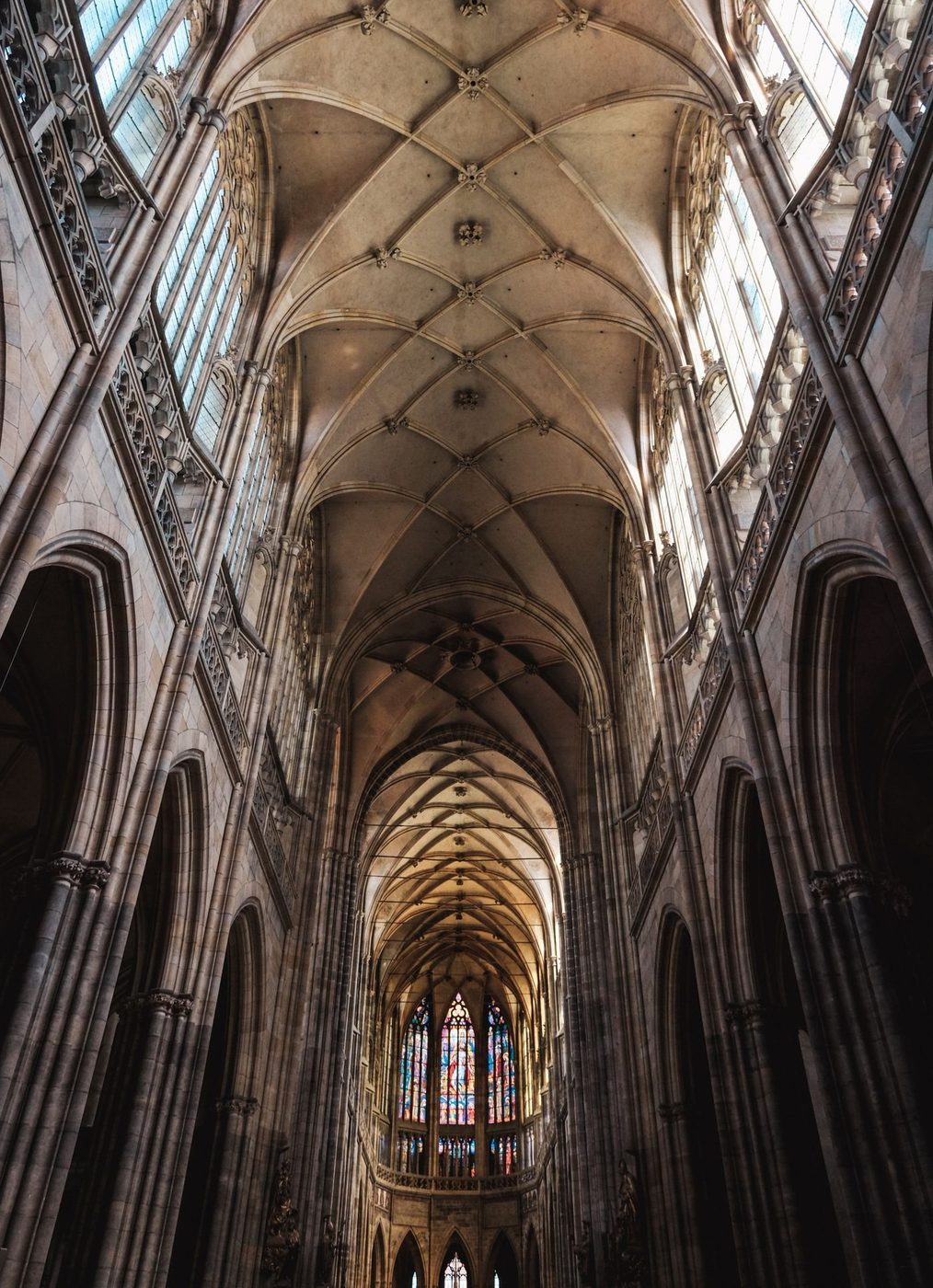
St Vitus Cathedral rewards visitors who stop treating it as one enormous Gothic object and start reading it as a building assembled across centuries. The first impression is scale: forest-like piers, ribbed vaults, coloured windows and a choir that seems to pull the eye east. Yet the most revealing details often sit at changes in masonry, decoration and historical purpose. The cathedral grew because Prague itself changed—from Přemyslid seat to royal capital, from Habsburg city to capital of an independent Czechoslovakia. That long biography matters. The cathedral contains the tomb of St Wenceslas, royal burials, the Crown Chamber above his chapel, chapels endowed by medieval elites and glass made in radically different artistic languages. It was also a coronation church. In other words, this is simultaneously a place of worship, a dynastic monument, a national symbol and a working part of the Prague Castle visitor circuit.
St Vitus Cathedral is the spiritual and architectural centre of Prague Castle. Work on the present Gothic cathedral began in 1344, but the site is much older: a 10th-century rotunda and an 11th-century Romanesque basilica stood here before it. Its long construction history explains why the building is not a single medieval time capsule. Medieval masonry, Renaissance and Baroque monuments, 19th- and 20th-century completion work, modern stained glass and state symbolism all occupy the same church. Allow at least 45–60 minutes for the interior if you want more than a quick circuit; add time for the Great South Tower when open, if you plan to climb it.
Why St Vitus Cathedral matters
The cathedral's importance begins before Gothic architecture. Prince Wenceslas founded a rotunda here in the 10th century and dedicated it to St Vitus after receiving a relic associated with the saint. The choice of dedication tied the Bohemian ruler to the wider Christian world. Wenceslas himself was later buried at the site, turning it into one of the key devotional places of the Czech lands.
After Prague was elevated to an archbishopric in 1344, Charles IV and his father John of Luxembourg launched a cathedral suitable for the new ecclesiastical status and for a monarchy with European ambitions. Its role then accumulated rather than replaced earlier meanings. The shrine of St Wenceslas remained central; royal coronations used the cathedral; rulers were buried here; and the building became inseparable from the idea of Czech statehood.
For a visitor, this layered function is more useful than a list of dates. It explains why a chapel can matter politically as well as religiously, why royal tombs occupy such prominent space and why the cathedral's completion in the modern era carried more than architectural significance.
A Gothic cathedral built in several lives
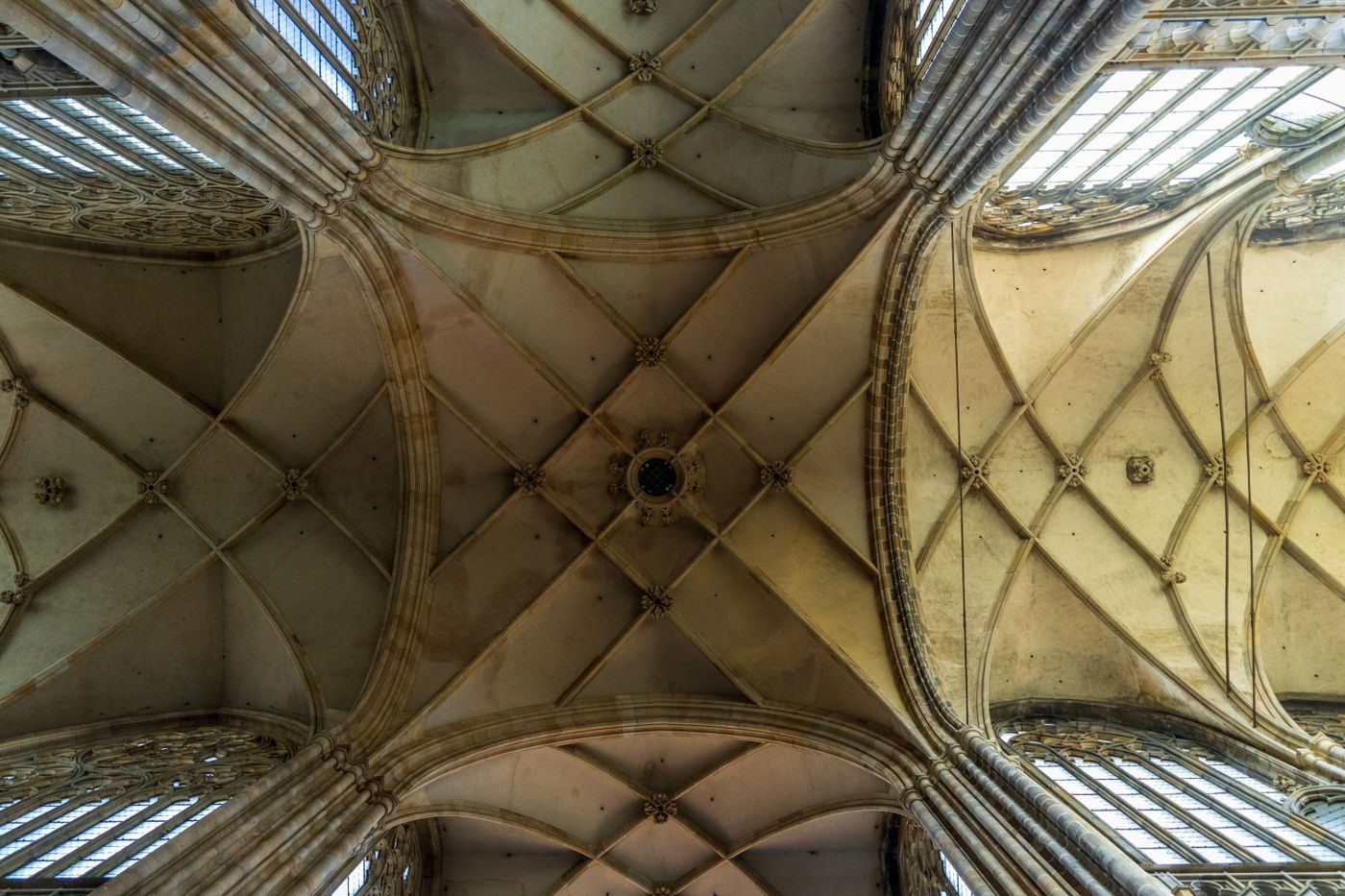
The Gothic project began in 1344 under Matthias of Arras, a French-trained architect who established the eastern choir on a clear cathedral plan. After his death, Peter Parler took over. Parler did not simply continue a blueprint: his workshop introduced more dynamic vaulting, sculptural treatment and structural solutions that helped give St Vitus its distinctive character.
Construction slowed and eventually stopped during the upheavals of the Hussite period. For centuries the cathedral remained incomplete, with the medieval choir functioning beside later additions and provisional closures. A serious completion campaign did not gather full force until the 19th century. The Union for the Completion of St Vitus Cathedral coordinated work that repaired medieval fabric and extended the nave and western front. A completion ceremony marked the finished cathedral in 1929, one thousand years after the traditional date of St Wenceslas's death.
This chronology changes how you look at the building. The western part is not a medieval survival in the same sense as Parler's choir. It is historicist completion carried out with enormous technical and artistic care. Calling the result 'fake Gothic' misses the point; St Vitus is an unusually legible case study in how later generations chose to finish an inherited national monument.
Before the Gothic church: rotunda and basilica
The Gothic cathedral did not begin on empty ground. The first church was a rotunda established by St Wenceslas in the 10th century. In the 11th century, Prince Spytihněv II replaced it with a much larger Romanesque basilica. Parts of these earlier structures survive archaeologically beneath the present cathedral.
That buried sequence is crucial to understanding the site's continuity. Medieval builders often worked around sacred locations rather than abandoning them, especially when a saint's tomb or important relic was involved. St Wenceslas's burial place remained an anchor around which later architecture developed. The cathedral therefore contains a spatial memory older than its visible Gothic walls.
The Story about the St Vitus relic goes deeper into why the earliest rotunda carried this dedication. One small object could redirect the history of an entire monumental site.
St Wenceslas Chapel: the cathedral inside the cathedral
St Wenceslas Chapel is the cathedral's most concentrated fusion of religion, dynasty and state. Built around St Wenceslas's tomb, the sacred core of the Czech lands, it was designed by Peter Parler's workshop in the 14th century. The lower walls are covered with semi-precious stones set into gilded plaster, while painted scenes above form a dense visual programme around the saint and the Passion of Christ.
The chapel is not simply luxurious decoration. Its position marks the sacred core inherited from the earlier church. A door in the chapel leads toward the Crown Chamber, where the Czech Crown Jewels are kept under a famously elaborate multi-key security arrangement. The jewels are not normally on public display; special exhibitions are exceptional events rather than a routine part of a cathedral visit.
Access to the chapel itself may be controlled, and visitors often view much of it from the entrance. Even from there, spend a moment comparing the glittering lower wall with the painted upper register. The room feels unlike the pale stone of the nave because it was meant to create an intense devotional environment rather than a broad architectural vista.
Royal tombs and dynastic memory
The cathedral also received royal and dynastic burials. The most visible royal monument in the choir is the Renaissance Royal Mausoleum, while the Royal Crypt below contains remains of important Bohemian rulers. Charles IV, one of the figures most closely associated with medieval Prague, is among those buried in the cathedral complex.
The placement is deliberate. Burial within the metropolitan cathedral linked dynasty, liturgy and memory. A king's political authority ended at death, but the monument kept his name present in the ritual heart of the kingdom. When reading inscriptions, remember that the cathedral tells history selectively: saints, rulers, bishops and patrons are highly visible because these were the people whose institutions could build and memorialise at this scale.
Stained glass: medieval space, modern colour
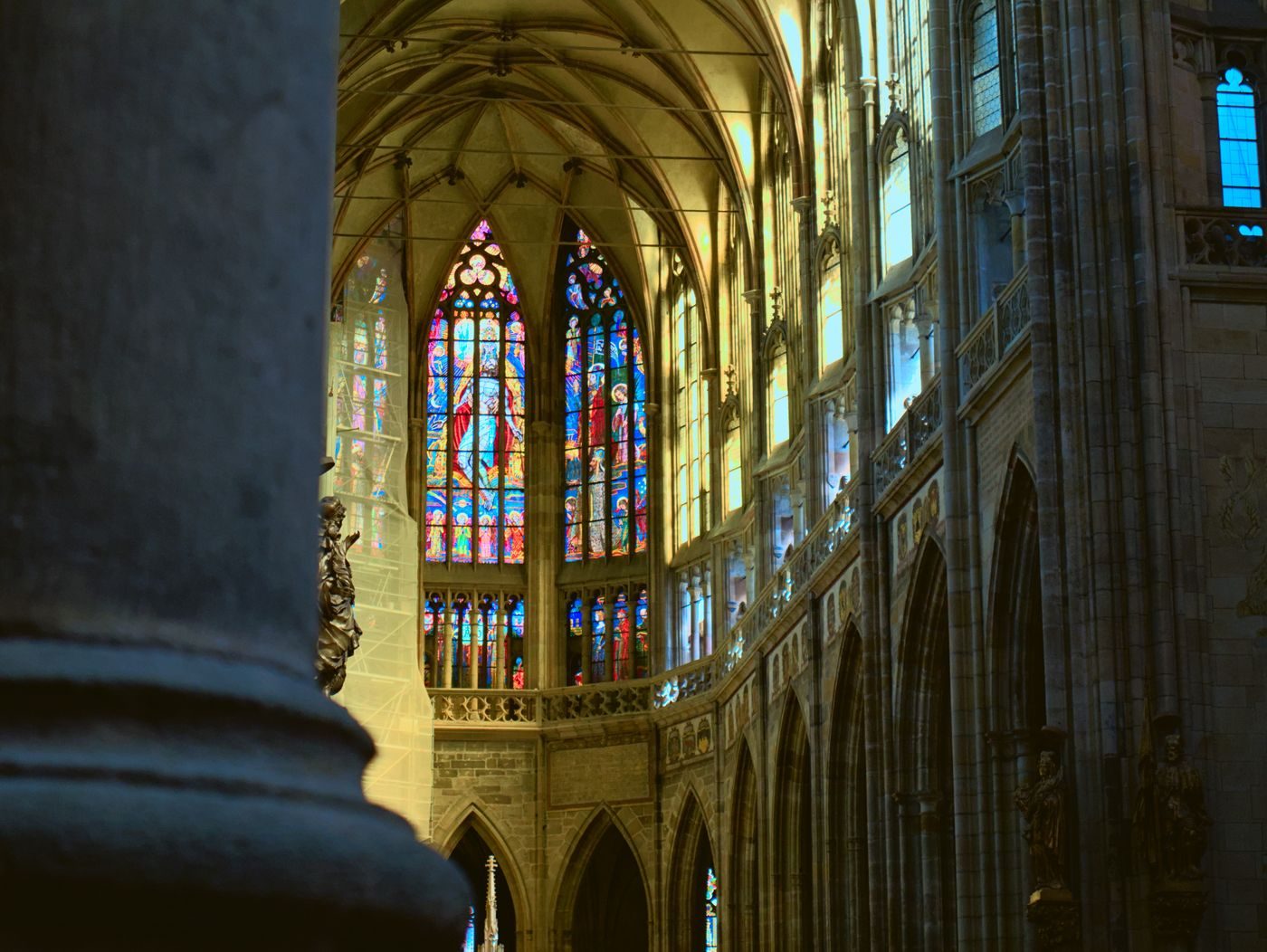
Visitors often assume all the coloured glass is medieval because it sits inside a Gothic shell. Much of the cathedral's stained glass, however, dates from the modern completion period. That layered completion history makes the windows especially valuable: they show how artists of the 19th and 20th centuries inserted contemporary artistic language into a medieval architectural framework.
One of the best-known examples is the window designed by Alfons Mucha in the New Archbishop's Chapel. Its Art Nouveau-inflected composition stands apart from strict medieval revival while remaining coherent within the church. Other windows were created by prominent Czech artists and workshops. Instead of asking which window is 'the oldest', compare how different generations solve the same problem: turning daylight into narrative, colour and atmosphere.
Sun position changes the experience significantly. A window that seems dark in the morning may project colour later in the day, while bright exterior light can flatten details in another. The glass is therefore not a static gallery display; the building's lighting changes hour by hour.
Coronations and the Czech crown
The cathedral was the coronation church of Bohemian kings and queens. Coronation processions approached through the city and castle before the rite inside the cathedral, connecting streets, royal residence, church and monarchy in one ceremonial geography. The Crown of St Wenceslas—created for Charles IV—became the central object of the Czech coronation regalia.
It is easy to confuse the crown's symbolic presence with ordinary visitor access. The Crown Jewels are stored at the cathedral but are displayed only on special occasions under strict conditions. A normal ticket should never be purchased on the assumption that the jewels themselves will be visible.
The coronation role also helps explain why St Vitus appears so often in Czech political imagery. It was not merely the largest church in the castle; it was a stage on which legitimate rule was publicly expressed.
The Great South Tower
The Great South Tower offers a different reading of the cathedral. From ground level, the tower is part of the skyline; from above, the cathedral becomes a plan embedded in the castle and the city. The climb is substantial and involves many steps, so it is better treated as a separate activity rather than an automatic extension of every interior visit.
Opening times for the tower differ from those of the cathedral and change seasonally. Weather, maintenance and special events can also affect access. Check the official Prague Castle opening-hours page on the day of your visit rather than following a stale blog post or a screenshot saved months earlier.
If you climb, use the view to orient the rest of Prague: the Vltava bends below, Lesser Town lies immediately downhill, the Old Town spreads across the river and the castle's courtyards reveal their axial arrangement. The panorama makes the political geography of medieval Prague unusually easy to grasp.
What to pay attention to inside
Begin with structure before decoration. In the choir, trace the piers upward and follow the ribs across the vault. Then compare the eastern medieval work with the later western nave. The transition is more interesting than hunting for a single 'best' object because it reveals the cathedral's construction history in physical form.
Next, give individual monuments enough distance. A deliberately theatrical silver tomb honours St John of Nepomuk and belongs to a very different visual culture from the 14th-century architecture around it. The Royal Mausoleum adds another period. Modern windows introduce yet another. St Vitus works precisely because these layers were not flattened into one aesthetic.
Finally, look at circulation. Chapels line the perimeter; the choir forms a sacred core; tombs and memorials create focal points; and visitors move through a route that was never designed for modern tourism. Crowding can make the interior feel like a corridor. Slowing down in one or two less congested bays often gives you a better sense of scale than trying to photograph everything.
Planning a visit in 2026
St Vitus Cathedral is inside the Prague Castle complex, but access rules depend on exactly where you want to go. Parts of the cathedral can be approached without the same ticket requirements as the full visitor circuit, while the principal sightseeing route and some spaces require the appropriate Castle ticket. The Great South Tower is a separate ticketed attraction.
For 2026, Prague Castle publishes seasonal opening hours, with longer access to historical buildings in the summer period and shorter hours in winter. Sunday cathedral access begins later because of worship. Special ceremonies, state events, religious services and maintenance can override normal schedules. The safest planning rule is simple: consult the Castle's official visitor information shortly before departure.
Arrive early if the cathedral is a priority. Security screening and queues can absorb time before you even reach the church. When the cathedral is part of a larger circuit through the Old Royal Palace, St George's Basilica and Golden Lane, plan the Castle as a half-day rather than compressing it into an hour. The Prague Castle & Lesser Town route linked from this page is a contextual way to place the cathedral within the larger royal district; that contextual link does not promise inclusion of every chapel, tower or interior on each departure.
From 1344 to 1929: why the cathedral looks unified despite six centuries
The Gothic cathedral was founded in 1344 when Prague became an archbishopric, but completion belongs to the twentieth century. That long span is not a footnote; it is the central fact of the building. Matthias of Arras began the project with French Gothic experience. After his death, Peter Parler took over and developed solutions that gave the cathedral some of its most distinctive medieval character. Work continued through political upheaval and then slowed or stopped for long periods.
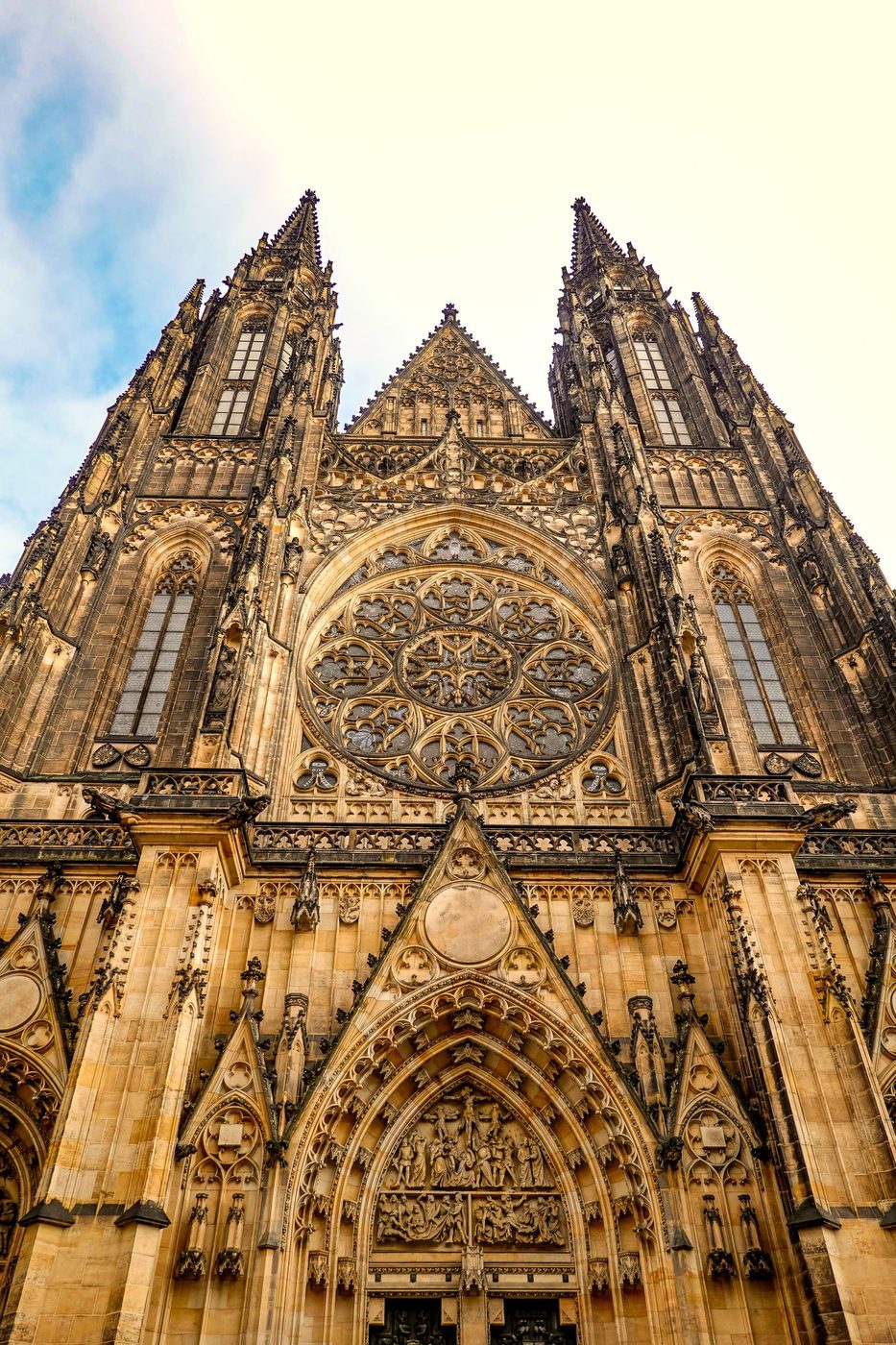
The nineteenth-century completion campaign did not simply finish an untouched medieval blueprint. Architects, historians and patrons had to decide how a national cathedral should be completed after centuries of interruption. The western parts and towers therefore belong to a historicist phase that sought continuity with Gothic language while also expressing the ambitions of a modern Czech society. The cathedral was formally completed in 1929, tied to the millennium of St Wenceslas’s death.
That chronology changes how the nave should be viewed. A visitor is not looking at one medieval building miraculously preserved whole. Medieval choir, chapels and structural ideas coexist with later completion and modern decorative programmes. The unity is intentional, but the dates differ.
The long construction period also explains why the stained glass varies so much. Some windows belong to modern artists and donors, including work associated with the Czech national revival and twentieth-century design. Their presence is not an intrusion into a “pure” Gothic church. It is evidence that the cathedral continued to be a national project long after the Middle Ages.
Sacred space, royal memory and state symbolism overlap here
St Vitus cannot be reduced to an architecture museum because its roles were never purely architectural. It is the metropolitan cathedral of Prague, a place of worship, the shrine of St Wenceslas, a burial place for rulers and church figures, and a building bound to Bohemian coronation tradition. Those functions overlap in ways that explain the density of chapels, tombs, relics and heraldic symbolism.
The St Wenceslas Chapel is the clearest concentration. It surrounds the tomb and cult of the patron saint whose political and religious meaning grew across centuries. Semi-precious stones and wall decoration create an interior visually distinct from the nave. The chapel’s relationship to the Crown Chamber above adds another layer: the Czech Crown Jewels are kept in a secured space associated with the chapel, but they are not normally on permanent public display. Visitors should be wary of itineraries implying otherwise.
Royal tombs make dynastic history physical. Charles IV and other rulers are remembered within the same church that served coronation ritual. The cathedral therefore connected sanctity and sovereignty instead of dividing them into separate modern categories.
For a respectful visit, this matters practically. Services and liturgical needs take priority over tourism. Voices, photography rules and access can differ from an ordinary museum. A person can study architecture closely while still behaving as a guest in an active church. The building’s continuing sacred use is part of its historical continuity, not an inconvenience around the visitor route.
A visual route through the interior
On entering, resist the instinct to walk directly toward the most famous chapel. Stay near the west end long enough to judge the nave’s height, pier rhythm and the way the vault draws the eye east. Then move slowly along one side aisle, using chapels as chronological interruptions instead of reading every chapel as an identical alcove.
At the transept and choir, compare the denser medieval fabric with the completed western portion. Find the triforium zone above eye level, where portrait sculpture links the cathedral to patrons, rulers and builders. Peter Parler’s workshop did not produce an anonymous abstraction; the church contains people embedded in its architectural programme.
The St Wenceslas Chapel deserves a separate stop because its surface treatment and devotional purpose differ from the rest of the church. Afterward, royal burial monuments and the eastern chapels can be read as a cluster of dynastic and sacred memory. On the way back, give the modern stained glass proper attention rather than dismissing anything younger than the Gothic fabric.
If climbing the Great South Tower, separate that experience from the interior mentally and physically. The tower is strenuous, weather-exposed and governed by its own hours. Its reward is topography: the Castle courts, roofs of Malá Strana, the Vltava and the wider city become a map of the political landscape the cathedral dominated.
The cathedral rewards one architectural comparison
Before leaving, compare St Vitus with one older church inside the Castle complex: St George’s Basilica. The distance between them is tiny, but the architectural world changes completely. Romanesque mass, thick walls and restrained openings at St George’s make the Gothic ambitions of St Vitus easier to see than a paragraph of terminology does.
Then compare St Vitus with the skyline outside the Castle. Its towers dominate Prague because the cathedral sits on an already elevated political ridge. Height and topography reinforce each other. The result goes beyond a large church: it is a landmark designed and completed within a landscape of power.
This comparison is especially useful for visitors who feel overwhelmed by dates. Instead of memorizing six centuries of construction, remember three contrasts: Romanesque versus Gothic, medieval fabric versus nineteenth- and twentieth-century completion, and sacred interior versus city skyline. Those contrasts preserve the essential history.
Sound changes how the interior is understood
A cathedral is an acoustic structure as well as a visual one. Long reverberation turns footsteps, speech, organ music and liturgy into part of the spatial experience. Quiet behaviour matters for the same acoustic reason: a small group speaking loudly can dominate a large volume for everyone nearby.
If a service, rehearsal or approved musical programme occurs during your visit, listen to how sound reveals the nave’s height and stone surfaces. Do not assume every concert advertised in central Prague has the same relationship to the building; programming and access vary.
The acoustic dimension also reminds visitors that St Vitus was designed for collective ritual, not for silent individual sightseeing. Architecture, liturgy, music and dynastic ceremony historically occupied the same space.
Frequently asked questions
Is St Vitus Cathedral inside Prague Castle?
Yes. It stands within the Prague Castle complex and is its dominant church. Castle security and visitor-circuit rules therefore affect how you reach and visit it.
How old is St Vitus Cathedral?
Work on the present Gothic cathedral began in 1344, but it occupies the site of a 10th-century rotunda and an 11th-century Romanesque basilica. Major completion work continued into the 20th century.
Is the whole cathedral medieval?
No. Important medieval sections survive, especially in the eastern part, but the building was completed in the 19th and 20th centuries and contains significant later monuments and stained glass.
Can I see the Czech Crown Jewels there?
Usually not. They are stored at St Vitus Cathedral and displayed only on special occasions; they are not part of normal daily sightseeing.
How long does a careful cathedral visit take?
Around 45–60 minutes gives most visitors time for a thoughtful interior visit. Add extra time for queues, the wider Castle circuit and the Great South Tower.
Is the tower included with the cathedral?
The Great South Tower is normally treated as a separate ticketed attraction with its own opening hours. Check Prague Castle's current visitor information.
Sources & further reading
- Prague Castle — Cathedral of St Vitus — Prague Castle Administration / Office of the President of the Czech Republic
- Prague Castle — Opening Hours — Prague Castle Administration / Office of the President of the Czech Republic
- Prague City Tourism — Prague Castle Cathedral — Prague City Tourism
- UNESCO World Heritage Centre — Historic Centre of Prague — UNESCO World Heritage Centre
- Prague Castle — Visitor information — Prague Castle Administration / Office of the President of the Czech Republic