
Explore Prague
Prague History & Culture
A practical historical guide to Prague—from Charles IV and the Hussites to Rudolf II, Nazi occupation, 1968 and the Velvet Revolution—focused on what still shapes the city visitors see today.
Prague’s history is easiest to understand as a sequence of political and cultural layers that reused the same compact city: medieval imperial capital, Hussite centre, Habsburg and Rudolfine court, national metropolis, occupied city, communist capital and democratic civic stage. The streets still make those transitions visible.
Prague history in one usable idea
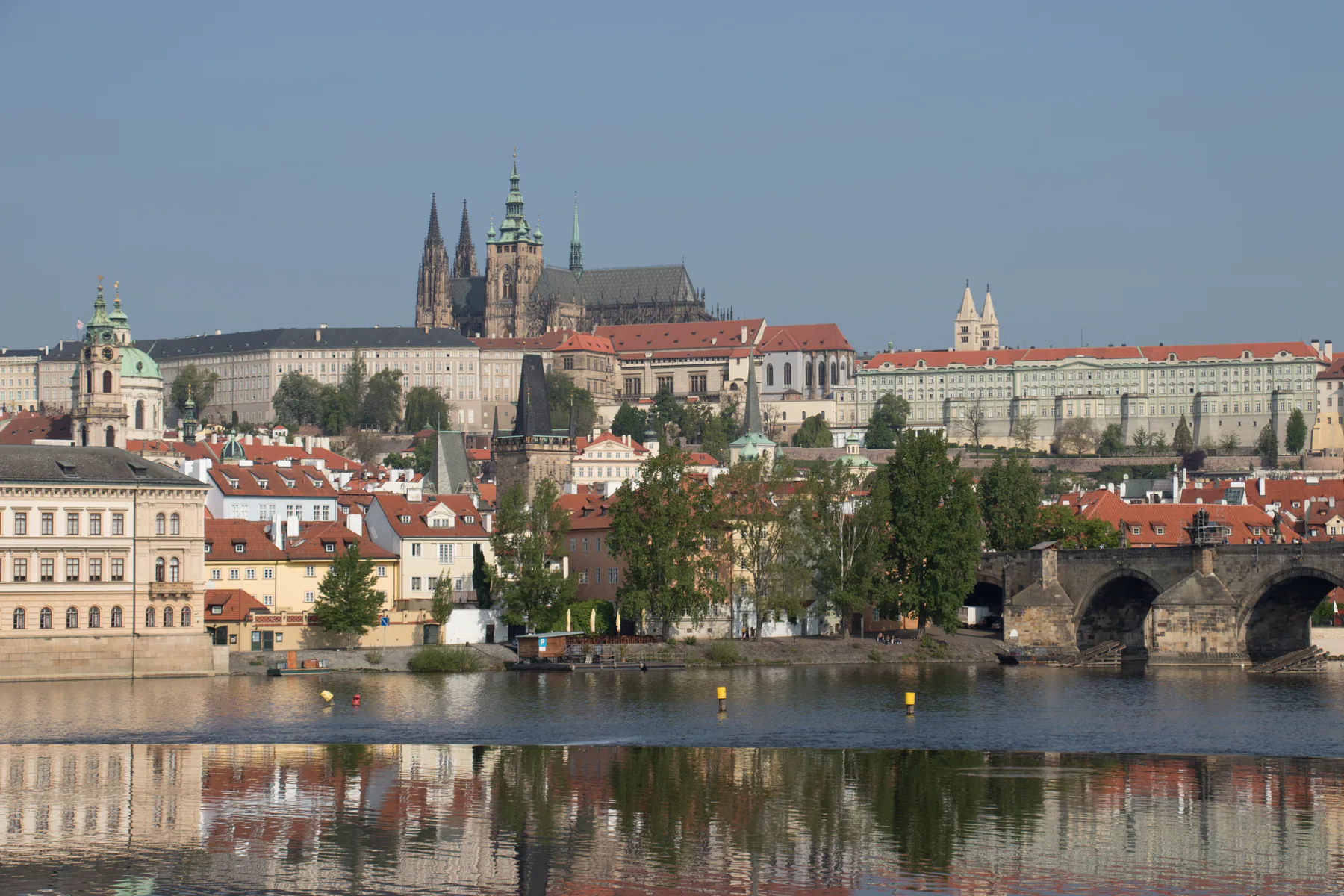
Prague makes more sense when you stop treating it as a collection of “old things” and start reading it as a city that repeatedly changed political language without erasing its earlier layers. The castle ridge, the Old Town, the medieval New Town, Baroque churches, nineteenth-century national institutions, interwar modernism, communist-era structures and post-1989 public space all coexist within a compact walkable core. That continuity is not accidental. UNESCO’s description of the historic centre emphasizes both the medieval urban plan and the unusually legible accumulation of later architecture. For a first-time visitor, this is the most useful historical lens: Prague is not a frozen medieval set, but a city in which successive regimes kept reusing the same streets, squares and symbolic buildings.
A workable timeline begins with the growth of settlement around Prague Castle and the river crossings, then accelerates under the Přemyslid and Luxembourg rulers. The fourteenth century under Charles IV gave Prague an imperial scale: the cathedral project, the stone bridge later known as Charles Bridge, the university and the planned New Town all belonged to a coordinated vision of a capital worthy of a Holy Roman Emperor. The fifteenth century then turned Prague into one of Europe’s great centres of religious conflict. Jan Hus’s reform preaching and the Hussite movement changed the city’s political geography as well as its memory. In the sixteenth and early seventeenth centuries Rudolf II again made Prague an imperial court, drawing artists, collectors and scientists.
The later Habsburg city is often compressed into a vague “Baroque Prague,” but the period matters because it changed both skyline and institutions. After the upheavals of 1618–1620 and the Thirty Years’ War, Catholic renewal and aristocratic building reshaped the city with churches, palaces and gardens. In the nineteenth century, Prague became an arena of Czech and German cultural competition inside the Habsburg monarchy. National museums, theatres, monuments and civic architecture were not simply decorative projects; they were statements about language, historical ownership and political identity.
The twentieth century repeatedly forced Prague to redefine itself: capital of independent Czechoslovakia after 1918, occupied city under Nazi rule after 1939, communist capital after 1948, the symbolic centre of reform in 1968, and the main stage of the Velvet Revolution in 1989. The result is a historical city where different eras are often only a few minutes apart on foot. That is why the best way to learn Prague’s history is not to memorize rulers. It is to understand what each era tried to build, preserve, suppress or reinterpret—and then notice where those choices remain visible.
Charles IV: when Prague was designed as an imperial capital
Charles IV is the hinge between “medieval Prague” as a general idea and the Prague that visitors can still read on the map. In 1348 he founded the New Town, dramatically expanding the urban area beyond the older settlements. This was not uncontrolled suburban growth. The wide market squares, major roads, churches and gates formed a deliberate extension of the capital. UNESCO explicitly identifies the New Town as an exceptional expression of medieval urbanism. The important point is scale: Charles was not merely adding monuments; he was making the city function as an imperial centre.
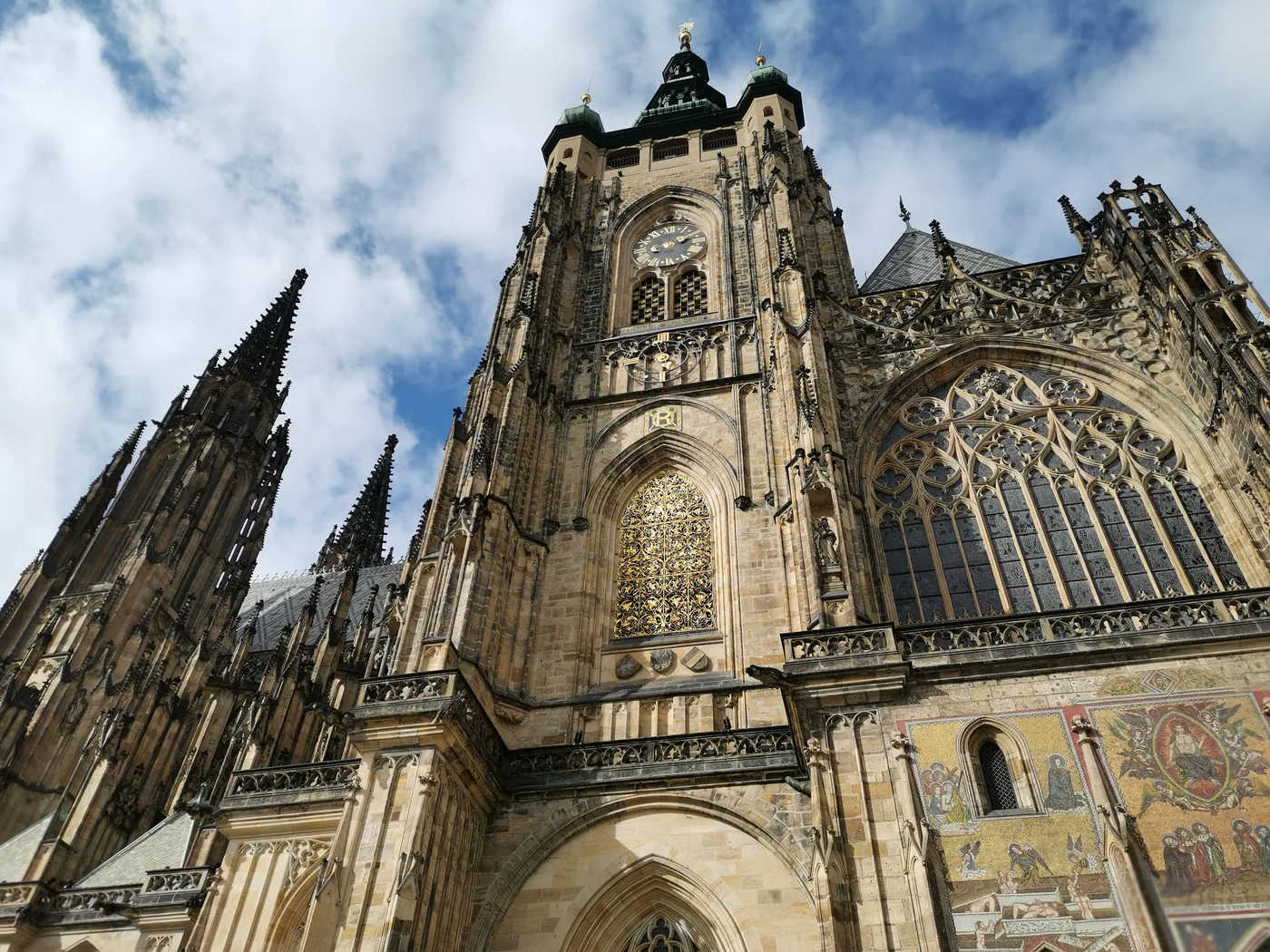
The castle complex was transformed at the same time. St Vitus Cathedral was begun in 1344, and Prague Castle became an imperial residence under Charles. Across the river, the new stone bridge started in 1357 after the earlier Judith Bridge had been damaged by flood. Charles University, founded in 1348, gave the city an institutional role that lasted beyond the emperor’s lifetime. Taken together, these projects created a network: court and cathedral on the hill, bridge and royal route across the river, university and markets in the urban core, and a new district large enough for future growth.
For visitors, the most revealing Charles IV site is not necessarily the most spectacular one. Charles Square, originally planned as a huge market in the New Town, makes the emperor’s urban ambition easier to grasp than a single royal portrait. The square’s modern park softens its medieval function, but its dimensions still show what the plan demanded. The same is true of the New Town’s long streets and the relationship between its great squares. The medieval city was designed for processions, markets, institutions and power.
This also explains why Prague’s “medieval atmosphere” can be misleading. Many facades seen today are Baroque, nineteenth-century or later; some medieval buildings were heavily reconstructed. The historical continuity lies as much in street pattern, parcel structure and institutional location as in untouched masonry. Charles IV’s Prague survives partly as a framework that later generations kept inhabiting and rebuilding.
Hus, Žižka and the Hussite city
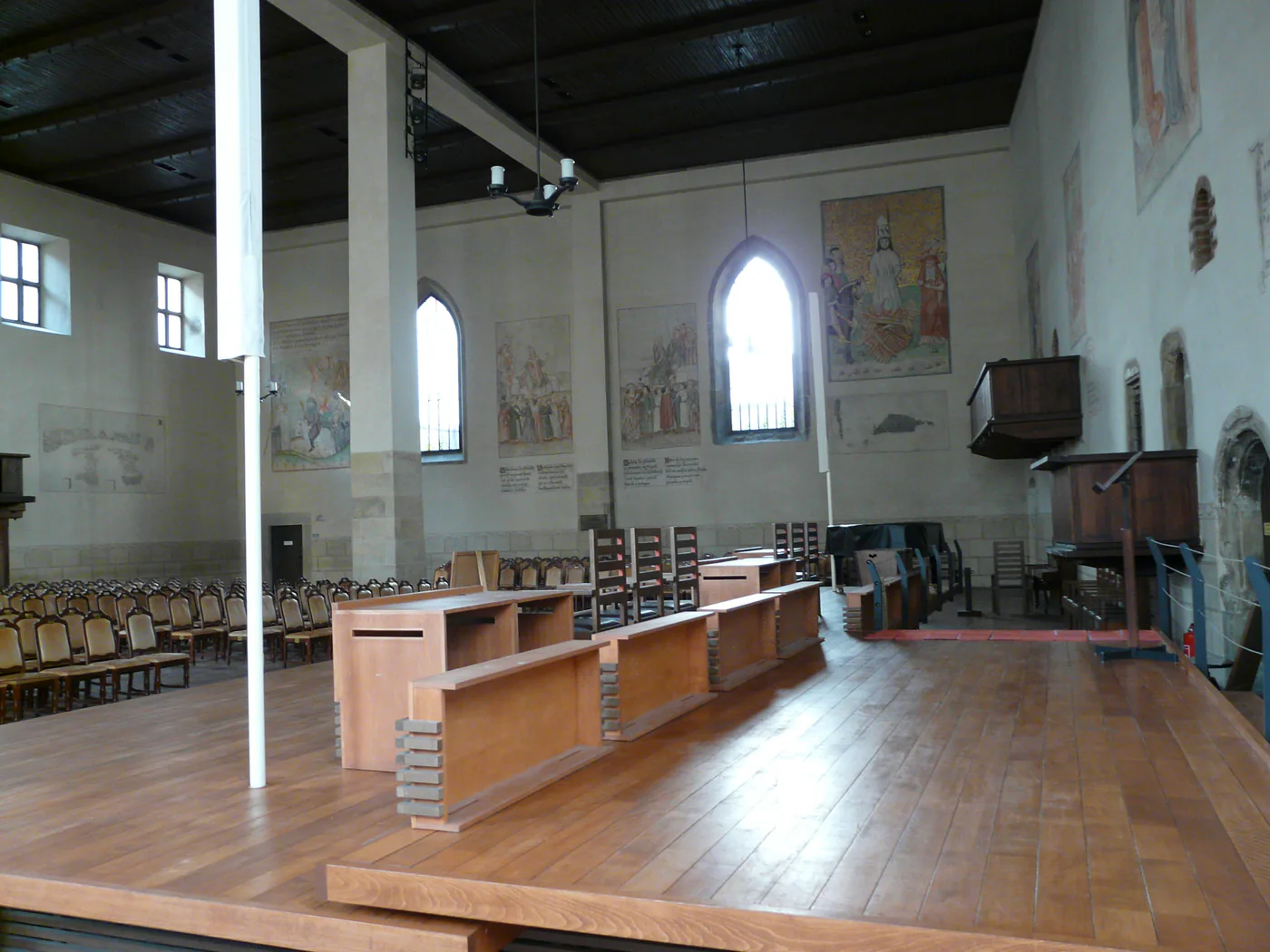
A century after Charles IV’s imperial project, Prague became the centre of a reform crisis that was religious, social and political at once. Jan Hus preached at Bethlehem Chapel from 1402 to 1413, using Czech in a space founded for Czech sermons. His criticism of church abuses drew on a wider reform environment and eventually brought him into conflict with ecclesiastical authority. Hus was executed at the Council of Constance in 1415. His death did not end the movement; it intensified it and turned his memory into a powerful political symbol.
Prague’s Hussite history should not be reduced to “people throwing officials out of windows,” even though the first Prague defenestration of 1419 is an important milestone. The conflict involved competing ideas of church authority, communion, kingship and civic power. Prague itself was not ideologically uniform. Different urban communities, preachers and factions competed, and alliances changed. The Hussite wars that followed Hus’s death were therefore more complicated than a simple Czech-versus-foreign narrative.
Jan Žižka’s victory on Vítkov Hill in July 1420 became one of the movement’s defining military episodes. A crusading army trying to pressure Hussite Prague was repelled by forces led by Žižka. The modern National Memorial on Vítkov is a twentieth-century structure, not a medieval battlefield reconstruction, but the hill’s topography helps explain why control of the approaches to Prague mattered. Looking back toward the historic centre from Vítkov makes the strategic geography more intelligible than reading the battle as an isolated heroic anecdote.
Bethlehem Chapel requires a similar distinction between historical event and later memory. The medieval chapel where Hus preached was largely demolished in the eighteenth century; the present structure was rebuilt in the 1950s using surviving fragments and historical evidence. It is therefore both a place connected to Hus and a modern reconstruction shaped by later politics. That dual status is typical of Prague: a genuine historical association may survive through a building that has itself been reinterpreted.
Rudolf II: court culture, collecting and science
Around 1600 Prague again became an imperial centre, this time under Rudolf II. His court is remembered for art collecting, astronomy, alchemy and an atmosphere that later legend has made even stranger. The reliable core is impressive enough without embellishment. Rudolf settled at Prague Castle and expanded spaces for artistic and scientific collections. The Castle Administration and Prague City Tourism both describe the northern palace wing, halls and collection rooms built or adapted during his reign.
Rudolf’s Prague drew figures such as Tycho Brahe and Johannes Kepler. This did not make the city a modern research university in the contemporary sense; court science depended heavily on patronage, astrology, astronomy, instrument-making and the ruler’s interests. Yet Kepler’s work in Prague was genuinely consequential. His use of Tycho’s observations contributed to the planetary laws that transformed astronomy. The court also gathered paintings, naturalia, crafted objects and curiosities on a scale that made collecting itself part of imperial representation.
The popular image of Rudolf’s Prague often slides from documented history into legend, especially around alchemists, secret laboratories and the Golem. Visitors should keep three levels separate. First, Rudolf’s court really did attract learned and artistic specialists and maintain extensive collections. Second, alchemy was a serious early modern practice intertwined with metallurgy, medicine and natural philosophy, not simply theatrical “magic.” Third, many specific tourist stories—hidden tunnels, royal sorcerers in every lane, direct links between particular houses and famous experiments—are late traditions or commercial storytelling unless independently documented.
The best way to experience Rudolfine Prague is therefore comparative. At Prague Castle, think about the palace as a working court and collection machine. Around Hradčany and the Lesser Town, look for the residences and institutions that served elite life. Then connect the court to the city’s longer intellectual history: medieval university, early modern astronomy, nineteenth-century museums and twentieth-century science. Rudolf II is one chapter in Prague’s recurring ability to concentrate knowledge and display power in the same urban spaces.
The nineteenth century: language, nation and the modern city
Prague’s nineteenth century is essential because many buildings that visitors instinctively read as “historic Prague” are products of a modernizing metropolis. The city was industrializing, expanding beyond old walls and integrating new transport and infrastructure while Czech- and German-speaking institutions competed for cultural authority. The result was not a neat national split. Prague was linguistically and socially mixed, and individuals could move through overlapping worlds of administration, education, publishing, business and the arts. But language increasingly mattered in politics and public life.
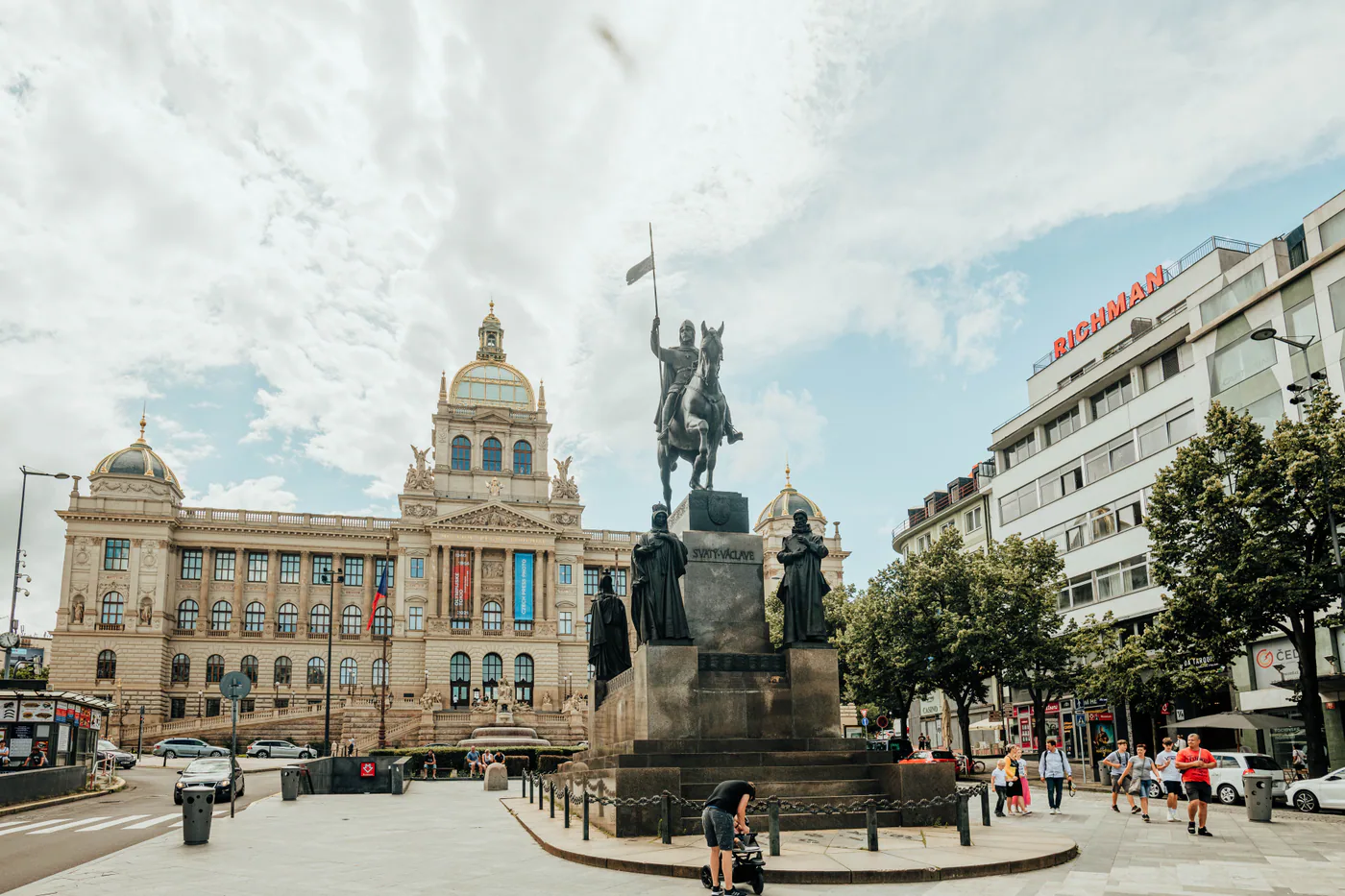
The Czech National Revival turned culture into infrastructure. Museums, learned societies, newspapers, theatres and public monuments were tools for building a modern national community. The National Museum and National Theatre are the obvious monuments, but the deeper change was institutional: Czech-language science, drama, music and publishing gained durable platforms. Their locations in the city were symbolic. Wenceslas Square and the riverfront became stages on which a modern Czech public represented itself.
At the same time, urban modernization altered the medieval city. Josefov, the former Jewish Town, was largely demolished and rebuilt around the turn of the twentieth century during sanitation works. Broad new streets and apartment blocks replaced a dense older fabric, while key synagogues and the Old Jewish Cemetery survived. This is an important warning against romanticizing “preserved Prague.” Preservation and demolition happened together. The city protected some monuments while radically reshaping entire neighbourhoods.
By 1918, Prague was ready to become the capital of the new Czechoslovak Republic because the nineteenth century had already supplied many of the institutions a capital needs: universities, theatres, museums, civic administration, industry and a dense public sphere. Independence changed their political meaning, but not their urban foundations. When visitors move from the neo-Renaissance National Theatre to Art Nouveau Municipal House and then to interwar functionalism, they are walking through the transition from imperial provincial capital to national metropolis.
Occupation and resistance: Prague in World War II
Prague’s Second World War history is inseparable from the destruction of Czechoslovakia. Nazi Germany occupied the Czech lands in March 1939 and established the Protectorate of Bohemia and Moravia. Repression included arrests, executions, forced labour, the closure of Czech universities after the student protests of 1939, racial persecution and the deportation and murder of Jewish residents. The city’s intact architecture can obscure the violence of occupation because Prague was not physically destroyed on the scale of Warsaw or Dresden. The absence of ruins does not mean the occupation was mild.
Operation Anthropoid provides one of the clearest ways to connect the international war to a precise Prague landscape. Czechoslovak parachutists trained in Britain attacked acting Reich Protector Reinhard Heydrich in Prague on 27 May 1942. After Heydrich died from his wounds, Nazi reprisals escalated brutally. The attackers and other parachutists were eventually betrayed and traced to the Orthodox Church of Saints Cyril and Methodius, where seven men fought German forces on 18 June 1942. The crypt survives as an authentic site of that final battle and is now a national memorial administered by the Military History Institute.
The moral and historical frame matters. Anthropoid was not a cinematic episode detached from civilian consequences. Reprisals included mass arrests and executions and the annihilation of Lidice and Ležáky. At the same time, the operation demonstrated the existence and reach of Czechoslovak resistance and had international political effects. A serious visit should therefore avoid turning the crypt into a “secret bunker attraction.” The physical damage, memorials and exhibition are evidence of a resistance network that depended on soldiers, church figures and civilians who accepted extraordinary risk.
Elsewhere in Prague, wartime memory is more dispersed: plaques on houses, Stolpersteine, synagogues and deportation sites, the former Petschek Palace associated with Gestapo interrogation, and monuments to the Prague Uprising of May 1945. Taken together they correct a common tourist bias. Prague’s historic centre may look continuous, but the communities that inhabited it were violently transformed by occupation, genocide, expulsion and postwar political change.
Communism, 1968 and the city as a political stage
The communist takeover of February 1948 changed Prague’s institutions, economy and public culture. Private property was nationalized on a large scale, political opposition was suppressed, show trials and imprisonment targeted real and perceived opponents, and public space filled with the imagery and rituals of the new regime. Yet Prague did not become architecturally uniform. Historic districts remained, new housing estates expanded on the edges, transport infrastructure changed, and modern buildings were inserted into older areas. To understand communist Prague, look for systems as well as monuments: housing, metro construction, department stores, broadcasting, censorship and ceremonial space.
The Prague Spring of 1968 was an attempt to reform the socialist system rather than simply abolish it. Under Alexander Dubček, censorship was relaxed and public debate widened. The reform experiment was crushed by the Soviet-led Warsaw Pact invasion during the night of 20–21 August 1968. Czechoslovak Radio’s building on Vinohradská became a focal point because control of broadcasting mattered immediately. Citizens gathered there, Soviet forces moved to seize the station, people were killed, and broadcasts continued from improvised locations after the main building was occupied.
The years after the invasion are described as “normalization,” a deliberately bland term for political reversal, purges, censorship and pressure toward public conformity. For visitors, one danger is to treat this era as retro design—old trams, socialist typography, concrete interiors. Those material remains are valuable, but they should be read alongside the costs of political exclusion and surveillance. The Lennon Wall, for example, became associated in the 1980s with unofficial expression and clashes over who controlled public messages, but it is only one fragment of a much wider dissident and cultural landscape.
Prague’s political geography in this period often reused earlier symbolic places. Wenceslas Square, universities, theatres and radio buildings mattered because people already understood them as civic stages. That continuity becomes crucial in 1989, when a student march, theatres, mass gatherings and public squares once again turned urban space into a mechanism for political change.
1989 and the Velvet Revolution
On 17 November 1989 a student commemoration in Prague developed into an anti-regime demonstration and was violently dispersed by police on Národní Street. The crackdown triggered public outrage. In the following days students went on strike, theatres became organizing and information centres, Civic Forum emerged, and enormous demonstrations filled Wenceslas Square and Letná. By the end of the year the communist monopoly on political power had collapsed and Václav Havel had become president of Czechoslovakia.
The adjective “velvet” can make the revolution sound inevitable or frictionless. It was neither. The outcome was comparatively non-violent, but it depended on rapid mobilization, negotiation and the regime’s loss of legitimacy in a wider Central European collapse of communist governments. The fall of the Berlin Wall eight days before 17 November was part of that context, as were earlier developments in Poland, Hungary and East Germany. Prague was a central stage, not an isolated miracle.
For a visitor, the most useful 1989 route is short. Begin on Národní Street, where memorial plaques and the passage associated with the police intervention anchor the first night. Continue to Wenceslas Square, where mass demonstrations made the scale of public support visible, and then consider Letná, where even larger gatherings took place. The route is not about ticking off statues; it shows how movement through ordinary streets can become political choreography.
After 1989 Prague changed quickly through restitution, privatization, tourism, new media, foreign investment and integration into European institutions. That transformation produced gains and controversies of its own, including pressure on housing and the historic centre. The Velvet Revolution is therefore best understood not as the final page of Prague’s history but as the opening of the city’s current chapter.
Cultural heritage: more than monuments
Prague’s heritage is unusually visible in stone, but Czech cultural heritage is not limited to architecture. Music, theatre, literature, craft traditions, foodways, language and forms of performance all help explain why the city’s historical buildings still matter. A theatre is not only a façade; it belongs to traditions of repertory, political speech and public gathering. A pub can be part of literary history without becoming a shrine. A market tradition can survive even when the stalls, products and regulations change.
Puppetry is a useful example because UNESCO inscribed puppetry in Czechia and Slovakia on the Representative List of the Intangible Cultural Heritage of Humanity in 2016. The significance lies in a living practice passed through professional and amateur performance, family traditions and community education—not in claiming that every marionette shop in central Prague is “ancient.” The distinction protects the real tradition from tourist packaging.
The same discipline helps with legends. Prague has a rich folklore ecosystem: Golem stories, ghost tales, prophecies, miraculous images, alchemical myths and legends around historical figures. These stories are culturally valuable even when they are not factual records. A good historical guide labels them honestly: documented event, later tradition, literary invention or modern tourist adaptation. Doing so does not drain the city of mystery; it shows how Prague has continually rewritten itself.
For a first visit, the strongest historical itinerary is therefore layered rather than exhaustive. Spend one block of time in the castle and Lesser Town for dynastic and court history; one in Old Town and the New Town for medieval urbanism, reform and civic life; one with a twentieth-century focus such as the Anthropoid memorial, Vinohradská radio area or Národní Street; and one cultural stop—a museum, concert, theatre or craft tradition—that shows heritage as something practiced rather than merely preserved. That balance makes the city’s chronology legible without reducing Prague to a giant outdoor museum.
How to read history while walking Prague
The most productive historical walk is organized by questions rather than centuries. At Prague Castle ask who needed the complex to represent power, and what each dynasty added. On Charles Bridge ask how a transport crossing became a ceremonial and symbolic object. In Old Town Square compare commercial, religious and political uses of the same space. In the New Town look at scale: the medieval plan is often easier to understand through street width and square dimensions than through individual façades.
Then choose one site where memory and authenticity diverge. Bethlehem Chapel is historically tied to Hus, yet the present building is largely a twentieth-century reconstruction. The Anthropoid crypt, by contrast, is an authentic battle location with surviving evidence of 1942. Vítkov combines a medieval battlefield landscape with a twentieth-century monument. These differences matter because Prague tourism often uses the word “historic” as if it meant one thing. It can mean original fabric, continuous site, faithful reconstruction, later memorial or simply association.
Finally, leave room for the living city. The historic centre is protected, but Prague’s culture is not confined to it. Žižkov, Holešovice, Libeň, Dejvice, Vinohrady and other districts reveal industrial, modernist, socialist and contemporary layers that the postcard core cannot. A visitor who sees only Gothic towers and Baroque domes misses how Prague became a modern capital—and why its historical identity is still argued over rather than merely displayed.
A compact timeline for first-time visitors
Use Prague's chronology as a set of turning points rather than a list of rulers. The medieval city expands decisively under Charles IV in the fourteenth century; reform preaching around Jan Hus helps open the Hussite crisis in the early fifteenth; Habsburg rule and Rudolf II's court bring a different imperial culture around 1600; nineteenth-century national institutions reshape the meaning of language, history and public monuments; Nazi occupation and the Heydrich assassination place resistance and repression into the modern street map; communist rule, the 1968 invasion and normalization add another political layer; and 1989 turns central squares and theatres into stages of democratic transition. Each period left material traces, but none erased everything before it.
That sequence is useful because it prevents the centre from collapsing into a single label such as “medieval Prague.” A Gothic church may stand beside a Baroque façade, a nineteenth-century national institution and a memorial to twentieth-century violence. When dates feel overwhelming, identify the political question each layer answered: royal and imperial representation, religious reform, dynastic rule, national culture, occupation, one-party power or civic protest. Prague's visual density becomes easier to read once those questions are attached to places.
Sources & further reading
- Historic Centre of Prague — UNESCO World Heritage Centre
- Prague Castle — Prague City Tourism
- Bethlehem Chapel — Prague City Tourism
- National Memorial on Vítkov Hill — Prague City Tourism
- National Memorial to the Heroes of the Heydrich Terror — Military History Institute Prague
- The Prague Spring — Radio Prague International / Czech Radio
- 1989: the Velvet Revolution in context (or how ‘November’ began in ‘January’) — Radio Prague International
- Puppetry in Slovakia and Czechia — UNESCO Intangible Cultural Heritage
- History of Prague Castle — Prague Castle Administration