
Explore Prague
Prague Astronomical Clock
At the top of the hour, hundreds of people look upward and wait for small windows to open. Less than a minute later, many leave without looking at the instrument that made the building famous. The Orloj is more interesting in the twenty minutes between performances. Its dial is a machine for representing time, daylight, celestial movement and medieval cosmology on one façade.
The Prague Astronomical Clock is not mainly a clock show. Its oldest core dates to 1410 and the astronomical dial is a working medieval-style model of time and the sky. Watch the apostles once, then spend longer on the dial: it shows multiple time systems, the Sun and Moon, zodiac position and the relationship between horizon and sky.
What visitors actually see
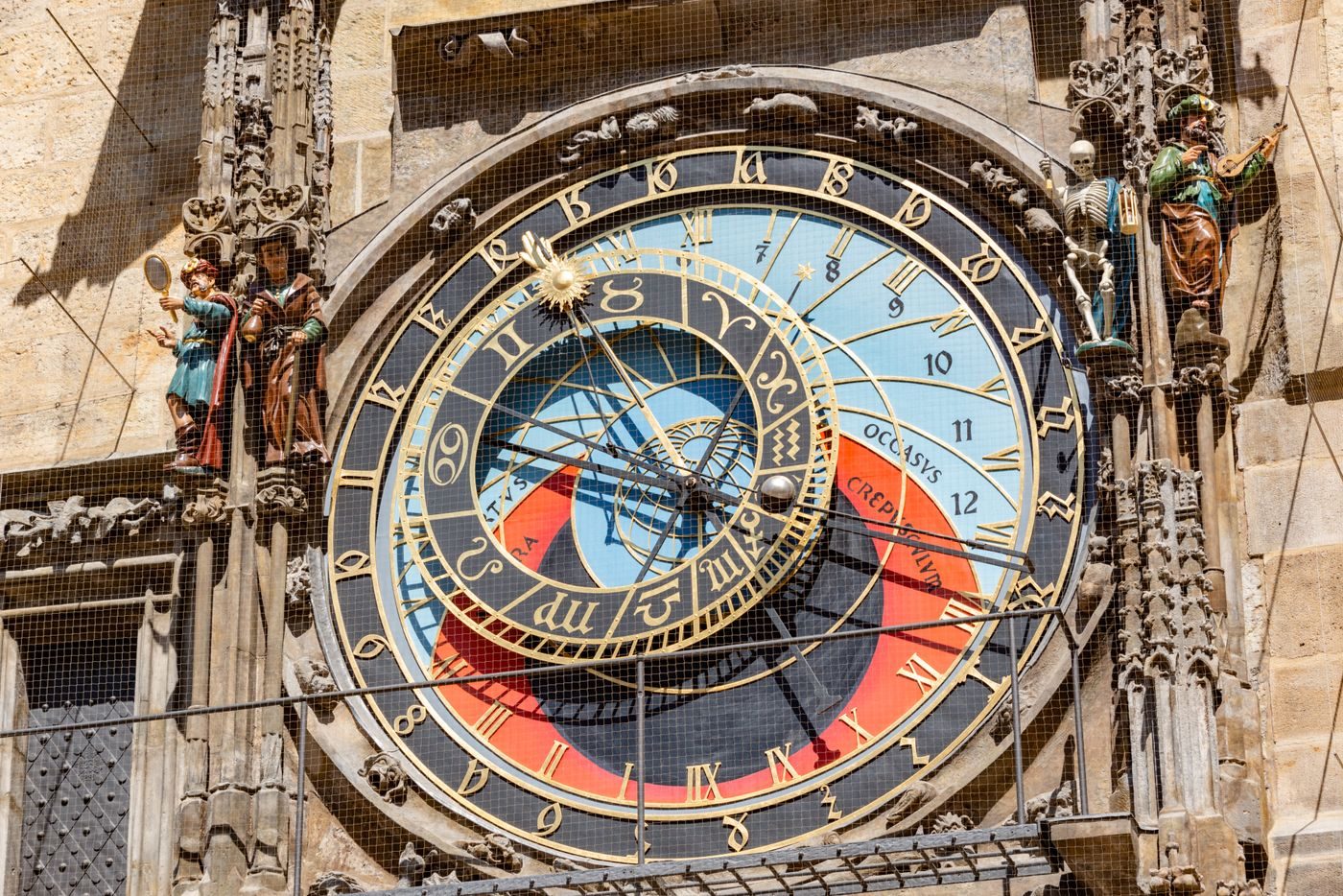
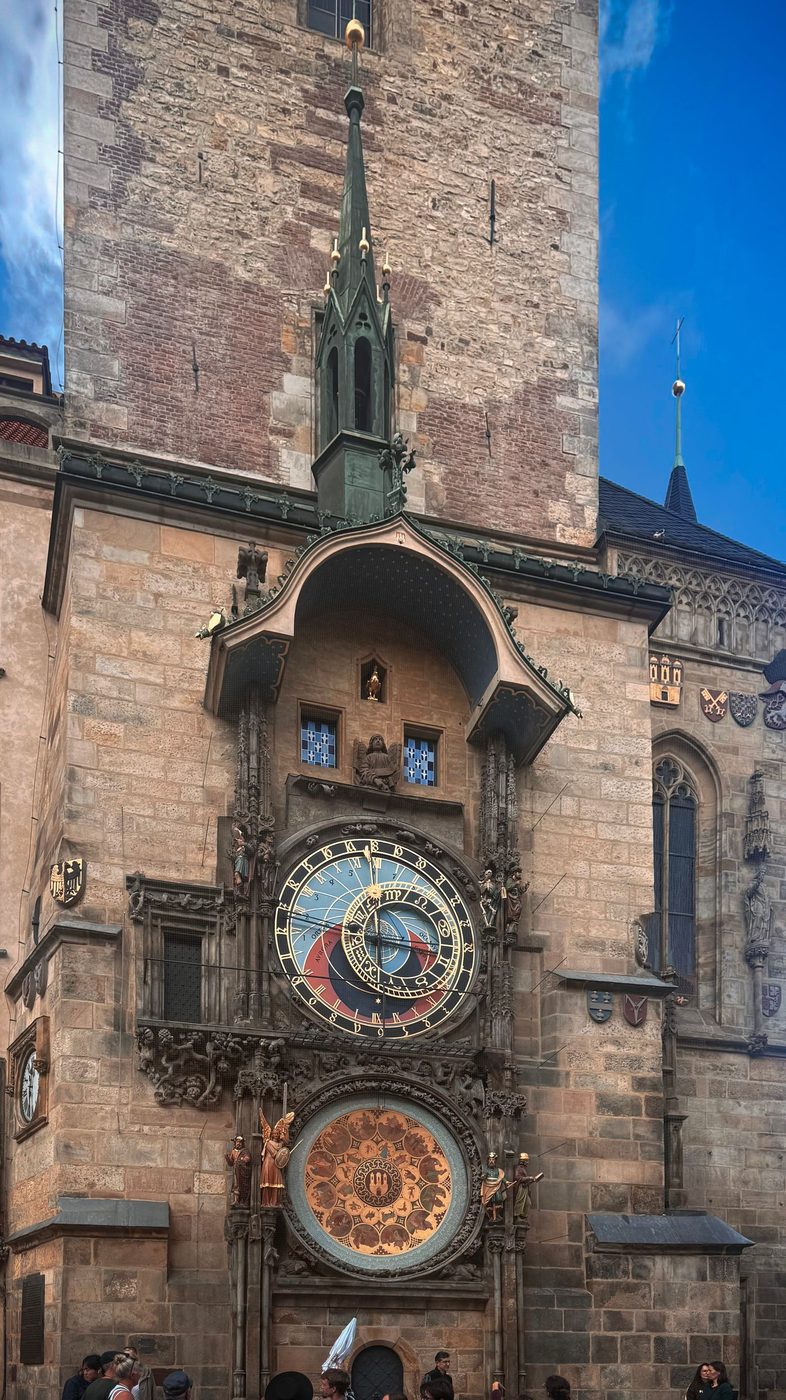
The Orloj is mounted on the south wall of Old Town Hall. Its main visible components are the astronomical dial, the calendar dial below it, the moving figures around the main dial and the upper windows used by the procession of apostles. A skeleton representing Death sets the hourly animation in motion; other allegorical figures stand beside the dial.
The current apostle display is a later addition to a much older instrument. The present city timetable runs the Apostle display once per hour, starting at 08:00 and finishing at 23:00. Their popularity can distort the history: the clock's significance comes from the astronomical mechanism begun in the early fifteenth century, not from a mechanical theatre preserved unchanged since 1410.
How the astronomical dial works
The central dial is an astrolabe-like representation. Earth sits symbolically at the centre of the visible scheme, consistent with the astronomical model used when the instrument was created. Colored fields distinguish day, twilight and night. The zodiac ring is offset because it represents the ecliptic — the apparent path of the Sun through the sky — rather than simply repeating the clock face.
A golden Sun moves around the dial and also shifts relative to the zodiac. A Moon indicator shows lunar position and phase. Different rings and numerals allow several systems of time to be read, including Central European time, old Czech or Italian-style hours counted from sunset, and unequal Babylonian hours that divide daylight into twelve parts and therefore change length through the year.
You do not have to decode all of this on the street. The useful insight is that the clock does several jobs at once. It is closer to a public astronomical computer built in gearing than to a decorative clock with an animated bonus.
The calendar dial
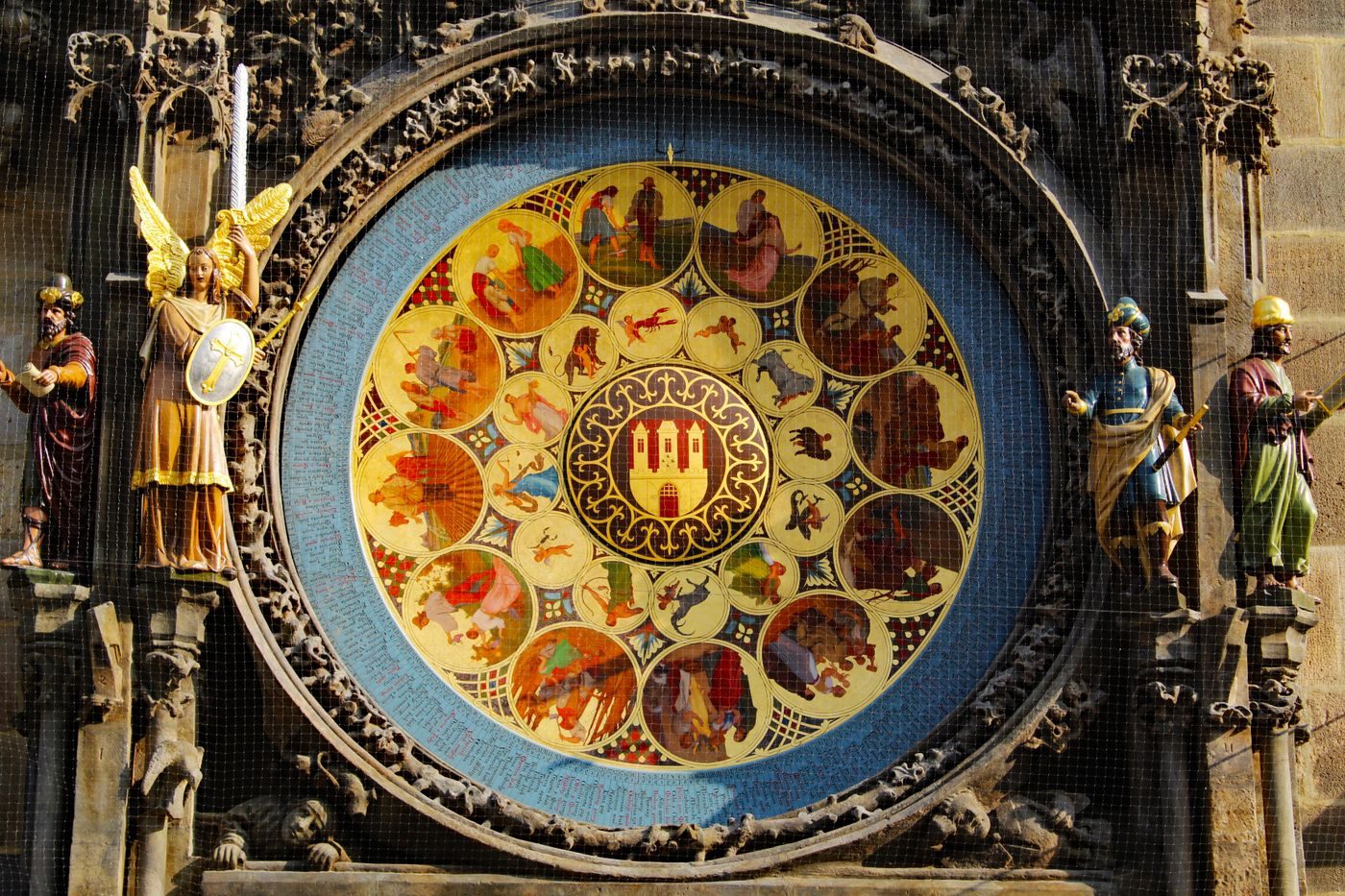
The lower calendar dial presents the year rather than the daily sky. Its current form is connected with nineteenth-century renewal and the painted calendar work of Josef Mánes; what visitors see on the exterior is not a fragile medieval painting left exposed to weather for six centuries. The medallions represent the months through seasonal rural activities, and the surrounding names and feast-day structure reflect the calendar tradition.
Here the Orloj also becomes a lesson in how restoration works. The mechanism has survived because parts were repaired, replaced, reconstructed and reinterpreted. Original is not a yes-or-no category for a working machine of this age.
Apostles and moving figures
The upper windows open for the procession of the twelve apostles. Around the astronomical dial, allegorical figures include Death, Vanity and Greed alongside imagery whose old labels reflect historical stereotypes. Modern interpretation should explain that period symbolism without casually repeating prejudicial labels as neutral present-day categories.
The skeleton rings a bell and turns an hourglass, while other figures move their heads. A rooster concludes the sequence. The mechanical theatre developed over time and was restored after severe damage to Old Town Hall in May 1945. The post-war reconstruction is part of the clock's history, not a footnote to hide.
Who built the clock?
The oldest documented astronomical mechanism dates to 1410 and is associated with clockmaker Mikuláš of Kadaň and astronomer Jan Šindel. This is the key fact for correcting one of Prague's most persistent legends. Master Hanuš, or Jan Růže, worked on the clock later in the fifteenth century, but he was not the original creator of the 1410 mechanism.
The confusion survived because a dramatic legend was easier to remember than archival history. In the story, Prague councillors blind Hanuš so he cannot build a rival clock elsewhere; he then takes revenge by disabling the Orloj. It is a powerful tale about civic pride, betrayal and genius — but not the documented origin story of the clock.
Six centuries of repair and rebuilding
A working mechanism exposed to weather cannot survive for six centuries without intervention. The Orloj was adjusted in different periods, stopped at times, repaired and modernized. The worst modern damage came in May 1945: fire during the Prague Uprising hit the Old Town Hall, damaged the mechanism and destroyed the building's eastern wing. Restoration returned the Orloj to operation.
More recent restoration has also generated debate about paint, copies and interpretation. That is normal for a complex machine-monument. The responsible description is continuity of function supported by repeated conservation, not an untouched object sealed in 1410.
Old Town Hall tower: the best second view
After watching the clock from the square, go up the Town Hall tower if time and mobility allow. From the tower, Old Town Square opens below; Týn Church, the Jan Hus Monument, Pařížská and the red-roofed blocks beyond become part of one readable plan. It also makes clear how the instrument is attached to a larger municipal complex.
The official visitor route operates on a seasonal timetable. The complex includes historical rooms and underground spaces as well as the tower. The lift makes this viewpoint more accessible than many Prague towers, though exact accessibility conditions should still be checked.
Where and when to stand
For the apostle performance, stand far enough from the wall to see both upper windows and the astronomical dial. Directly beneath the clock you lose the overall composition. Five to ten minutes before the hour is usually enough outside the busiest periods; at peak times the square can become dense much earlier.
For reading the dial, come back after the crowd leaves. Morning light, rain and seasonal markets can affect visibility more than the hour itself. If you are trying to understand the clock rather than simply film it, watch one cycle without a screen between you and the façade.
Read the astronomical dial from the outside inward
The Orloj looks difficult because several systems are drawn on the same surface. The simplest method is to stop trying to read everything simultaneously. Start with the fixed architectural frame and the large circular dial. Then identify the moving solar pointer, the zodiac ring and the coloured background. Only after those are clear should the additional time scales be added.
The central coloured fields are a model of the sky as understood through medieval astronomical conventions. Broadly, they distinguish areas associated with daylight, twilight and night. The Sun’s marker moves through that scheme while also indicating time on different scales. The zodiac ring represents the apparent path of the Sun against the background of the zodiac and is deliberately offset rather than centred like a modern clock face. That eccentric arrangement is part of the instrument’s astronomy, not a later decorative quirk.
The clock can display Central European time, older Bohemian or Italian-style hours counted with reference to sunset, unequal or Babylonian hours in which the length of an “hour” changes with the season, and sidereal information. Prague City Tourism notes that the Orloj is unusual in retaining the ability to show Babylonian time. Trying to decode all of these during the apostle performance is nearly impossible. Use the quiet minutes after the crowd disperses.
A practical sequence is to find the Sun first. Ask where it sits relative to the horizon zones. Then look at the golden hand and Roman numerals. Next inspect the outer ring with Gothic numerals used for the older time system. Finally examine the zodiac ring and its relationship to the Sun marker. Even without calculating an exact reading, the visitor begins to see the object as a working astronomical diagram rather than a decorated clock.
The key conceptual shift is that medieval timekeeping did not assume one universal display. Civic time, daylight, the Sun’s annual path and astronomical reference systems could coexist. The Orloj’s density is therefore the feature, not the flaw.
The calendar dial tells a different story from the astronomical one
Below the astronomical face sits a calendar dial whose function is easier to overlook because the upper mechanism dominates photographs. The calendar belongs to the rhythm of the year rather than the daily sky. Its imagery and inscriptions connect dates, months, zodiac signs and feast-day information to a visual programme that viewers could use in civic and religious life.
The dial seen today is not a untouched survival from 1410. The clock evolved repeatedly, and the calendar component has its own history of replacement and artistic redesign. Josef Mánes created the celebrated nineteenth-century calendar plate, and conservation has required originals or vulnerable elements to be protected while replicas take the weather outside. This is another reason “original” needs careful use at the Orloj. The mechanism, artistic surfaces and moving figures have different dates and restoration histories.
Stand close enough to separate the rings and scenes, then step back. From a distance the two dials form one vertical composition: astronomy above, annual calendar below, moving apostles in windows above them. The façade thus combines several kinds of time—daily, seasonal, sacred, civic and theatrical.
That layering also explains why the clock feels less like a modern instrument than a public knowledge system. A contemporary phone gives a precise number instantly. The Orloj externalizes relationships: day and night, Sun and zodiac, date and feast, civic building and public spectacle. Much of its value comes from the mental model required to interpret it.
For families or visitors without an interest in technical astronomy, the lower dial is often the easier entry point. Find the months, agricultural or seasonal scenes and zodiac signs first. Once the idea of cyclical time is visible there, the upper astronomical face becomes less intimidating.
1410 was a beginning, not the date of everything you see
The best-documented origin point is 1410, when clockmaker Mikuláš of Kadaň and astronomer Jan Šindel are associated with the astronomical mechanism. That date does not mean the entire present façade, apostle show, calendar artwork and decorative figures appeared as one finished invention. Over six centuries the clock was modified, repaired, damaged, threatened with removal and reconstructed.
Master Hanuš of Růže belongs to that later history. He worked on the clock in the late fifteenth century, but the popular legend that he was its original creator and was blinded by councillors so that he could not reproduce his masterpiece is not supported as the factual account of the Orloj’s invention. The persistence of the legend is historically interesting in its own right because it shows how easily a complex collaborative object becomes attached to one tragic genius.
Nineteenth-century restoration was another decisive moment. By then the mechanism’s condition had prompted serious concern, and the clock was repaired rather than abandoned. The calendar programme associated with Mánes dates from that era. The twentieth century brought catastrophic damage in May 1945, when armed clashes of the Prague Uprising set the Old Town Hall on fire; the clock required major post-war reconstruction.
Later restorations have generated their own debates about materials, appearance, replicas and conservation philosophy. That is normal for a public monument that is simultaneously a machine, artwork, architectural feature and national symbol. Mechanical accuracy cannot be the only goal, because replacing every old component with a new one would destroy historical evidence. Absolute material preservation cannot be the only goal either, because a stopped and inaccessible mechanism would change the nature of the monument.
The Orloj visitors see is therefore a continuity maintained through intervention. Its authenticity comes from the long-lived system and documented fabric across several periods, not from an impossible claim that every visible part has remained untouched since the fifteenth century.
Why the Master Hanuš story survived even after historians corrected it
The Hanuš legend is effective because it has the structure of a perfect cautionary tale: genius creates an unrivalled work, jealous authorities mutilate him, and the betrayed craftsman takes revenge by stopping the machine. It explains technical mystery through human motives. It also gives a visitor one name to remember instead of a chain of clockmakers, astronomers, councillors, repairers and restorers.
Czech literary retellings helped fix the story in popular memory. Once a legend enters guidebooks, school culture and oral tourism, correction does not erase it; the correction becomes a second story told beside the first. That is why responsible interpretation should not simply say “the Hanuš story is false” and move on. The more interesting distinction is between Hanuš as a real historical figure who later worked on the clock and Hanuš as the blinded sole inventor of legend.
This distinction is transferable to other Prague stories. The city contains real people around whom later narratives accumulated: Rabbi Loew and the Golem, Dalibor and the violin, Faust and a house he never occupied. Treating legend and fact as separate categories does not impoverish the visit. It reveals how Prague has remembered itself.
At the Orloj the evidence is unusually strong because the 1410 attribution to Mikuláš of Kadaň and Jan Šindel is well established in modern interpretation. Visitors can therefore enjoy the Hanuš tale as folklore without using it to overwrite the documented origin of the mechanism.
That approach also avoids a common tourism problem: repeating a dramatic story in a factual tone because it is more memorable than the archive. Prague has enough documented history to be compelling without making every legend do the work of evidence.
Use the tower to understand why the clock belongs here
The astronomical clock is attached to the Old Town Hall, and the building is not incidental. The Town Hall was the seat of Old Town’s municipal government from the fourteenth century. A sophisticated public clock on its tower façade expressed civic organization, technical knowledge and urban prestige. Seeing the Orloj as a free-standing attraction misses that institutional context.
Go inside if time allows. Historical rooms, the chapel and underground spaces show that the Town Hall is a group of buildings with medieval cores rather than one monumental shell. From the tower gallery, the square becomes a diagram. St Nicholas and Týn Church frame the square differently, while the street openings and Jan Hus Monument reveal how the open space is organised. The crowd beneath the clock, so dominant at street level, shrinks to one temporary use of a much older civic space.
The tower also helps explain the damage of 1945. The lost eastern wing left an absence beside the surviving tower. Old photographs and the present footprint make clear that the Town Hall complex was once more extensive. This wartime layer belongs to the Orloj’s story because fire and fighting damaged the clock itself.
For viewing the hourly show, step back until the windows and figures fit in view without losing the dials below. Immediately after the performance, move closer. The crowd often disperses within minutes, creating a better chance to read the astronomical face. If the tower is open and conditions suit, finish above rather than beginning there; the aerial view works best after the ground-level relationships are familiar.
The performance is brief. The building, mechanism and square are the actual visit.
A five-minute explanation to give a child or a non-specialist
Think of the Orloj as three things stacked together. At the top, windows open for the moving apostle figures. In the middle, the astronomical dial acts like a model of the sky, showing the Sun and several systems of time. At the bottom, the calendar dial tracks the year. The decorative figures around the faces add moral and religious imagery, and they serve a different purpose from the astronomical calculation.
When the hour approaches, watch the short performance once without trying to film every second. After it ends, step closer to the middle dial. Find the Sun symbol, then the horizon colours, then the zodiac ring. That is enough to understand why the clock is more than a mechanical parade.
This deliberately simple explanation is useful because the Orloj attracts two opposite mistakes. Some visitors expect a huge spectacle and are disappointed by a compact medieval mechanism. Others assume the science is so complicated that only a specialist can understand anything. Neither is necessary. The performance is modest because the machine is old; the astronomy is layered, but its basic idea—showing time through the motion of the sky—can be grasped by anyone willing to study it for a few minutes.
What the clock cannot tell you by itself
The Orloj is a brilliant primary object, but it cannot narrate its own restoration history, political context or legends. Plaques and façade details help, yet understanding why the Town Hall burned in 1945 or how the Hanuš story entered popular culture requires evidence outside the mechanism. This shows that “seeing the original” and “understanding the original” are different activities.
A short preparatory read before arrival can save time. Learn the names Mikuláš of Kadaň and Jan Šindel, understand that 1410 refers to the astronomical mechanism rather than every visible element, and know that the apostle show is only one layer. With those three facts in place, the façade becomes easier to decode independently.
After the visit, photographs can be used as a diagram. Zoom in on the rings and figures, compare them with an authoritative explanation and reconstruct what you missed in the crowd. Medieval technical objects reward a second look more than instant mastery.
The figures around the dial are moral theatre
Visitors tend to watch the apostles and ignore the stationary or moving figures flanking the astronomical face. These characters belong to a moral and symbolic programme rather than to the clock’s astronomical calculation. Vanity, greed or avarice, death and other personifications made the façade a lesson as well as an instrument.
Death, represented by a skeleton, is the easiest to recognize because it visibly participates in the hourly action. The surrounding figures have changed across restorations, so interpretation should distinguish present appearance from the earliest mechanism.
The useful point is not to memorize every label. It is to see that medieval and later viewers encountered time as moral, religious and civic order simultaneously. The clock counted hours, displayed the heavens and staged reminders about human conduct on the wall of a town hall.
Frequently asked questions
How old is the Prague Astronomical Clock?
Its oldest documented astronomical mechanism dates to 1410, making it one of the oldest astronomical clocks still operating.
Did Master Hanuš build it?
No. The original 1410 mechanism is associated with Mikuláš of Kadaň and Jan Šindel. Hanuš worked on the clock later; the blinding story is a legend.
What time do the apostles appear?
Current official visitor information gives the procession every hour between 8 a.m. and 11 p.m.
What does the clock show?
It combines several time systems with an astronomical display of the Sun, Moon, zodiac and the changing relation between daylight, twilight and night.
Is the Old Town Hall tower worth it?
It is worthwhile if you want a clear view over Old Town Square and the surrounding roofscape while placing the clock within the larger Town Hall complex.
Sources & further reading
- Prague City Tourism — About the Old Town Astronomical Clock — Prague City Tourism
- Prague City Tourism — Old Town Hall with Astronomical Clock — Prague City Tourism
- Prague City Tourism — Old Town Square — Prague City Tourism
- UNESCO World Heritage Centre — Historic Centre of Prague — UNESCO World Heritage Centre