
Merchant Prague
Ungelt Was a Merchants’ Court — So Why Did Its Famous Ghost Become ‘the Turk’?
Václav Cibula preserves the Turek z Ungeltu as one of the Old Town’s most firmly localized revenants. Different versions connect him with jealousy, violence and a young woman’s death, but the setting gives the legend its deeper meaning.
Ungelt / Týn Courtyard, Old Town

The Ungelt legend tells of a foreign merchant who fell in love with an innkeeper’s daughter, returned from Constantinople to find her promised to another man and murdered her in a jealous rage.
A revenant with a stable Old Town address
In the legend, a wealthy Turkish merchant arrived at Ungelt, Prague’s old merchant courtyard, and fell in love with the innkeeper’s beautiful daughter. They became engaged, but before the wedding he had to return to Constantinople. His journey lasted so long that the young woman eventually gave up hope of seeing him again and agreed to marry someone else.
The setting is more informative than the gore
The merchant returned just as she was preparing to marry. In the darkest version of the tale, jealousy drove him to kill her and hide her body. His punishment was to become a restless ghost of Ungelt, sometimes described wandering the courtyard in rich foreign clothes while carrying the severed head of the woman he loved. The precise details vary between retellings, but the tragic triangle — long absence, jealousy, murder and haunting — is the heart of the legend.
A name can preserve an old stereotype
The label ‘Turk’ should be handled as part of the historical folklore rather than as a neutral description of a documented person. Older European storytelling often compressed foreign identities into simplified types, and this Prague legend survives with that inherited label. A modern Story does not need to erase the term, because doing so would sever the tradition from its sources. It does need to explain what kind of evidence it represents: a name inside a legend, revealing how older Prague imagined an outsider, not a verified ethnic biography of a particular ghost.
The story keeps changing while the courtyard stays put
Violence, jealousy and the death of a girl remain part of the story complex, but different collections do not necessarily arrange those elements in exactly the same way. The courtyard, by contrast, is remarkably stable. The more a detail changes, the more cautiously it should be treated; the more consistently the geography survives, the more confidently Ungelt can serve as the fixed setting for successive variations of the same unresolved foreign revenant.
Read the enclosure as the real dramatic device
On site, the visitor can enter Týnský dvůr, notice its enclosed character, passages and houses, and understand why the location lends itself to a self-contained legend. The physical space gives the tradition atmosphere without any need to manufacture an apparition. Cibula supplies the folklore anchor; the courtyard supplies the material one. Together they show how a cosmopolitan trading place acquired a supernatural figure who personified distance, danger, jealousy and otherness in a form that Prague could remember.
Reviewed visuals
See the story
Supporting images selected in the Prague Stories visual review. Context images are labeled so they are not mistaken for documentary proof of the exact subject.
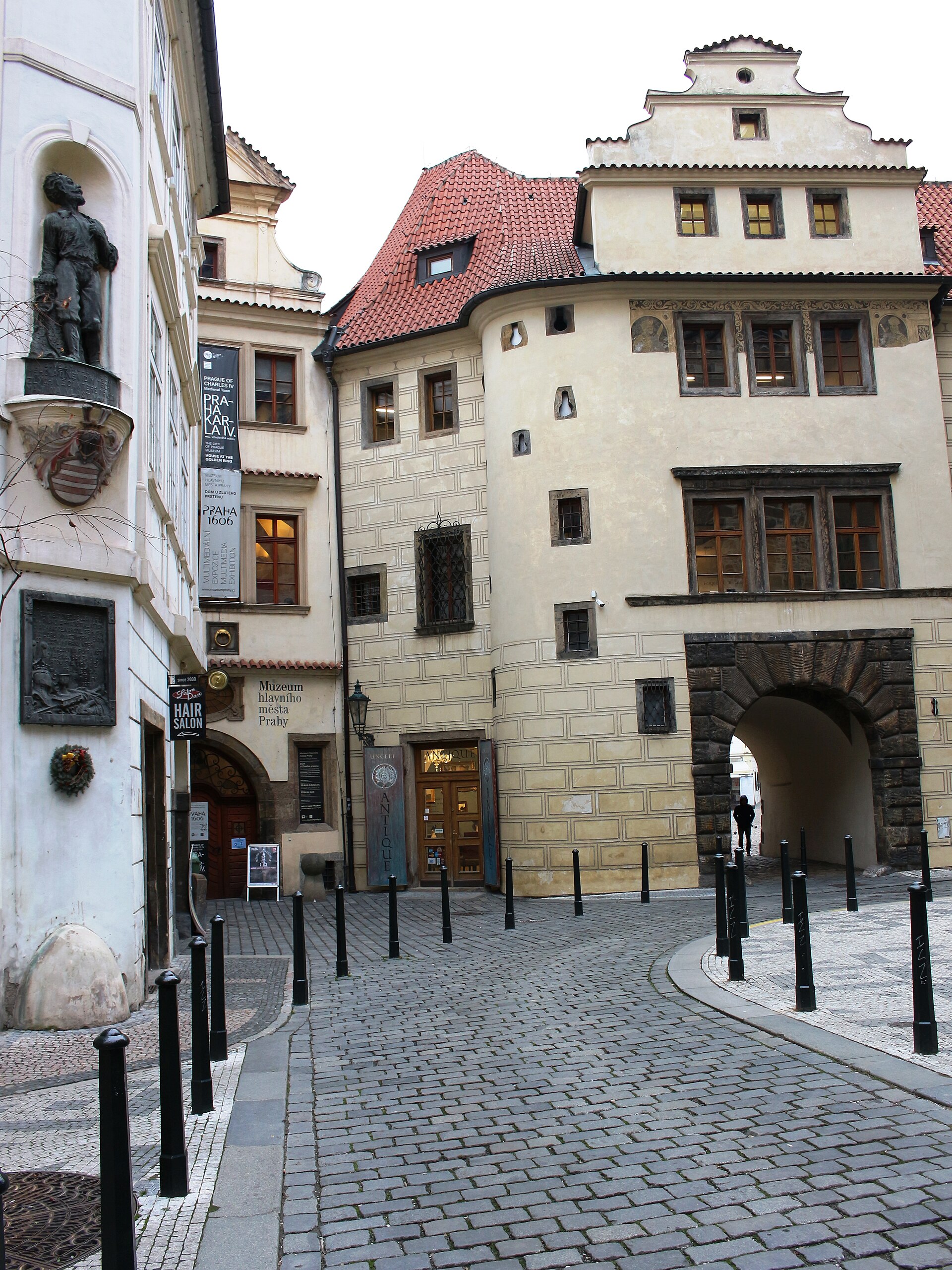
Walk into Týnský dvůr and notice how the enclosure creates a world distinct from the surrounding Old Town streets.
Quick facts
- Václav Cibula records O Turkovi z Ungeltu in Pražské pověsti.
- The revenant is stably associated with Ungelt / Týnský dvůr.
- Retellings connect him with violence, jealousy and the death of a young woman.
- The exact sequence of the story varies between collections.
- The foreign identity should be treated as part of the folklore tradition, not a verified biography.
- The merchant-courtyard setting is central to understanding why the figure belongs here.
Questions
Was the Turek z Ungeltu a real historical merchant?
The sources used here preserve a legendary figure, not a verified biography of a specific man.
Why do versions differ?
Urban legends are repeatedly retold. The core location survives more consistently than the precise arrangement of jealousy, violence and death.
Why is Ungelt so important to the story?
Because the setting gives the figure social meaning: a merchant courtyard is a natural place for older Prague to imagine distant outsiders.
Sources & further reading
- Pražské pověsti — O Turkovi z Ungeltu — Václav Cibula
- Pražské pověsti (1983) — bibliographic contents listing — Václav Cibula / Databáze knih