
Prague Stories · Practical
Prague Looks Walkable on a Map — Until the Cobbles and Hills Start
Central Prague is compact enough to reward walking, but a flat map hides the parts your feet notice first: polished cobbles, steep Castle-side streets, tram tracks and long climbs. For strollers and mobility-limited travelers, route choice matters more than raw distance.
Prague

Prague earns its reputation as a walking city honestly.
Compact does not mean effortless
Old Town, the river, Charles Bridge and much of New Town sit close enough together that walking often beats making a transport connection. The problem begins when “walkable” gets translated into “easy for everyone.” Historic paving is uneven. Cobbles can become slick in rain and tiring after hours underfoot. Kerbs, tram rails, construction diversions and crowded lanes add small obstacles that barely appear on a route planner. None of this makes Prague unwalkable. It means a distance measured in metres tells only half the story. For a traveler with good mobility, the practical answer may be as simple as supportive shoes and a willingness to slow down. With a wheelchair, walker, stroller, heavy suitcase or limited stamina, surface and gradient deserve the same attention as distance.
The river is your easiest geography lesson
Much of central Prague feels gentler close to the Vltava. The Old Town side is relatively forgiving compared with the climb toward Prague Castle and Hradčany. Cross Charles Bridge and the street pattern begins to rise through Malá Strana; choose a picturesque uphill lane and a short-looking route can become the hardest twenty minutes of the morning. Here, trams stop being a sightseeing novelty and become route design. They can remove a climb, shorten a long return or let you save your energy for the historic area you actually want to explore. Walking every metre of Prague earns no prize. A smart route uses elevation selectively.
Accessibility exists, but it is not uniform
Prague’s public-transport network has substantial step-free infrastructure, yet visitors should not assume every station entrance, platform or vehicle works the same way. The Prague Public Transit Company publishes current accessibility information for metro stations, lifts, platforms and tram services, including live information when equipment is unavailable. Low-floor trams operate across daytime lines, but the vehicle arriving at a particular moment and the design of the stop still matter. A stop may involve an island, a curb or boarding from the roadway. Metro stations that are classed as accessible can also differ in how lifts connect to the street. For that reason, accessibility planning is best done route by route. Check the exact station, exit and stop you intend to use.
A stroller has different problems from a wheelchair
Family advice often compresses both into the vague phrase “not stroller friendly.” That is not very useful. A stroller can usually be lifted over a few steps by two adults; a wheelchair user may need a genuinely step-free route. A lightweight buggy behaves differently on cobbles from a loaded travel system. Independent wheelchair users, people using powered chairs and travelers with reduced walking endurance can all face different barriers. So think in specific questions. Is the route step-free? Is the surface smooth enough? Is there a lift at the station you need? Can you board the tram from this stop? Does the final block climb sharply? Prague City Tourism and the transit authority publish accessibility resources, but no citywide label can answer those questions for every person.
Luggage turns small hills into bad decisions
The most preventable walking mistake often happens on arrival. A hotel may sit only 700 metres from a station, which sounds trivial until those metres include cobbles, a slope and two suitcases. If your accommodation is on the Castle side, in upper Žižkov or on another hill, mapping the actual route before arrival can save a miserable first impression. Use a tram, metro connection or taxi when luggage changes the equation. The same traveler who happily walks ten kilometres after checking in may reasonably refuse one kilometre with a rolling case. Wheels designed for an airport floor are not designed for every historic street.
Build the day downhill whenever you can
One of the simplest planning tricks is to spend transport on altitude. Ride toward the upper part of the Castle district, then walk down through Hradčany and Malá Strana. Starting at the river would make you climb the same ground in reverse. Use a tram to reset after a long riverside walk. Group sights on the same side of a hill before crossing town again. That strategy is not only for travelers with mobility concerns. It reduces fatigue for almost everyone, particularly in summer heat or winter conditions. Prague is compact, but it has texture. Once you plan for that texture instead of fighting it, walking becomes one of the city’s pleasures again.
Reviewed visuals
See the story
Supporting images selected in the Prague Stories visual review. Context images are labeled so they are not mistaken for documentary proof of the exact subject.
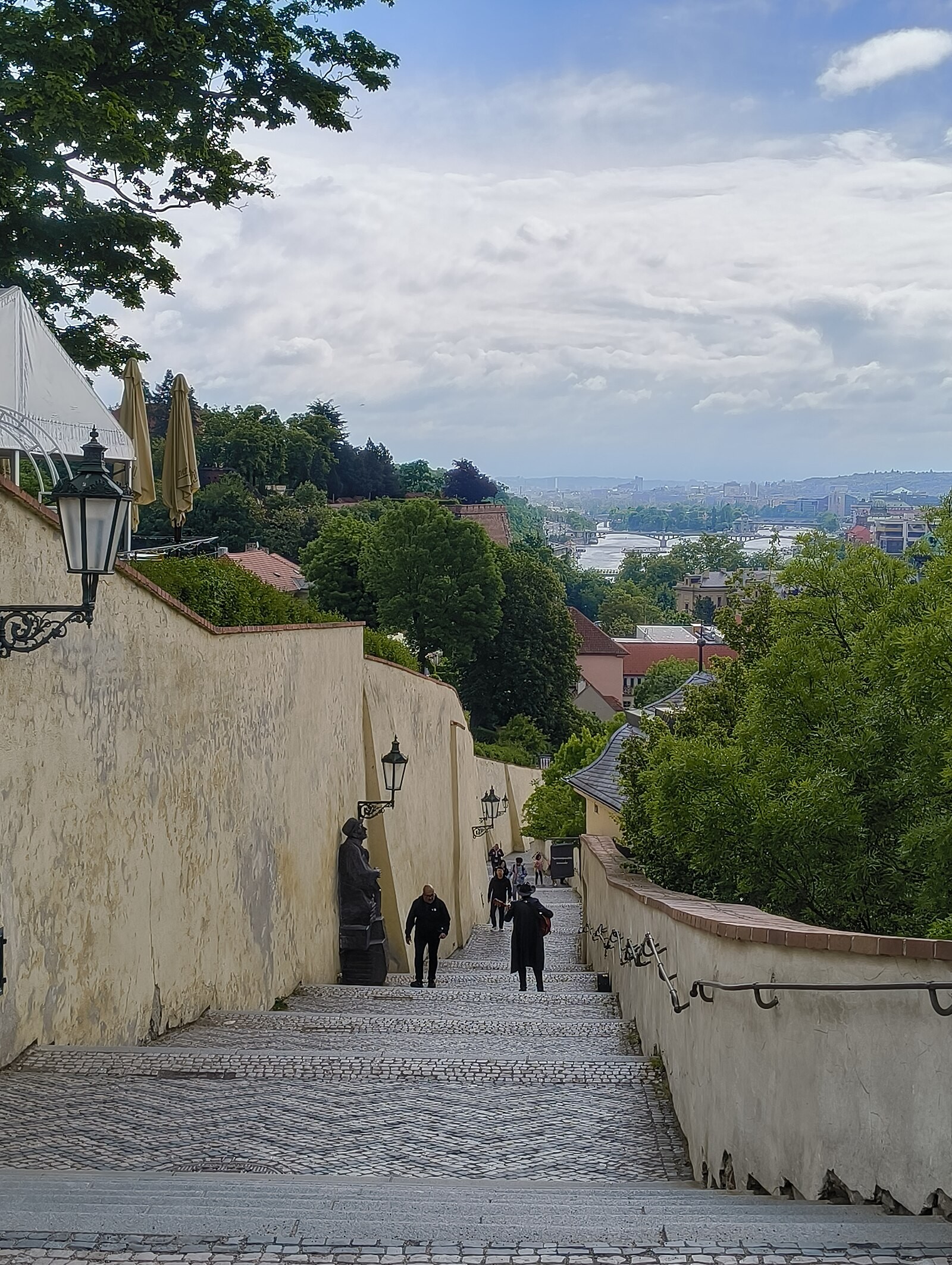
Steep Old Castle Stairs leading toward Prague Castle, clearly illustrating elevation and steps.
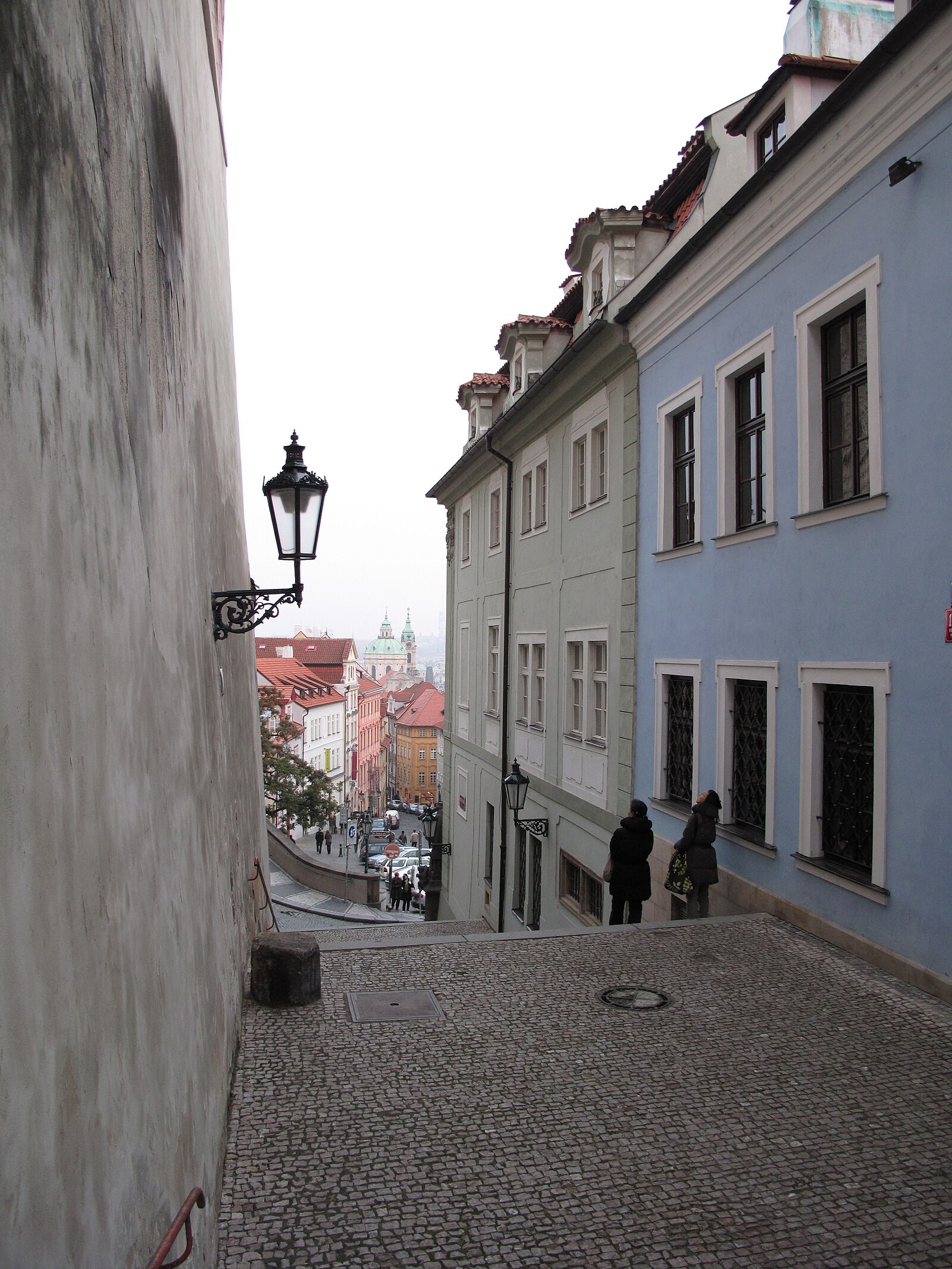
Radnické schody descending toward Nerudova in Hradčany, Prague.
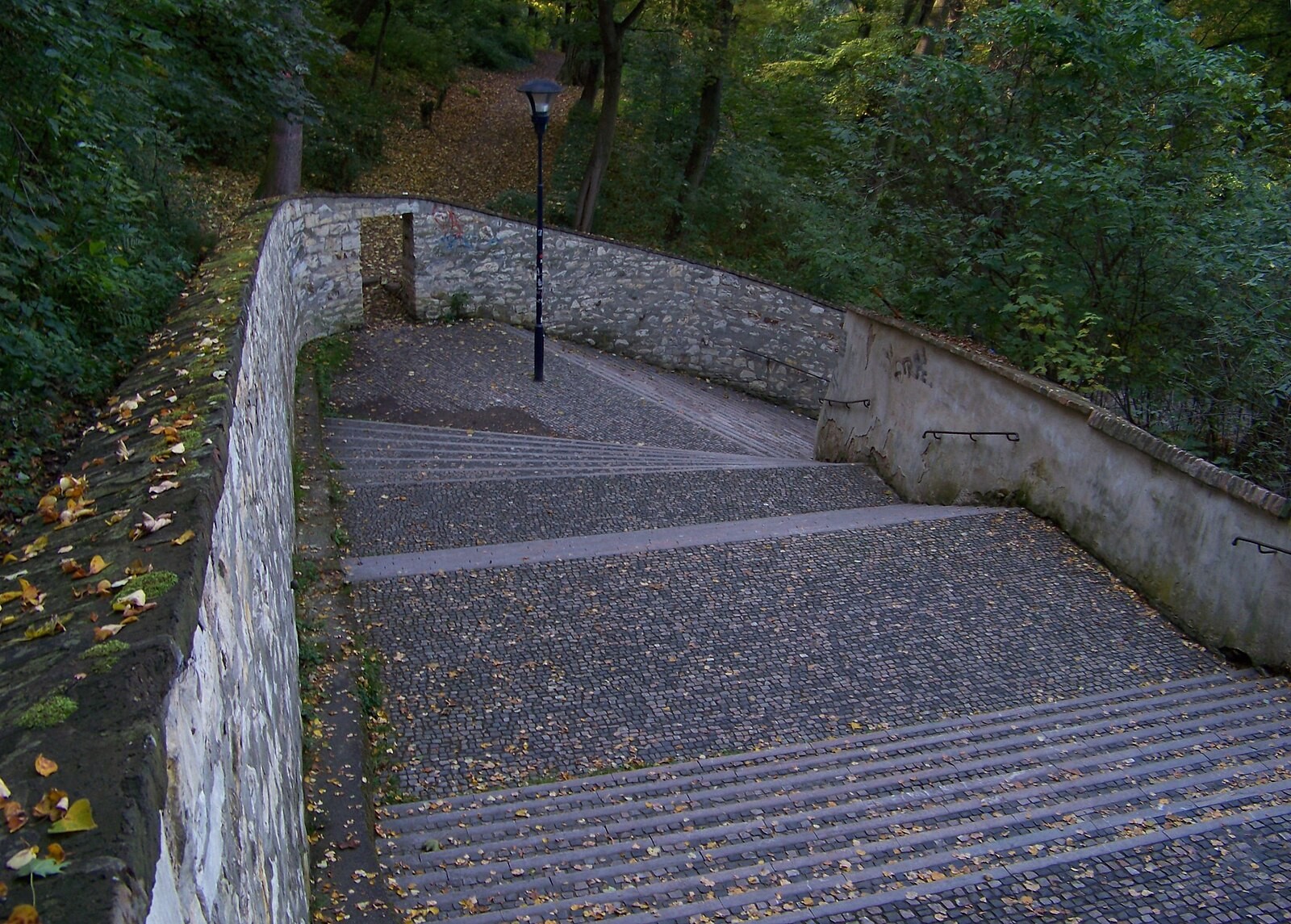
Long outdoor staircase climbing from Vlašská Street into Petřín gardens.
Quick facts
- Central Prague is geographically compact, but paving and gradients vary sharply.
- The climb from Malá Strana toward Prague Castle and Hradčany is one of the most obvious central elevation changes.
- Prague’s transit authority publishes current metro, lift and tram accessibility information.
- Low-floor trams are used across daytime services, while stop design and the arriving vehicle still matter.
- A route that works for a stroller is not automatically suitable for a wheelchair user.
- Live lift outages can change an otherwise step-free metro journey.
- Using public transport to gain elevation can make a walking day substantially easier.
Questions
Is Prague walkable?
Yes for many visitors: major central areas are close together and walking is often the best way to experience them. The important caveat is that cobbles, crowds and hills make some short routes more demanding than the map suggests.
Is Prague wheelchair accessible?
Parts of Prague and much of the transport network are accessible, but access is uneven across historic streets, buildings, stations and stops. Plan specific routes using current Prague Public Transit Company and Prague City Tourism accessibility information, and check lift status on the day.
Can I use a stroller in Prague?
Yes, but cobbles, steps and hills can make a light, robust stroller easier to manage than a bulky one. Use trams or metro strategically and check individual attractions where step-free access matters.
Do I need good walking shoes?
Comfortable, stable footwear is a sensible choice because Prague combines long walking days with uneven historic paving. In rain or winter conditions, grip becomes more important.
Sources & further reading
- Accessible Prague — information and services — Prague City Tourism
- Metro — barrier-free travelling — Prague Public Transit Company
- Status of elevators and platforms — Prague Public Transit Company
- Trams — barrier-free travelling — Prague Public Transit Company
- Vinohrady and Vršovice — La dolce vita — Prague City Tourism