
Baroque Death
Beneath Prague Loreto, a Hidden Crypt Is Painted With Death
A protected crypt below Prague Loreto contains skeletons, skulls, Time and a scene based on Rembrandt.
Loreto, Hradčany

Below Prague Loreto, a protected Baroque crypt turns death, time and resurrection into a painted programme.
Below the Loreto is a room painted for thinking about death
Loreto Prague describes a crypt for benefactors beneath the Church of the Nativity whose murals were created in 1664. Executed largely in black and grey, the painted programme revolves around Death, Resurrection, Time and the fragility of human life. The room is not simply “creepy”; it belongs to a Baroque tradition of teaching through mortality.
The skeletons have an argument to make
Skulls, skeletal figures and allegories of transience point toward memento mori—the reminder that life ends. But the programme does not stop with decay. Resurrection is present too, so the imagery moves between fear, moral reflection and Christian hope rather than functioning as macabre decoration alone.
Rembrandt entered Prague through a print
One of the most striking details is the Raising of Lazarus. Loreto says the mural was based on a famous Rembrandt etching and notes that the Prague response was created while the artist was still alive. That connection turns the crypt into evidence of how printed images carried artistic ideas across Europe.
The original survives because visitors do not enter it
Loreto does not normally open the actual crypt to the public because the murals require protection. Instead, a three-dimensional reconstruction allows visitors to understand the space without exposing the fragile original. The replica is therefore not a disappointing substitute; it is part of the conservation strategy that keeps the seventeenth-century room intact.
Reviewed visuals
See the story
Supporting images selected in the Prague Stories visual review. Context images are labeled so they are not mistaken for documentary proof of the exact subject.
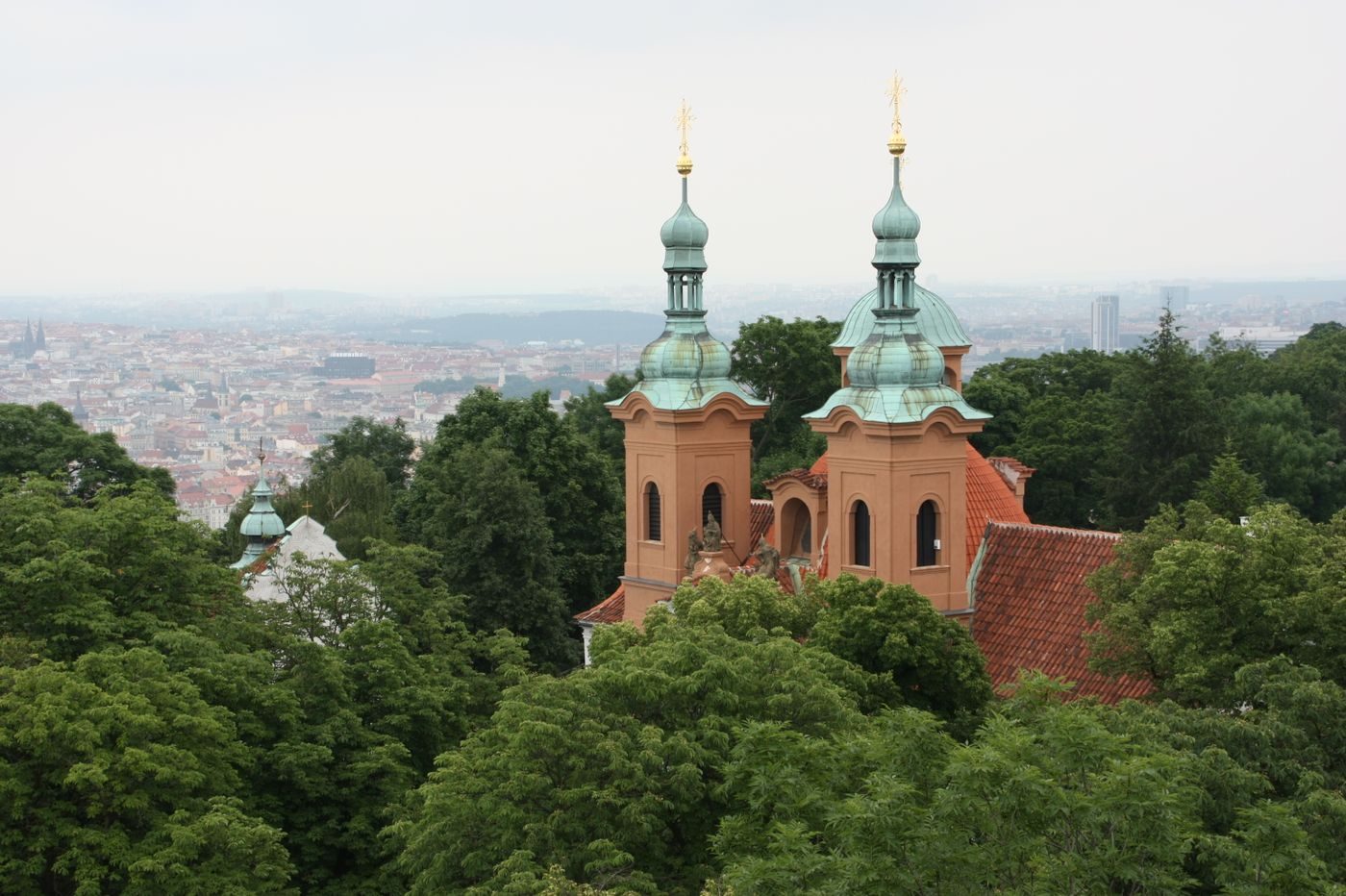
Exact Loreta Church complex is visibly identifiable from above against the Prague skyline.
Quick facts
- The murals date to 1664.
- Their programme centres on Death and Resurrection.
- The imagery includes allegories of Time and human transience.
- The Raising of Lazarus derives from a Rembrandt print.
- The original crypt is not normally open to the public.
- Visitors can enter a three-dimensional reconstruction.
Questions
Can visitors enter the original crypt?
No. Loreto says the original underground space cannot be opened to the general public.
Did Rembrandt paint the crypt?
No. An unknown painter used a Rembrandt print as a visual source.
Sources & further reading
- Ars Moriendi — The Loretan Crypts — Loreto Prague
- The Loreto Crypt — Loreto Prague
- The Loreto Crypt — step inside its replica and discover the Baroque Ars Moriendi — Loreto Prague