
Hidden details
Prague’s Hand-Split Cobblestones Made Curved Patterns Possible
Prague City Tourism explains that older cobbles were split by hand, leaving irregular shapes suited to both straight and curved pavement patterns.
Prague

The irregularity of hand-split stones was a design advantage.
Irregular stones were useful, not defective
Older Prague cobbles were split by hand, Prague City Tourism explains, so individual pieces naturally came out irregular rather than mechanically identical. It is easy to read that unevenness as lack of precision. The more interesting interpretation is the opposite: variation gave pavers flexibility. Different shapes could be fitted into straight runs but also persuaded around curves, letting the surface behave more like a mosaic than a grid.
The pattern is the unit of design
A machine-perfect stone invites repetition. A hand-split stone asks the craftsperson to judge each piece in relation to its neighbours. That shifts attention from the individual cobble to the pattern formed by many cobbles together. Prague City Tourism specifically connects the irregular shapes with the ability to make both straight and curved pavement designs. The stone’s imperfection becomes part of the geometry.
Look down on purpose
On a curved paving motif, follow the turn with your eyes. Notice how no single piece has to carry the whole curve; the change of direction is distributed through many slightly different stones. Then compare that with a straighter section. The same basic material can support two kinds of order because the units are not forced into one identical shape.
Craft leaves a different kind of precision
Old paving was not imprecise simply because the stones were irregular. Hand work allowed pavers to respond to each piece individually and still create tightly controlled patterns. Once you notice that, Prague’s pavement stops being background texture and starts to look like the result of dozens of small craft decisions.
Reviewed visuals
See the story
Supporting images selected in the Prague Stories visual review. Context images are labeled so they are not mistaken for documentary proof of the exact subject.
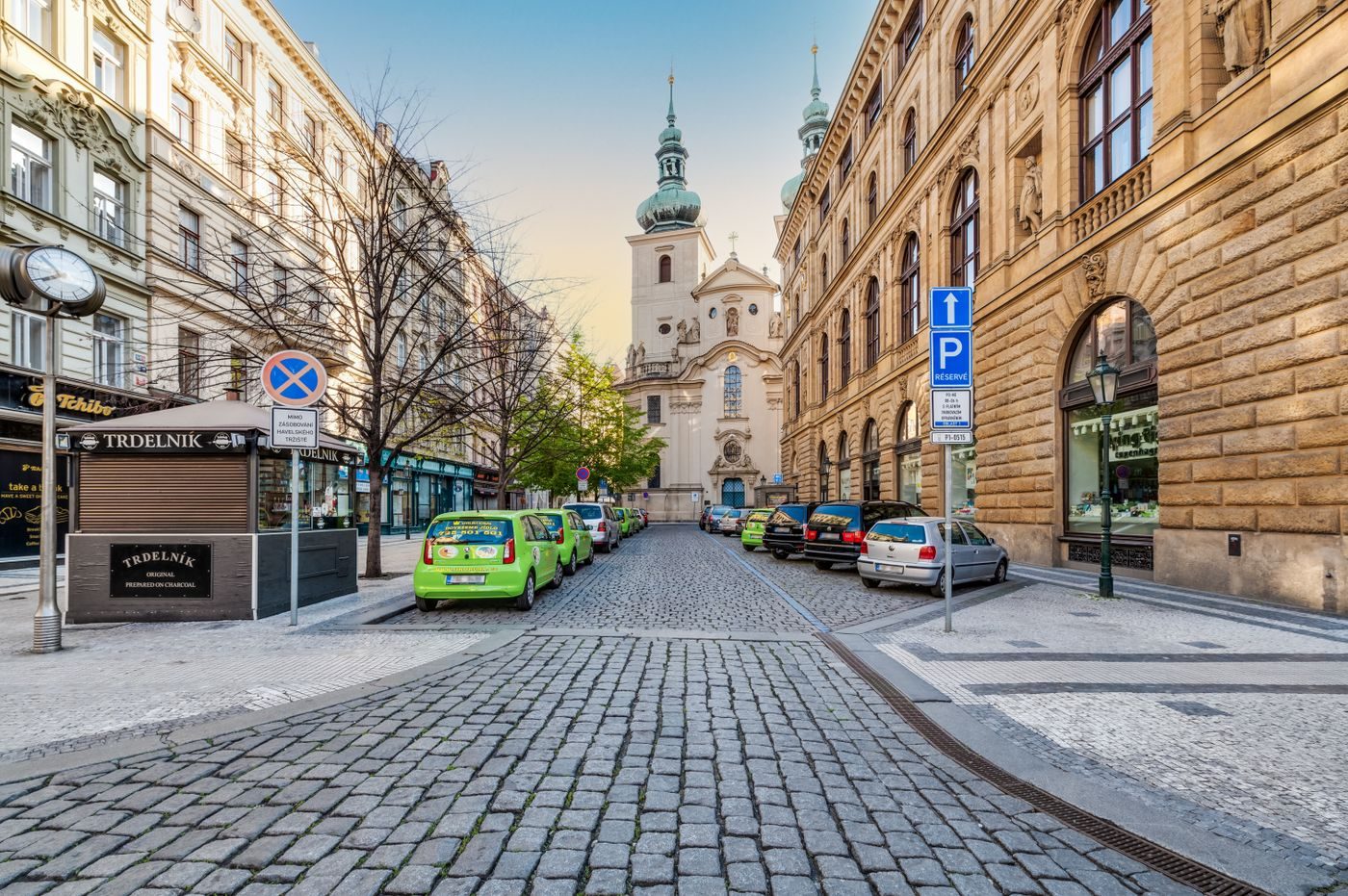
Empty Old Town alley visibly shows square cobbles plus contrasting patterned sidewalk bands.
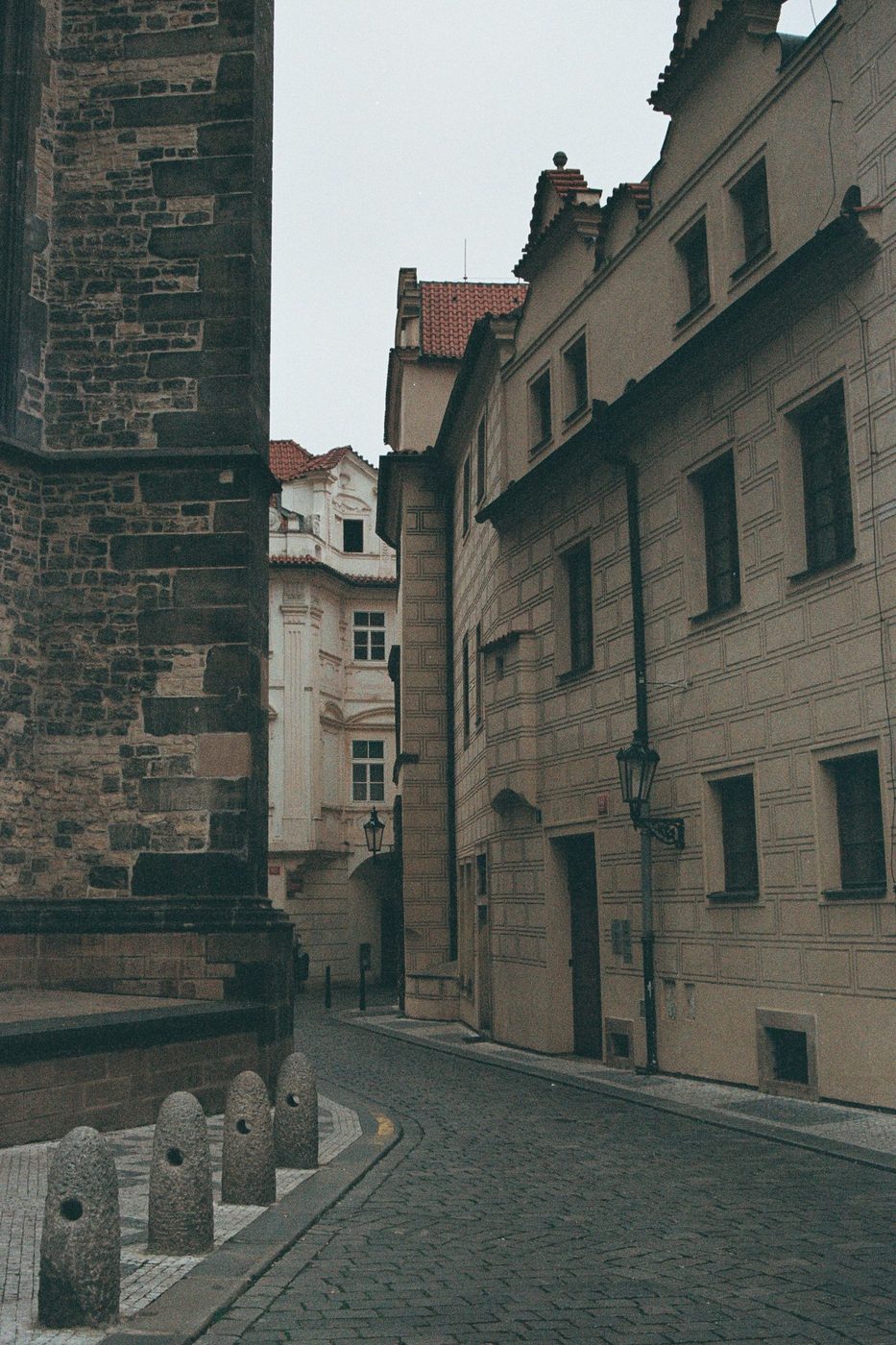
Curving passage/street with visible cobbles and a patterned pavement edge.
Quick facts
- Older Prague cobbles were split by hand.
- Hand splitting produced irregular stone shapes.
- Prague City Tourism says those shapes were suited to straight patterns.
- The same irregularity also allowed curved pavement patterns.
Questions
Why are older cobblestones irregular?
Prague City Tourism explains that older cobbles were split by hand, producing varied shapes.
Did that irregularity have a design use?
Yes. The official city source says the stones were suited to both straight and curved pavement patterns.
Sources & further reading
- Seventy with a lady, dragons and stars — Prague City Tourism