
Prague Stories · Czech Food
Prague Ham: From Bohemian Export Product to Old Town Tourist Classic
Pražská šunka is not merely a ham stall with a city name. Its documented reputation reaches back to nineteenth-century Prague, and the name is now protected as a Traditional Speciality Guaranteed across several production forms.
Prague

Some foods in Prague's tourist centre acquired local branding only recently.
This tourist-market food has a deeper paper trail
Prague ham is different. European registration documents trace the name Pražská šunka to the second half of the nineteenth century. They identify Prague producers including František Zvěřina and, later, Antonín Chmel in the product's rise to commercial fame. That makes it an unusually satisfying case: the modern stall product can be tourist-facing and still rest on a real historic product tradition. The trick is to distinguish the legal/historical category from whatever a particular vendor happens to carve under that name.
A Prague butcher turned the name into an export story
The EU specification records that Prague ham was already known in the 1860s and describes Antonín Chmel's business, established in 1879, as an important force in industrial production and export. The ham's reputation travelled beyond Bohemia, and the name was imitated abroad — one reason formal protection later mattered. There was no single recipe frozen forever in 1879. It is a story of urban food manufacturing, branding and reputation. Prague's name became part of the product long before tourism made Old Town ham stalls into a spectacle.
TSG protects tradition differently from a geographical indication
Pražská šunka is registered in the European Union as a Traditional Speciality Guaranteed, or TSG. That protection recognizes a traditional product specification and name; it is not the same as a Protected Geographical Indication requiring every example to originate physically in Prague. It is easy to assume the protection works like a geographical indication because Prague is right there in the name. The registered specification covers three forms: on the bone, boneless and tinned. So the enormous roast joint being carved at a market stall is only one expression of the wider product category. Packaged ham carrying the protected name belongs to the same legal story if it meets the specification.
The market stall changes the buying experience
At a tourist market, Prague ham may be sold hot, carved into portions and priced by weight. That creates a practical risk unrelated to the ham's authenticity: customers can underestimate the final price if they read a per-100-gram figure as though it were the price of a serving. Czech consumer rules require clear price information, so the best defence is simple — read the unit and ask for the approximate portion weight before agreeing. That practical layer should remain separate from the food history. A confusing price at one stall does not invalidate the nineteenth-century Prague ham tradition, and a historic product name does not excuse unclear selling.
Taste the product, not only the legend
Good Prague ham should make sense as ham first: pork flavour, salt balanced enough to leave room for meat, and a texture suited to the form. Hot market presentation emphasizes aroma and spectacle; packaged versions emphasize consistency and slicing. Neither alone defines the category. The story therefore runs in two directions at once. Prague ham moved from nineteenth-century urban production into an internationally known name, then returned to the historic centre as a highly visible visitor food. Few tourist bites let you hold industrial history, EU food law and a steaming slice of pork in the same hand.
Reviewed visuals
See the story
Supporting images selected in the Prague Stories visual review. Context images are labeled so they are not mistaken for documentary proof of the exact subject.
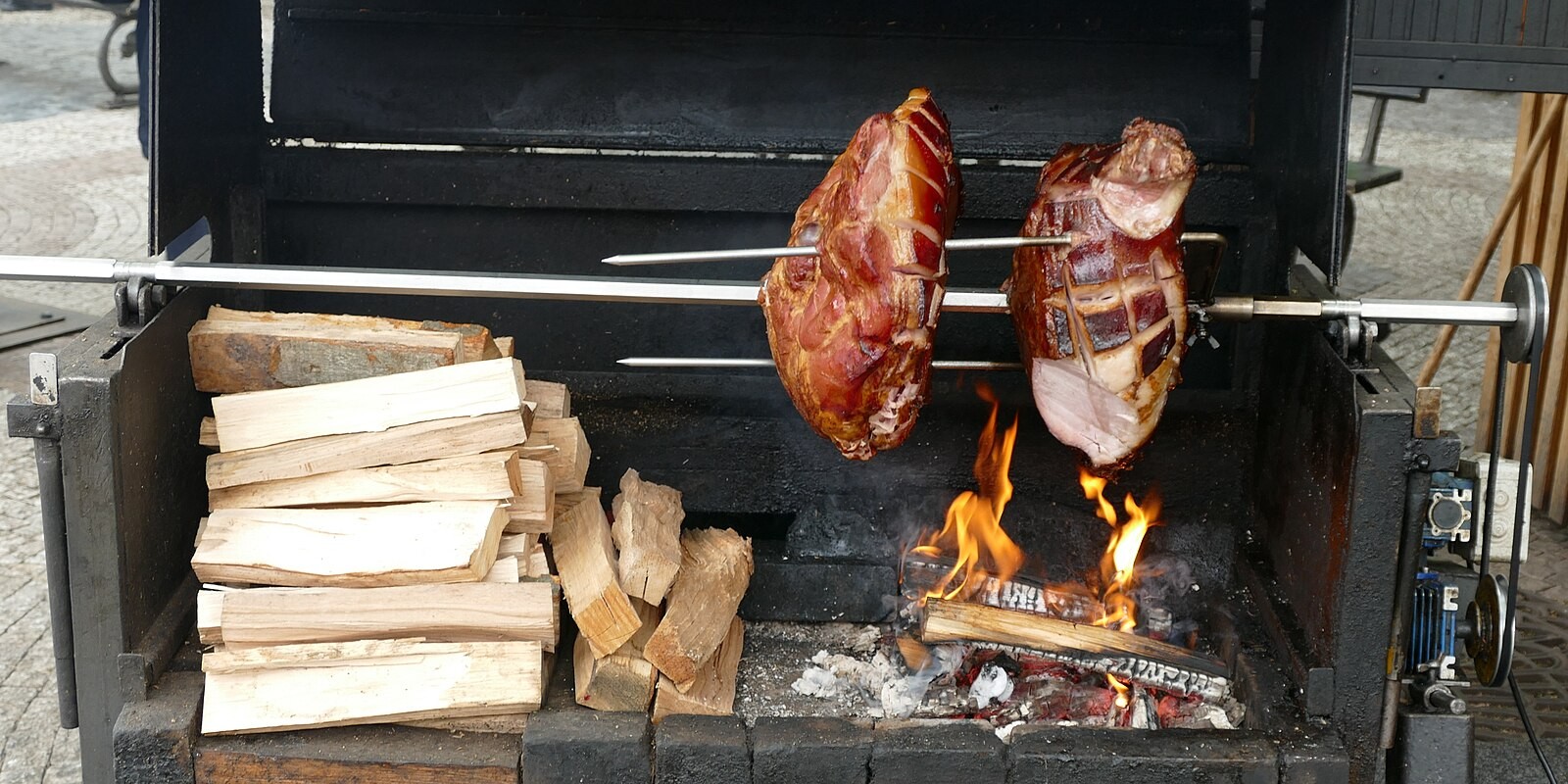
Pražská šunka roasting over wood at an Old Town Square food stall.
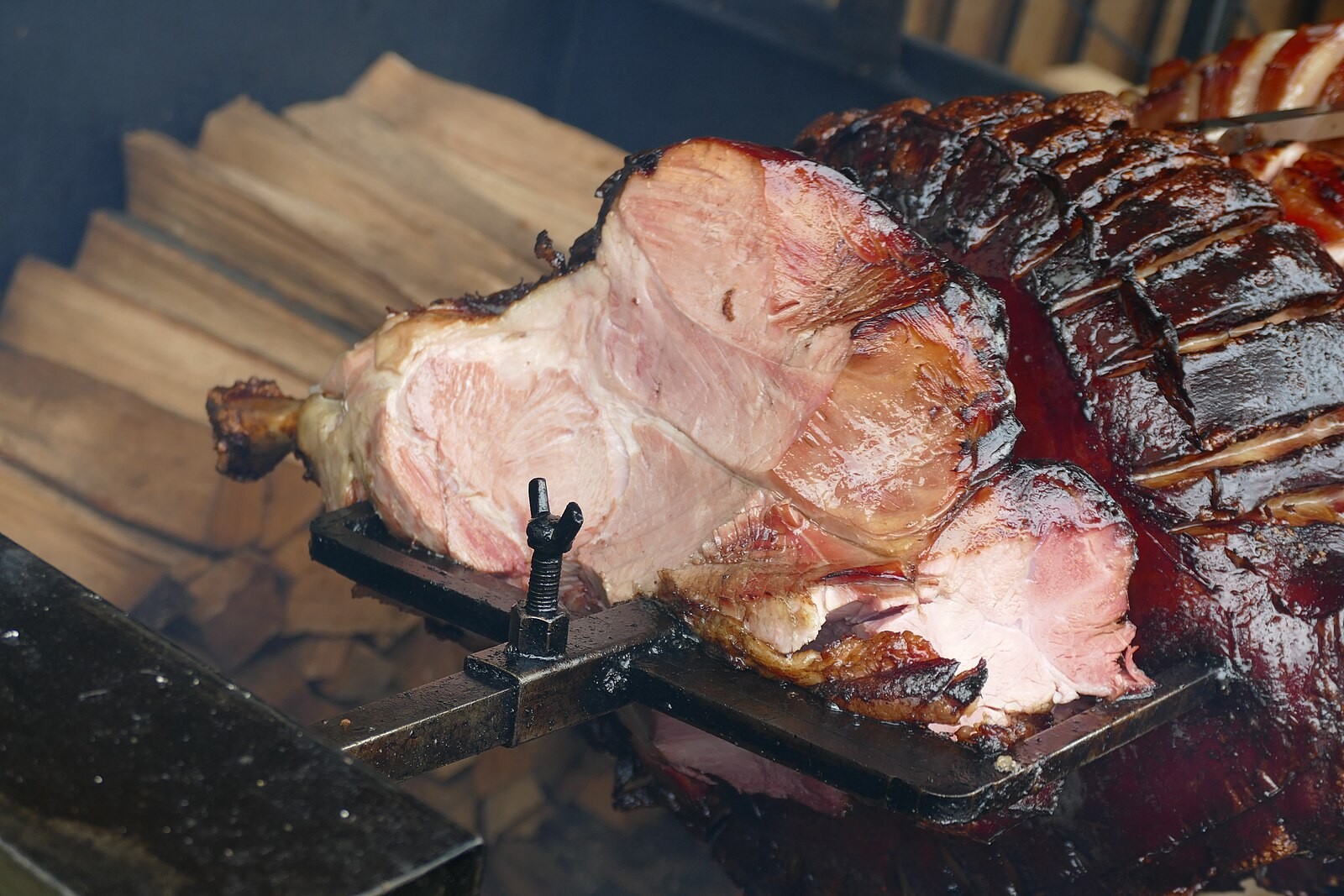
Different composition of Prague ham being roasted at an Old Town stall.
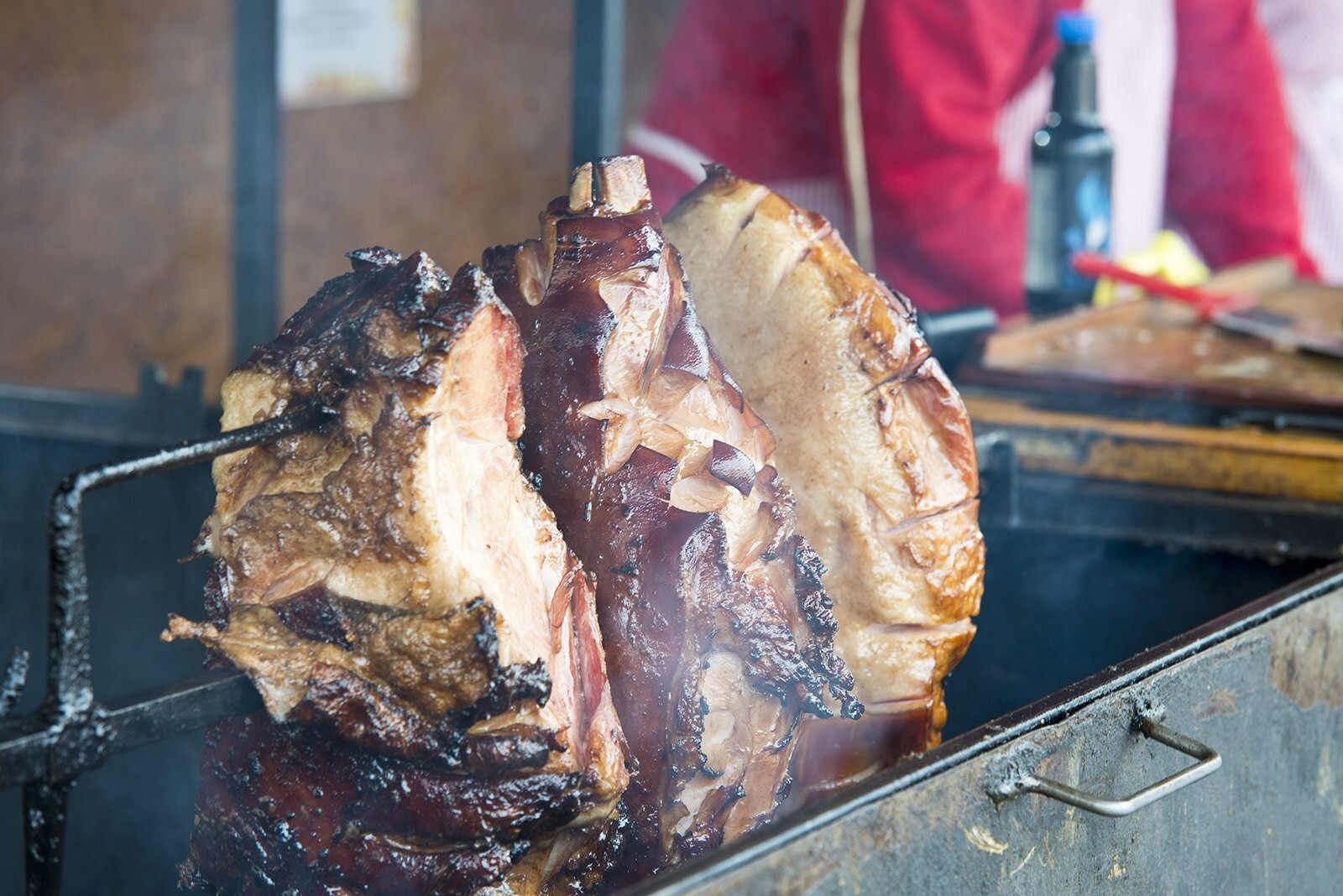
Prague ham photographed in 2012, providing a distinct historical tourist-market example.
Quick facts
- Pražská šunka is documented as a named Prague product from the second half of the nineteenth century.
- Antonín Chmel's Prague business, established in 1879, helped industrialize and export the ham.
- Pražská šunka is registered in the EU as a Traditional Speciality Guaranteed.
- The TSG specification covers on-the-bone, boneless and tinned forms.
- TSG protection concerns the traditional product specification and name, not a rule that every ham must be produced inside Prague.
- At tourist stalls, price may be quoted by weight, so visitors should read the unit before ordering.
Questions
What is Prague ham?
Pražská šunka is a traditional cooked/cured ham product with a documented Prague commercial history and EU Traditional Speciality Guaranteed registration.
Is Prague ham actually from Prague?
The name has genuine nineteenth-century Prague roots. The modern TSG protects the traditional specification rather than requiring every qualifying product to be physically made in Prague.
How is it served?
Depending on the form, it can be sold on the bone, boneless, tinned, sliced cold or served hot. Tourist markets often emphasize hot carved ham.
Why is Prague ham sold at tourist markets?
The historic city name, strong aroma and dramatic carving make it a natural visitor-facing food, while the product itself has a documented Prague history predating modern tourism.
Sources & further reading
- Commission Implementing Regulation (EU) 2018/506 registering Pražská šunka — EUR-Lex / European Union
- How must a business inform me about the price of a service? — Czech Trade Inspection Authority