
Wartime Urban Legend
Pérák Is a Prague Monster Whose Birth Can Be Traced Through the Occupation
Pérák is not presented as an ancient medieval revenant. Petr Janeček’s research follows a modern Prague legend in which a spring-legged night figure shifts from menace and rumour to anti-German hero and popular-culture icon.
Prague — city-wide tradition

Because Pérák belongs to the twentieth century, the most fascinating part is not whether he existed, but how quickly his meaning changed.
A legend born in modern Prague
Pérák belongs to the Protectorate-era and post-war cultural landscape. Petr Janeček’s monograph Mýtus o pérákovi and the English-language Spring Man. A Belief Legend between Folklore and Popular Culture examine the figure as a modern urban legend rather than a relic of ancient folklore. During the occupation, stories circulated about an extraordinary night figure capable of remarkable jumps, often explained through springs or spring-like devices. That physical gimmick gave the rumour a memorable body: Pérák could cross obstacles, appear suddenly and vanish faster than an ordinary pursuer.
The same figure can be villain and hero
One of the most revealing features is instability of role. In some versions Pérák harms or mocks Germans; in others he frightens civilians or behaves as an undefined nocturnal attacker. A traditional hero normally becomes easier to recognize with every retelling. Pérák does the opposite. His moral identity shifts with the audience. That makes the contradictions useful evidence. They suggest that the legend was not simply a fixed anti-Nazi superhero story waiting to be discovered, but a flexible rumour capable of absorbing fear, wish fulfilment and humour.
Rumour moves faster when no address can contain it
Unlike a ghost tied to one house, Pérák is associated with Prague broadly. The lack of a single stable address should not be treated as a weakness. Mobility is part of the legend’s logic. A spring-legged figure is defined by movement, and a city-wide rumour can attach him to different streets as it circulates. A map of Pérák should therefore show spread and variation rather than one invented ‘birthplace’. The whole city becomes the stage, which is appropriate for a modern urban legend shaped through repeated reports rather than a single sacred or haunted site.
After the war, the menace can be rewritten
Janeček’s research follows the figure beyond the occupation into popular culture. Later treatments increasingly emphasize the heroic version — a Prague figure resisting or humiliating the occupiers. This is a classic example of cultural editing after the fact. An ambiguous wartime rumour becomes morally clearer and narratively more satisfying once artists, writers and audiences turn it into a character. The transformation does not make the later Pérák false or unimportant. It shows how folklore can become popular culture while keeping enough of its old silhouette to remain recognizable.
A modern legend is easier to watch changing
Pérák is one of the best Prague Stories for demonstrating that folklore is not something that only happened centuries ago. Because the legend is comparatively recent and academically studied, readers can see different stages: wartime rumour, competing descriptions, post-war reinterpretation and heroic cultural afterlife. The supernatural question becomes secondary. The real subject is a city creating a character under pressure and then continuing to rewrite him. Pérák survives not because one version defeated all the others, but because his basic idea — the impossible jumper in the Prague night — remained flexible enough to support many meanings.
Reviewed visuals
See the story
Supporting images selected in the Prague Stories visual review. Context images are labeled so they are not mistaken for documentary proof of the exact subject.
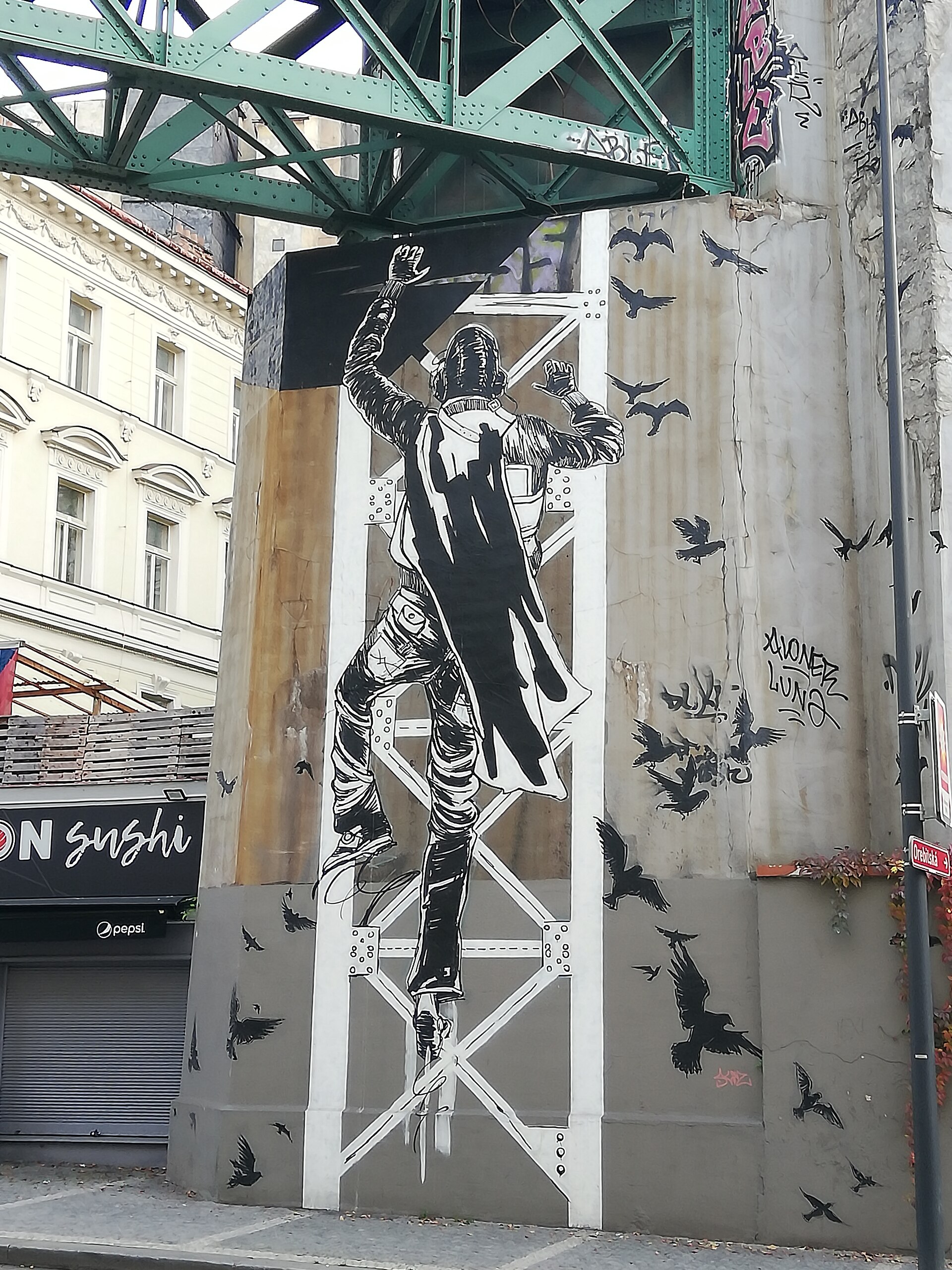
Think of Pérák as a moving city-wide rumour rather than searching for one definitive haunted corner.
Quick facts
- Pérák is primarily a Protectorate-era and post-war Prague urban legend.
- Petr Janeček has studied the phenomenon in the monographs Mýtus o pérákovi and Spring Man.
- The figure is characterized by extraordinary jumping or spring-assisted movement.
- Some versions make him hostile to Germans; others make him a threat to civilians or an ambiguous night attacker.
- The legend is city-wide rather than securely tied to one single address.
- Later popular culture increasingly transformed Pérák into a heroic resistance figure.
Questions
Was Pérák always a resistance hero?
No. Janeček’s research deals with multiple versions, including frightening or ambiguous forms as well as anti-German ones.
Where exactly in Prague did Pérák appear?
The legend is not securely confined to one location. Its city-wide mobility is part of the phenomenon.
Which sources document Pérák best?
Petr Janeček’s 2017 Mýtus o pérákovi and 2022 English monograph Spring Man are the strongest sources listed for the topic.
Sources & further reading
- Mýtus o pérákovi — Petr Janeček
- Spring Man. A Belief Legend between Folklore and Popular Culture — Petr Janeček