
Legend & Sacred Topography
Why Did Legend Make Duchess Drahomíra Disappear Into the Earth on Hradčany?
A Hradčany tradition turns the historical name Drahomíra into a supernatural moral figure: swallowed by the earth or hell with her carriage, then returning as a hellish procession. The biography and the legend must remain separate.
Loretánské náměstí, Hradčany

The most revealing part is not whether the earth literally opened, but how a historical figure was demonized and attached to a precise Prague place.
A carriage disappears into the ground
The Hradčany tradition preserved in modern Prague legend inventories places the supernatural Drahomíra at Loretánské náměstí. In the story, the duchess is swallowed by the earth or by hell together with her carriage. She does not simply vanish from the legend after punishment. Later supernatural memory brings her back as a hellish carriage or procession moving through the Prague night. The image is powerful because punishment and apparition are tied to motion: the vehicle that carries her to damnation also becomes the form in which the legend can make her return.
The historical woman and the legendary sinner are not interchangeable
The most important boundary is between historical Drahomíra and the demonized figure of the legend. A medieval or early historical name can attract moral stories centuries later, especially when later culture wants a clear villain, sinner or opponent of a sacred order. The supernatural narrative should therefore never be written as biography. The earth opening beneath the carriage is part of Prague’s legendary treatment of Drahomíra, not a historical event that explains her real life.
The story explains a place through punishment
The legend has an etiological quality: it attaches a dramatic supernatural event to a precise piece of Hradčany topography. The square is not only where the story happens. It is part of the story’s logic, the point at which the city itself seems to reject the condemned figure. This is a common strength of place legends. A moral judgment becomes easier to remember when the landscape appears to carry its mark.
The hellish carriage is a mobile revenant
Unlike a ghost who remains in one doorway, the returning Drahomíra appears through transport — a carriage or infernal procession. Folklore comparisons place such stories near the broader phantom-coach family, including motifs indexed around Thompson E535.1. The exact classification depends on the version, and it should not be treated as proof of origin. The comparison simply shows that Prague’s hellish carriage belongs to a wider way of imagining the punished dead: not walking back, but driving through the night in a vehicle that makes their condemnation visible.
A later layer of the Drahomíra tradition
The surviving material used here preserves a modern Prague version of the Drahomíra-and-carriage tradition. Its reliable elements are Hradčany, Loretánské náměstí, Drahomíra’s legendary descent and return, and the clear separation between the historical duchess and her supernatural afterlife. An older textual witness could add further depth if one is identified.
Reviewed visuals
See the story
Supporting images selected in the Prague Stories visual review. Context images are labeled so they are not mistaken for documentary proof of the exact subject.
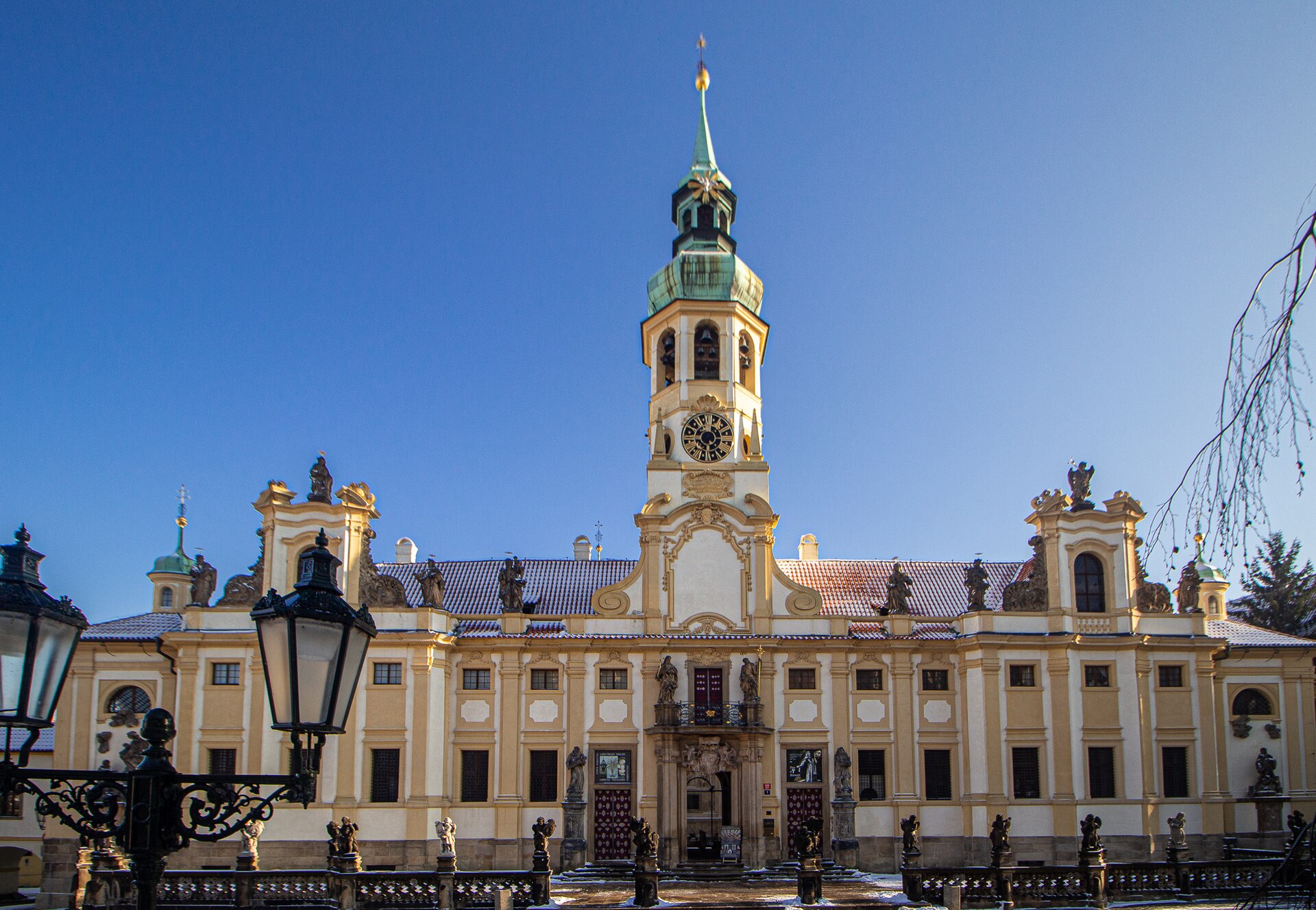
Use Loretánské náměstí as the physical anchor and make the legendary opening of the earth explicitly the supernatural layer.
Quick facts
- The legend is associated with Loretánské náměstí on Hradčany.
- Legendary Drahomíra is swallowed by the earth or hell together with her carriage.
- She later returns in the form of a hellish carriage or procession.
- The supernatural figure must be separated from the historical Drahomíra.
- The story has an etiological function because it attaches punishment to a precise place.
- The surviving version is preserved in a modern Prague legend inventory; an older textual witness could add further depth.
Questions
Did historical Drahomíra disappear into the earth at Loretánské náměstí?
No historical claim of that kind is established here. The disappearance belongs to the legend.
Why does she return in a carriage?
The tradition makes the vehicle part of both punishment and apparition, placing the story close to the wider phantom-coach motif family.
Is the sourcing as strong as for Pérák or the 1874 Podskalí case?
No. The version used here is preserved in a modern Prague legend inventory rather than an older primary witness.
Sources & further reading
- Encyklopedie strašidel — Drahomíra / pekelné spřežení tradition — PRAŽSKÉ POVĚSTI