
Prague Stories · Day trips
Karlštejn From Prague: The Castle Charles IV Built for a Very Specific Purpose
Karlštejn was never meant to be another Prague Castle. Charles IV founded it in 1348 as a private royal residence and a place connected with treasures, relics and the Imperial Crown Jewels — which explains both its architecture and its aura.
Karlštejn, Central Bohemia

Karlštejn announces itself before you reach it.
First you see the castle doing its job
The village road keeps climbing, the houses begin to fall away, and the castle sits above the valley in stacked masses of wall and tower. That theatrical approach can make the building feel like a romantic invention. In fact, the hierarchy is the point. Charles IV founded Karlštejn in 1348. Official castle history describes it as a private royal residence and a secure place for royal treasures, collections of holy relics and, later, the Imperial Crown Jewels. Those functions demanded separation, protection and ceremony. The farther and higher you move through the complex, the more the architecture speaks of restricted access, ceremony and security — not ordinary domestic comfort.
It makes more sense after Prague Castle, not instead of it
Visitors sometimes ask which castle is “better,” but the comparison flattens two very different places. Prague Castle is a vast political and religious complex that grew through centuries in the capital. Karlštejn is smaller, more concentrated and tied unusually closely to one ruler’s imperial project. That difference is what makes the excursion worthwhile. After seeing Prague Castle as a district of palaces, church buildings, courtyards and offices, Karlštejn can feel almost legible: a fortress-residence with a purpose you can follow upward. Karlštejn does not substitute for the capital’s castle. Think of it as a second chapter in the story of Charles IV, written in a much tighter space.
The walk from the village is part of the visit
The train does not deliver you to a drawbridge. From Karlštejn station, the approach continues on foot through the village and then uphill toward the castle. That matters if you are traveling with small children, pushing a stroller, managing limited mobility or arriving in hot weather. The climb is not an incidental transfer; it is part of the day’s physical effort. Take it slowly and the approach becomes useful. Each turn changes the angle on the towers, and the castle’s defensive position makes intuitive sense long before a guide explains it. Comfortable shoes and a realistic pace do more for the day than squeezing another attraction into the afternoon.
Interior access is structured, not free-form
Karlštejn’s interiors operate through defined visitor circuits, and current official information should be checked before travel. Some spaces have different access rules, seasonal schedules or reservation requirements. Turning up with the expectation of roaming every room independently is a reliable way to be disappointed. This is one reason the trip benefits from modest planning. Pick the tour that matches your interest, verify the operating day and leave time around it. If interiors are secondary for you, the village approach and exterior setting still make the excursion visually strong, but do not assume that buying transport to Karlštejn automatically guarantees access to every historic space. For many Prague visitors, Karlštejn works especially well as a half- to full-day escape: enough distance to feel like you have left the city, not so much that the journey consumes the experience itself. For a half-day version, keep the plan narrow: train, village walk, one chosen circuit, then return. A fuller day lets you linger over lunch, take the approach more slowly or add walking in the surrounding landscape without watching the next departure every few minutes. The castle itself does not need an overloaded schedule. Its strongest effect comes from understanding why it is on that hill and what Charles IV expected the place to protect.
Reviewed visuals
See the story
Supporting images selected in the Prague Stories visual review. Context images are labeled so they are not mistaken for documentary proof of the exact subject.
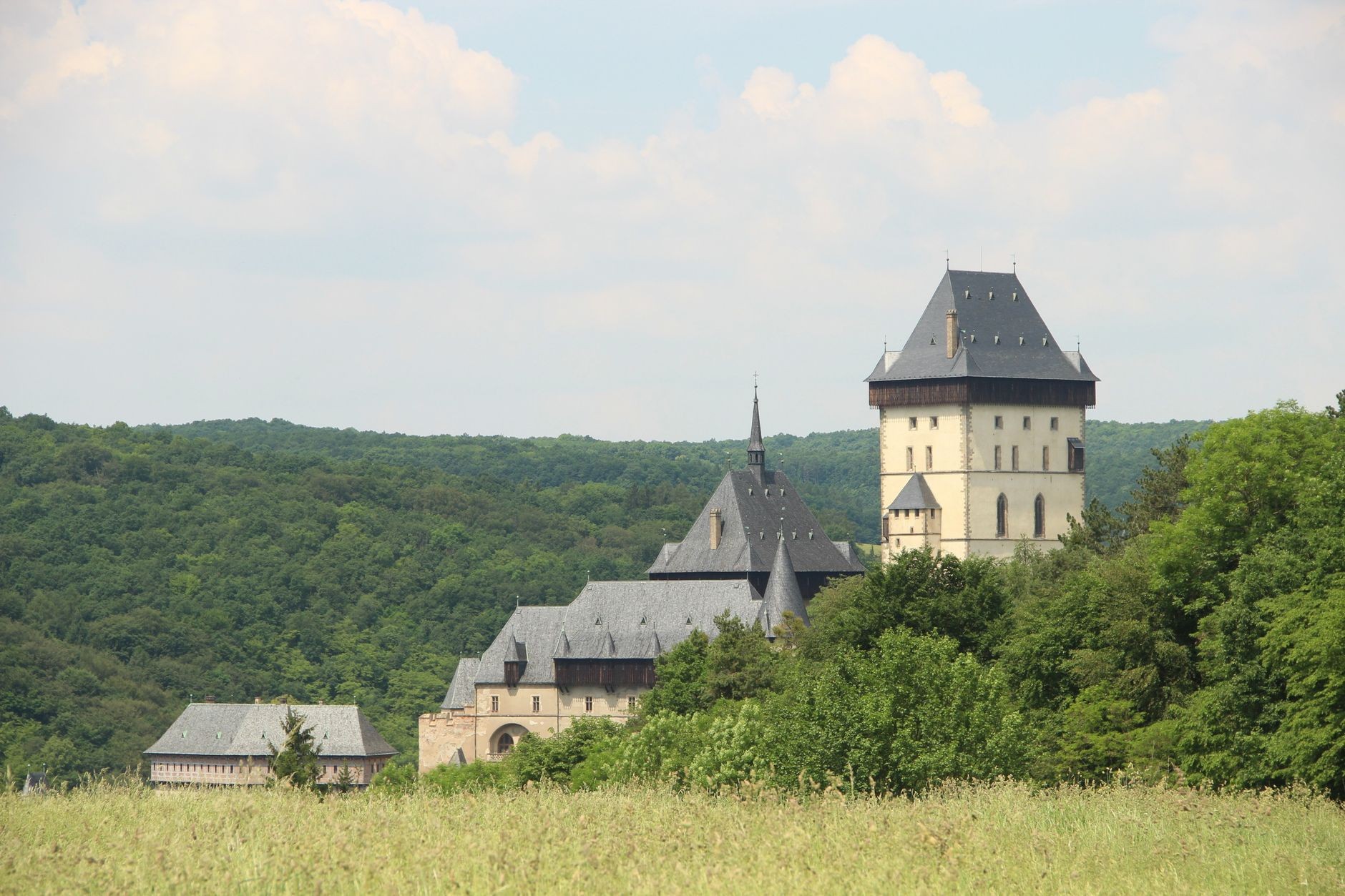
Karlštejn Castle viewed from the settlement below.
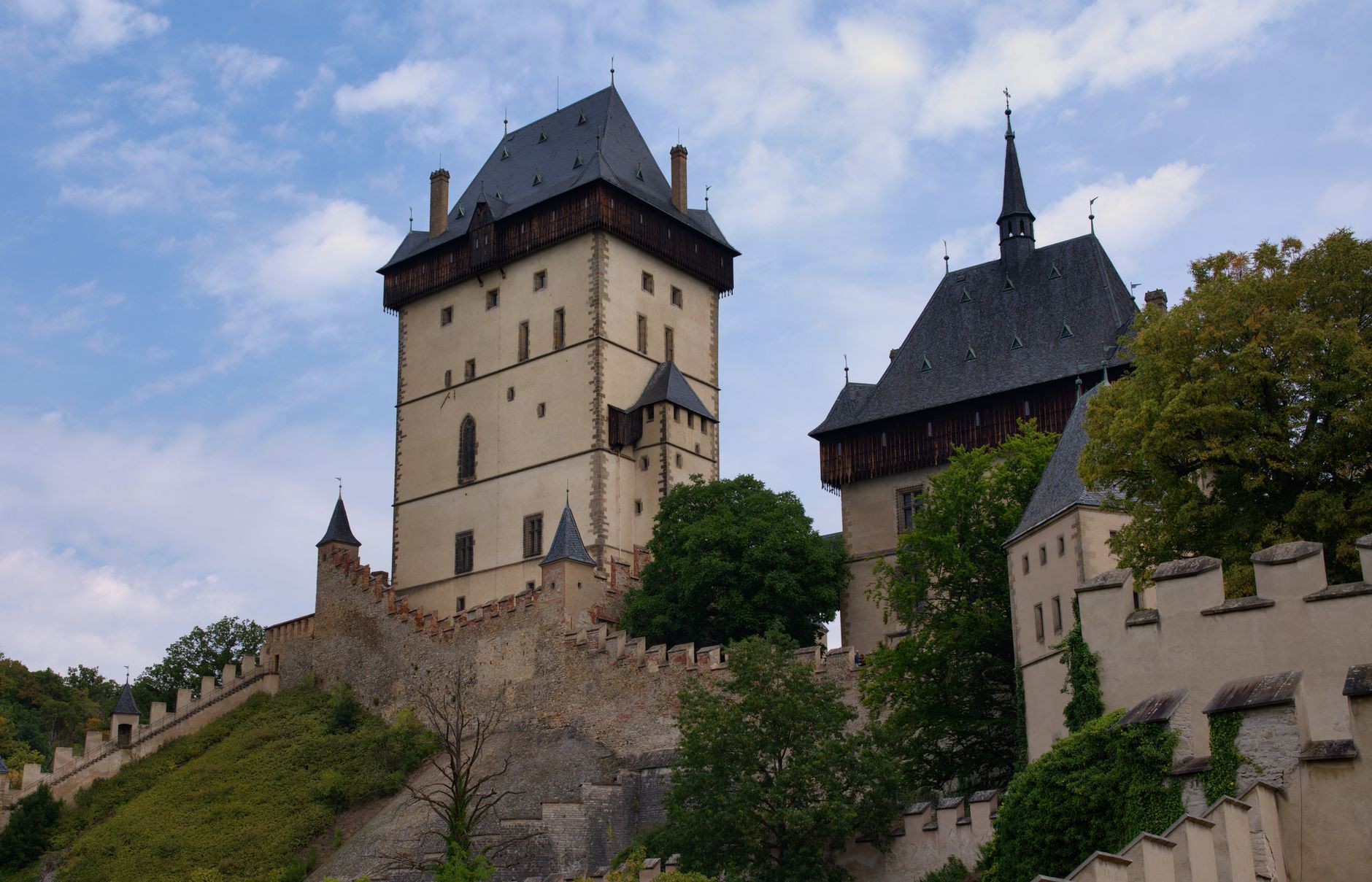
Historic Karlštejn Castle from a different angle and season.
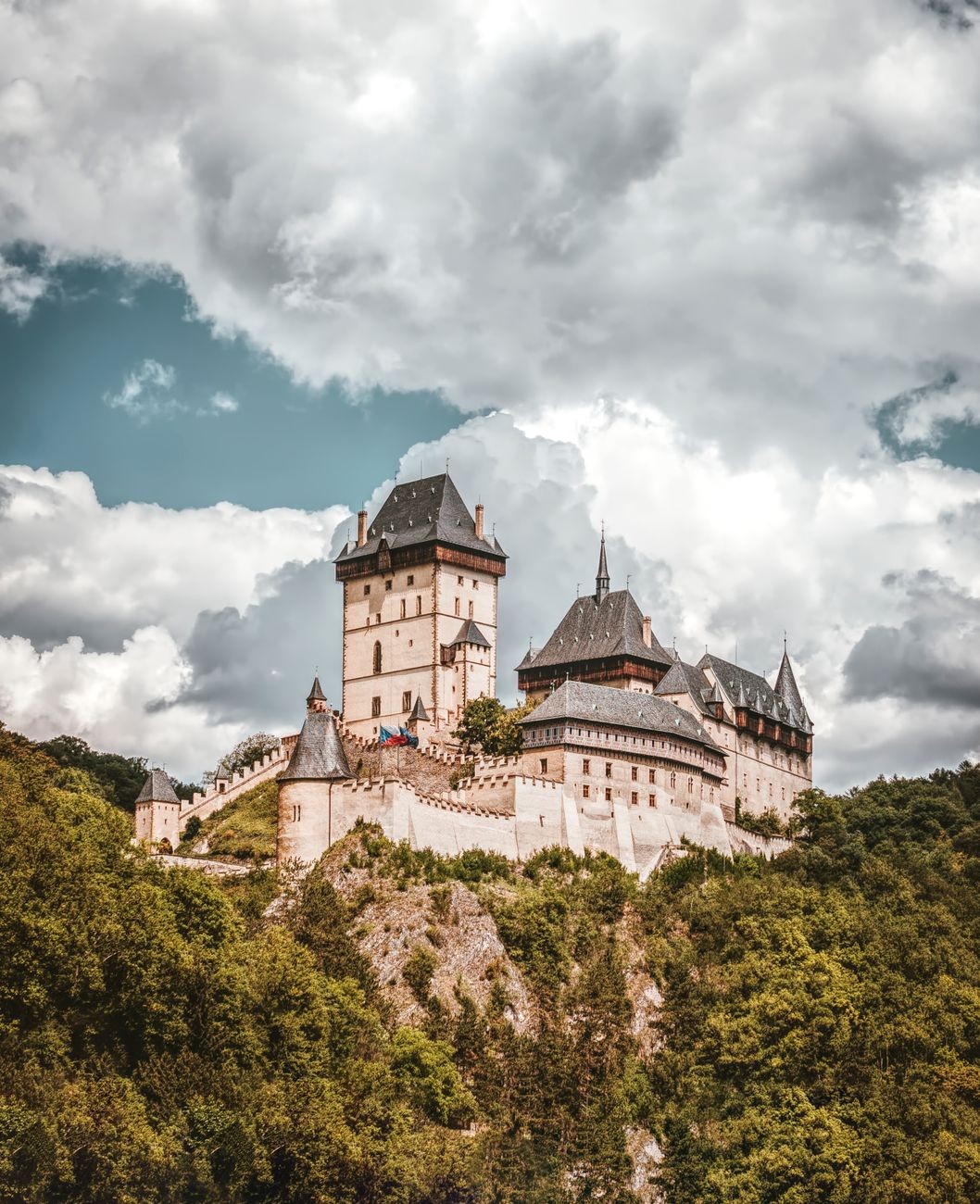
Karlštejn rising above wooded terrain under a broad sky.
Quick facts
- Charles IV founded Karlštejn in 1348.
- The castle served as a private royal residence and a place associated with royal treasures, holy relics and the Imperial Crown Jewels.
- Karlštejn and Prague Castle had different functions and should not be treated as interchangeable attractions.
- The castle stands uphill from the railway station and village.
- Interior visits follow official tour circuits rather than unrestricted self-guided access.
- Opening days and tour availability vary seasonally and should be checked before travel.
Questions
How do you get to Karlštejn from Prague?
Rail is a common independent option; check the current Czech Railways timetable for your date. From Karlštejn station, continue on foot through the village and uphill to the castle.
Can you visit Karlštejn without a tour?
You can reach the village and see the castle exterior independently, but historic interiors are visited through official tour circuits. Check the castle website for the current options and reservation rules.
How long is the walk to the castle?
Allow meaningful time for the uphill approach rather than treating it as a few steps from the station. The exact pace varies greatly, especially with children, luggage or mobility limitations.
Is Karlštejn worth it?
It is a strong choice if you want a manageable trip from Prague and are interested in Charles IV, medieval royal power or a castle whose original purpose is unusually clear. It offers a different experience from Prague Castle rather than a bigger or smaller version of it.
Sources & further reading
- History of Karlštejn Castle — National Heritage Institute / Karlštejn Castle
- Tours — National Heritage Institute / Karlštejn Castle
- Opening hours — National Heritage Institute / Karlštejn Castle
- Timetable — České dráhy