
Podskalí Folklore
Podskalí Had a Ghost That Did Not Chase People — It Made Them Dance
A female apparition recorded in the old Podskalí tradition stands out because its defining act is not a conventional attack. She draws passers-by into a dance, turning a vanished riverside neighbourhood into one of Prague’s strangest supernatural stages.
Podskalí, House at the Ten Maidens / surrounding area

The ghost is remembered through a very specific action — dancing — and through a neighbourhood that has changed almost beyond recognition.
A ghost preserved from old Podskalí
The tradition belongs to Podskalí, the old riverside district whose local stories were collected at the turn of the nineteenth and twentieth centuries. Popelka Biliánová preserved the apparition as part of that neighbourhood’s oral and literary memory, and later ethnological work by Petr Janeček treats Biliánová’s collections as important evidence for the way Prague legends were formed, transmitted and attached to particular streets and communities. The apparition is associated with the House at the Ten Maidens and its surroundings. What makes her memorable is not a complicated biography but a single uncanny action: she lures or draws people into dancing. That detail gives the figure a character very different from the more familiar Prague revenant who threatens, chases or repeats a violent death.
The dance matters more than an invented biography
The surviving core is unusually economical. A female apparition appears in the Podskalí tradition and entices passers-by to dance. That is the part worth protecting. There is no need to manufacture a murder, a curse or a precise life story for her in order to make the tale dramatic. In fact, the absence of an elaborate biography is part of the attraction. The legend works through behaviour: a stranger in the street, an invitation that should be ordinary, and the sense that once the dance begins the rules of everyday Prague have changed. It is a good example of how local folklore can make one gesture more durable than pages of backstory.
The historical name needs context
The traditional Czech name uses ethnic language inherited from the period in which the story circulated and was collected. It is useful for identifying the historical legend, but it should not be read as neutral modern terminology. Biliánová’s material belongs to a specific social and linguistic world, so the older wording is best understood in that historical context.
The second story is the neighbourhood itself
Podskalí is not just a backdrop. The old district, its river economy and its local social world are central to why a small supernatural story could survive. Janeček’s work on nineteenth-century Prague legend emphasizes the value of local collections such as Biliánová’s for understanding how stories grow out of concrete communities. That makes the apparition a doorway into a larger subject: the memory of a riverside quarter that was later transformed. The modern visitor should not be asked to imagine that every present building stood exactly as it does in the story. The more interesting exercise is to notice how much of the old urban environment has disappeared while a tiny fragment of its folklore remains recognizable.
A Prague Story built from place, behaviour and memory
Three layers remain visible. Biliánová’s Podskalí material documents the existence of the tradition; the dancing apparition supplies its distinctive folkloric image; and the real city preserves fragments of the neighbourhood that produced it. The apparition does not need to be treated as a historical person or a proven supernatural event for the legend to show how local memory can outlive the physical city around it.
Reviewed visuals
See the story
Supporting images selected in the Prague Stories visual review. Context images are labeled so they are not mistaken for documentary proof of the exact subject.
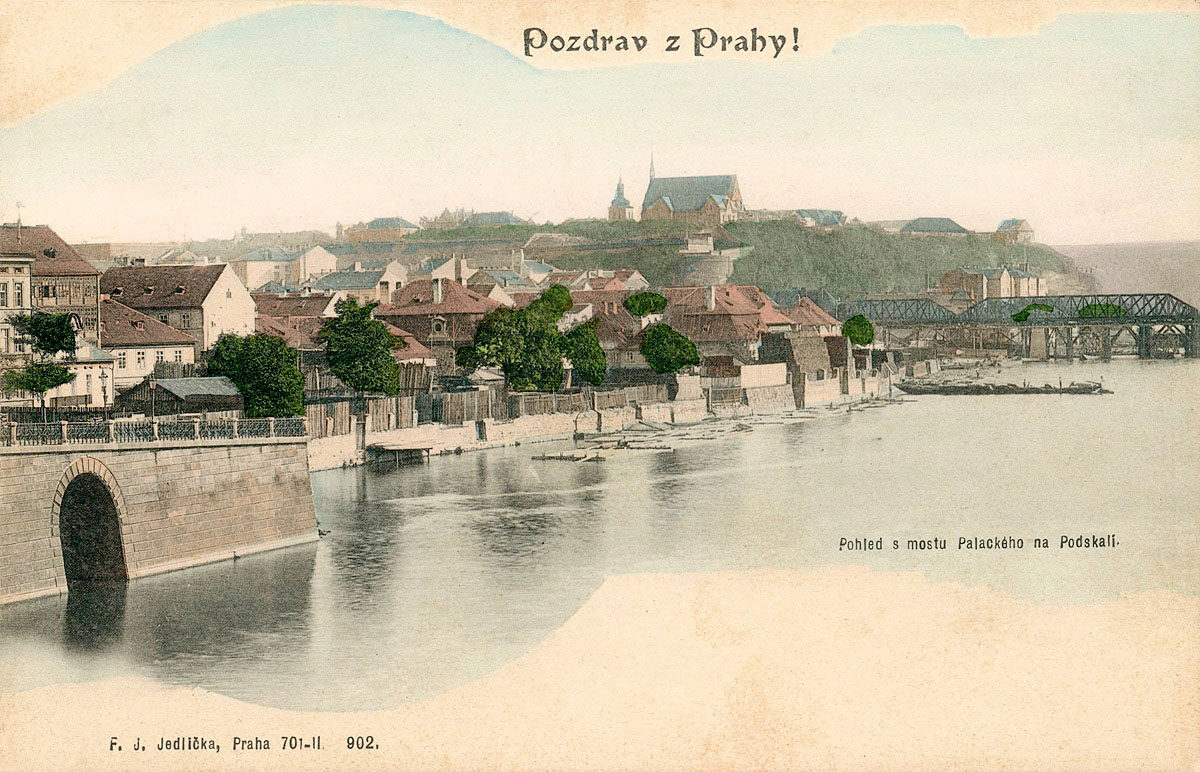
Use today’s Podskalí to compare surviving streets and names with the much-changed riverside district remembered by the legend.
Quick facts
- The apparition belongs to the local folklore of Podskalí.
- Popelka Biliánová recorded the tradition around the turn of the nineteenth and twentieth centuries.
- The story is associated with the House at the Ten Maidens and its surroundings.
- Its defining motif is a female apparition enticing passers-by to dance.
- Petr Janeček’s 2006 ethnological work treats Biliánová’s collections as important evidence for Prague legend tradition.
- The traditional name reflects period language and is best understood in its historical context.
Questions
Is the dancing apparition part of an old Prague source tradition?
Yes. Popelka Biliánová preserved the figure in the Podskalí story tradition, and Petr Janeček’s research discusses the evidentiary value of her collections.
Why is the dance so important?
Because it is the most distinctive stable action in the surviving story and makes the figure different from a generic threatening ghost.
Why explain the historical name?
Because the traditional label reflects the language of its period. It can be cited for identification while being clearly contextualized for modern readers.
Sources & further reading
- Z tajů pražských pověstí — Popelka Biliánová; Karel Chalupa
- Pražská pověst v 2. polovině 19. století (na příkladu sběrů Popelky Biliánové) — Petr Janeček
- Strašidelné příběhy města pražského – Tancující Židovka — Český rozhlas Dvojka