
Explore Prague
Charles Bridge
Charles Bridge is famous enough that it is easy to see badly. A crowded crossing at noon can reduce it to statues, souvenir stands and a photograph toward the Castle. The bridge becomes more intelligible when you read it as infrastructure: a medieval river crossing built after catastrophic flood damage, a ceremonial gate on the Royal Route, a platform later lined with Baroque saints, and a structure repeatedly repaired after ice and high water.
Charles Bridge is Prague's oldest surviving bridge and the historic link between Old Town and Lesser Town. Construction began under Charles IV in 1357 after the earlier Judith Bridge was destroyed by flood. Cross it slowly, but read it from the ends: the Old Town Bridge Tower, Judith Bridge remains, Baroque statue program and river engineering tell a richer story than the central span alone.
Why Charles Bridge matters
The bridge connected the royal and ecclesiastical centre on the left bank with Old Town on the right and formed a crucial section of the coronation route to Prague Castle. It was not built as a scenic promenade. For centuries it carried people, goods, processions and wheeled traffic across a river that could be destructive and unpredictable.
Prague City Tourism dates the start of construction to 1357 and completion to the beginning of the fifteenth century, with 1402 commonly given as the finishing date. The name Charles Bridge became standard only in the nineteenth century; earlier generations knew it as the Stone Bridge or Prague Bridge. That delayed naming is a reminder not to project today's monument identity back onto the entire medieval period.
Before Charles Bridge: the Judith Bridge
Charles Bridge replaced a Romanesque stone bridge associated with King Vladislav II and Queen Judith of Thuringia. The Judith Bridge was built in the twelfth century and badly damaged by the 1342 flood. It did not vanish without trace. Masonry survives around the current crossing, including a preserved tower on the Lesser Town side and structural fragments incorporated into later buildings.
This matters because Charles Bridge was not Prague's first attempt at a monumental stone crossing. The alignment, riverbanks and need for a permanent connection were already established.
Construction, dimensions and flood engineering
The bridge is built of sandstone blocks and rests on sixteen arches. Prague City Tourism gives its length as about 515.76 metres and width as roughly 9.5 metres. The piers are protected by cutwaters that help divide river flow and debris pressure. Medieval construction did not make the crossing invulnerable: major floods damaged it repeatedly, notably in 1432, 1784 and 1890.
The 1890 flood was especially destructive, knocking out piers and arches after floating timber and debris struck the structure. Repairs became part of the bridge's modern history. The bridge survives because it has been repaired, not because it remained untouched.
The Old Town Bridge Tower
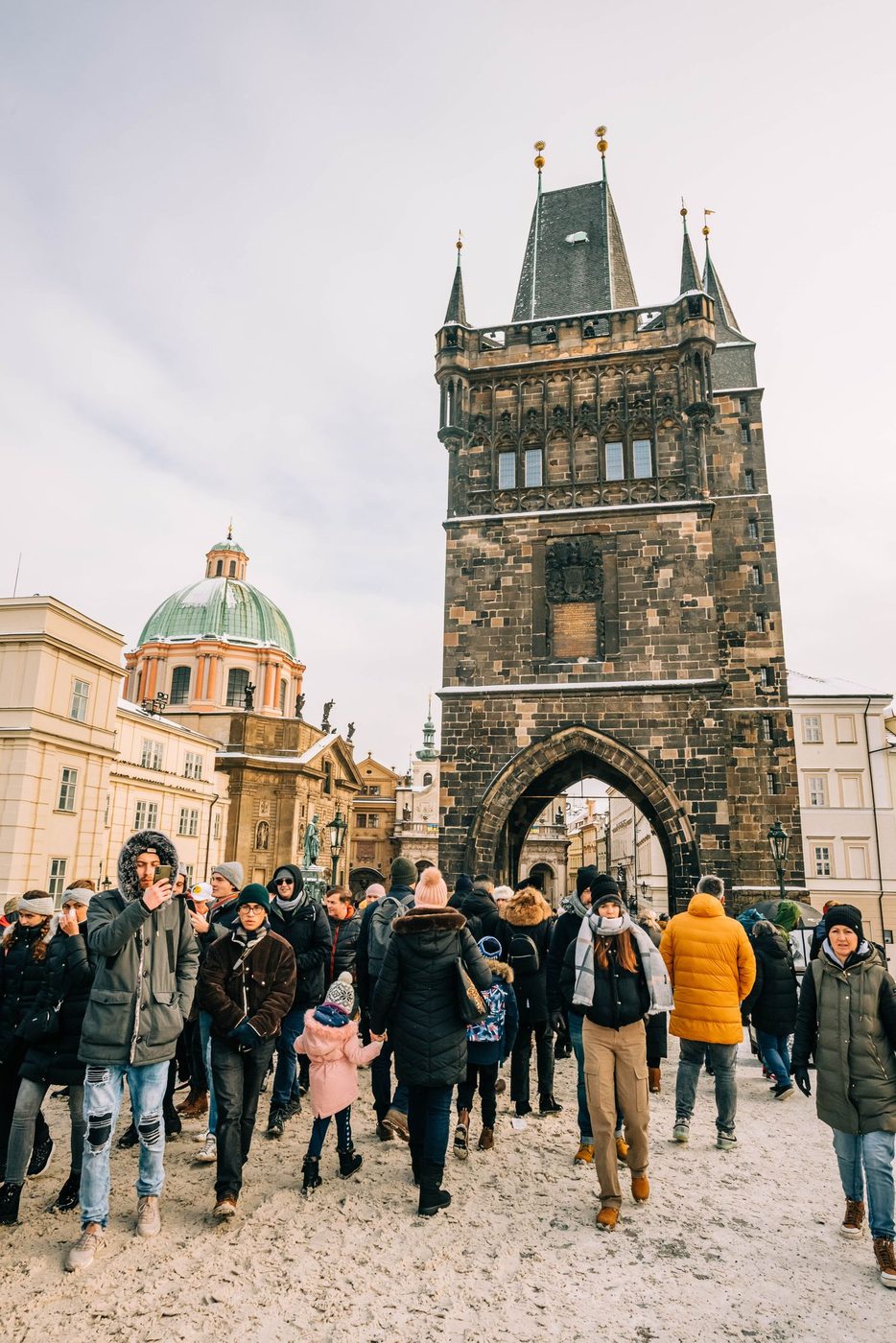
The Old Town Bridge Tower is not simply a gate with a view. Built in the Parler circle, it forms a ceremonial threshold to the bridge and Royal Route. Its sculptural program presents political meaning in stone: Charles IV, Wenceslas IV, saints and heraldic emblems turn the façade into a statement about dynasty, kingdom and sacred legitimacy.
Climbing the tower is a particularly clear way to understand the bridge's geometry. From above, the curve of the river, island edges, Lesser Town towers and Castle alignment become obvious. If you only have time for one tower around the bridge, this is usually the more explanatory one.
The Lesser Town Bridge Towers
At the west end, two towers stand side by side but belong to different periods. The lower Romanesque tower preserves the memory of the Judith Bridge. The taller Late Gothic tower visually answers the Old Town tower but was built later. Passing between them into Mostecká Street makes the connection between bridge and Lesser Town much clearer than stopping at the last statue and turning around.
The statues: Baroque on a medieval bridge
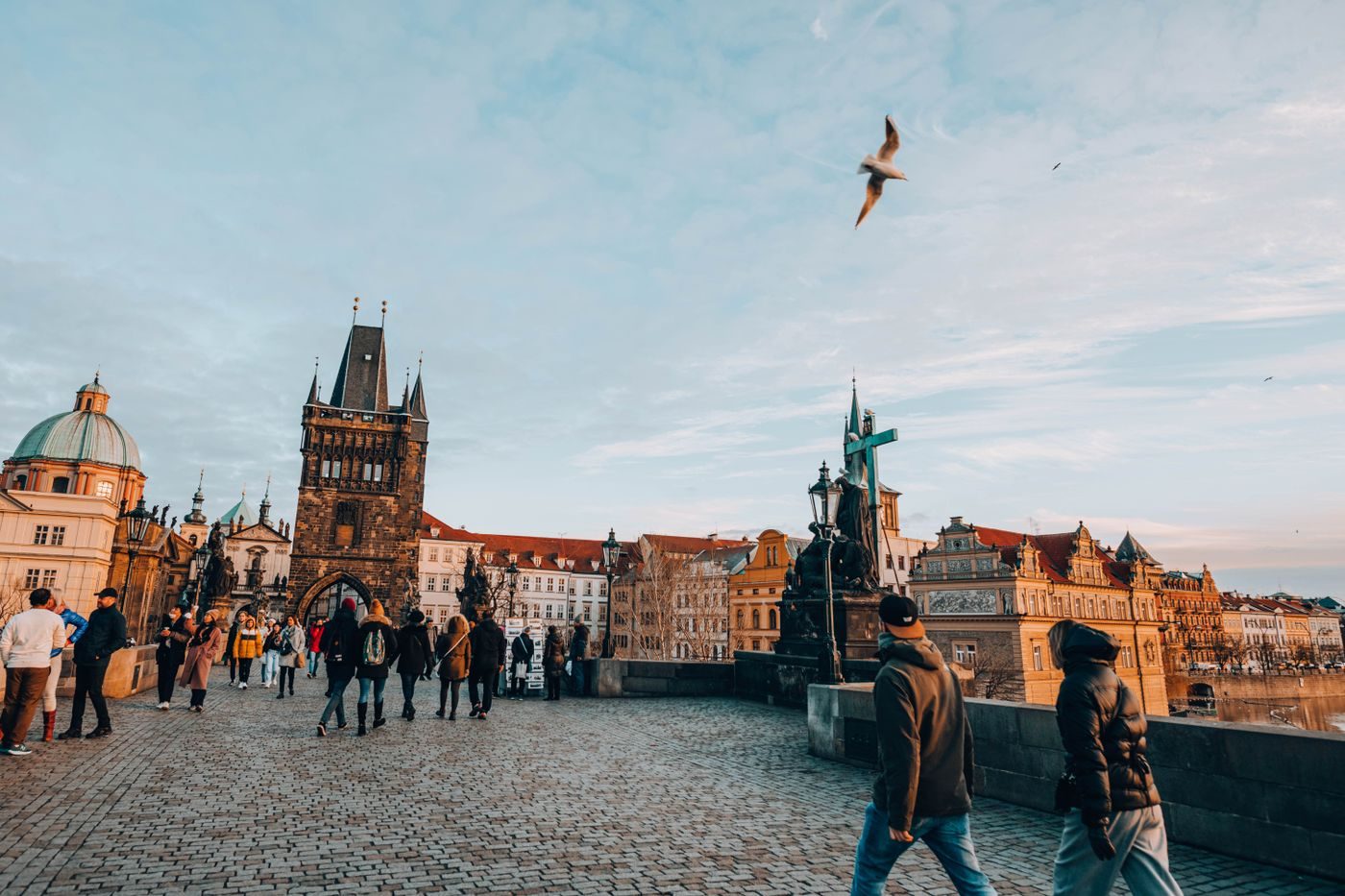
The sculptural avenue is later than the bridge. The program developed mainly from the late seventeenth into the eighteenth century, when Catholic patrons placed saints and religious groups along the parapets. Many originals have been moved to museums and replaced with copies because weather, pollution and touch damage soft stone.
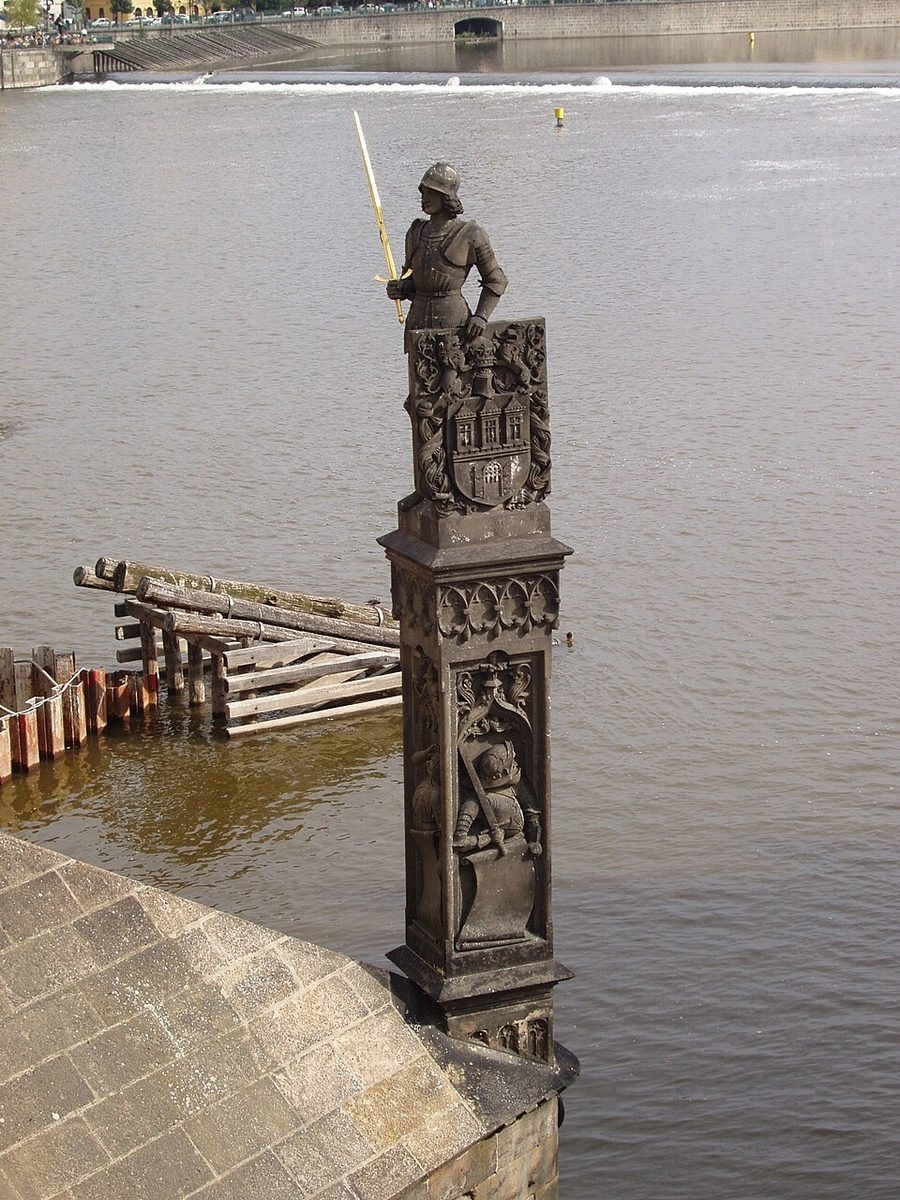
Among the bridge statues, the most famous figure is St John of Nepomuk. His bronze statue became a model for later images of the saint across Europe. Touching plaques on the pedestal has become a tourist ritual, but it is not an ancient medieval custom. Bruncvík's figure near the bridge is different: it belongs to Prague legend, but it should not be used as historical proof for the origin of the Czech two-tailed lion.
When the bridge changes character
There is no secret hour when Charles Bridge is guaranteed empty. Weather, season, sunrise time, group schedules and events all matter. Early morning normally gives the lowest pedestrian pressure. Late evening removes much of the tour-group traffic while the Castle and lamps remain visible. Midday works better when performers, activity and open nearby attractions, but it is the worst period for an unhurried read of the sculpture.
If photography matters, think about direction of light rather than chasing emptiness. Overcast weather can be better for stone detail than hard sun. Winter mist and snow can alter the scene completely, but ice makes the cobbles slippery.
Viewpoints that explain the bridge
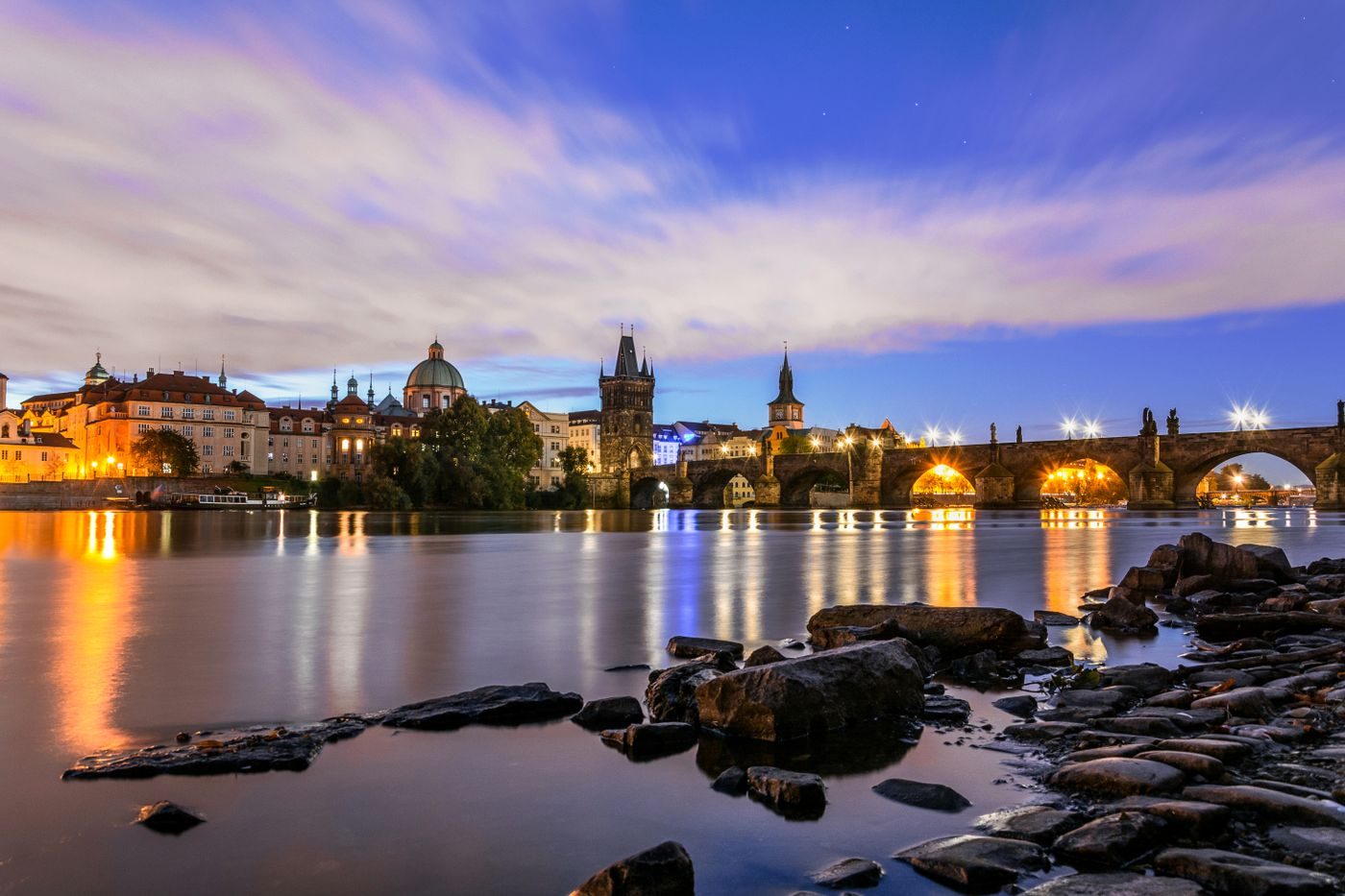
The Old Town Bridge Tower gives the most direct overhead reading. Kampa and the riverbank south of the bridge show arches and piers from a lower angle. The Smetana embankment gives the Castle alignment, while Letná shows Charles Bridge as one member of a chain of Vltava crossings.
A river view also reveals islands, weirs and channels that disappear when you walk only at parapet level. Prague's centre is organized by water engineering as much as by monuments.
Legends versus documented facts
The famous sequence 1-3-5-7-9-7-5-3-1 is associated with the traditional claim that the foundation stone was laid on 9 July 1357 at 5:31. The date has become part of Prague's popular historical narrative, but the precision of the astrological timing is a case where popular retelling can outrun surviving evidence. Present it as a tradition linked to Charles IV's astrological culture, not as an unquestioned timestamp.
The story that eggs were mixed into the bridge mortar is similarly durable folklore. Scientific analyses have produced more complicated discussions of organic additives, but the simple schoolbook version of villages sending eggs to strengthen the bridge should be labeled as legend rather than repeated as settled construction fact.
A practical 45–90 minute bridge walk
Start in Old Town at Křižovnické náměstí. Look at the tower before entering the bridge; if open and you are willing to climb, take the tower first. On the bridge, stop at a few sculptural groups rather than every statue. Near the west end, compare the bridge end with the surviving Judith Bridge tower. Pass through the Lesser Town towers and continue down Mostecká.
For a longer route, turn left to Kampa and walk along the Čertovka channel before rejoining Lesser Town. For a history-focused route, continue to Malostranské náměstí and then uphill toward Prague Castle. The bridge itself is free to cross; tower interiors have separate admission and hours.
A bridge designed for a difficult river, not for photographs
The Vltava is the reason Charles Bridge exists and the reason its history is full of repairs. Medieval Prague needed a durable crossing between the Old Town and the settlement beneath the Castle, but the river carried floodwater, ice and debris through a channel that could become destructive very quickly. The earlier Judith Bridge, a major Romanesque stone crossing, was badly damaged in the flood of 1342. The replacement begun under Charles IV had to be both monumental and resilient.
The bridge’s dimensions make more sense when read as engineering. Sixteen arches of different spans carry the deck across the river and islands or river-edge ground. Stone piers have to divide the current while resisting hydraulic pressure and impacts. The structure was not immune to disaster: Prague City Tourism records severe damage in several floods, with 1890 especially destructive when accumulated timber struck the bridge and caused the failure of piers and arches. Repairs were therefore not an exceptional modern intrusion into a perfectly preserved medieval object. Maintenance has always been part of the bridge’s survival.
The often-repeated story that eggs were mixed into the mortar shows how easily a memorable claim can outrun evidence. Research on historic mortars has produced discussion about organic additives in medieval construction, but the popular version involving eggs sent from towns across Bohemia should be treated as a story unless a specific scholarly source supports that precise narrative. The bridge does not need the tale to be technically impressive.
Modern conservation faces a different problem: how to repair a working public monument without erasing the record of earlier repairs. Stone replacement, drainage, parapets and surface work are highly visible and politically sensitive because millions of people feel ownership of the bridge’s appearance. The useful visitor question is therefore not “Is this all original?” No structure exposed to six centuries of flood, weather and traffic could answer yes. Ask instead which parts preserve medieval fabric, which reflect later reconstruction and how the whole structure has been kept in service.
The towers turn a river crossing into an urban ceremony
A bridge can connect two banks without marking either end. Charles Bridge does the opposite. Its towers make the crossing feel like passage through a sequence of gates. On the Old Town side, the Gothic bridge tower is both fortification and symbolic architecture. Its sculptural programme places rulers, saints and heraldic imagery above the route that linked the royal city with the Castle. The tower therefore belongs to the history of royal representation as much as to defensive infrastructure.
At the western end, the two Lesser Town towers are deliberately unequal. The lower tower preserves the line of the older Judith Bridge and has Romanesque origins beneath its later appearance; the taller tower is a fifteenth-century Gothic structure visually related to the Old Town tower across the river. Their mismatch is historically informative. Prague did not clear the site and rebuild a symmetrical pair. It incorporated structures from different periods into one entrance.
This matters on foot because the towers control perspective. Approaching from Old Town, the eye is drawn through the Gothic gate toward the Castle hill. Coming from Malá Strana, the Old Town tower frames the denser right-bank city. Climbing a tower reverses the usual experience entirely: the bridge becomes an object in the river landscape rather than a surface beneath your feet.
The Royal Route later gave this crossing added ceremonial weight. Coronation processions moved from the Old Town toward Prague Castle, passing through a chain of urban spaces in which the bridge was both practical connector and public stage. That history is more useful than describing the bridge as a generic “romantic” landmark. It explains the towers, the directionality and the concentration of symbols along the route.
Thirty statues do not mean thirty medieval originals
The sculptural gallery is younger than the bridge beneath it. The best-known Baroque statues and groups were added mainly from the late seventeenth century onward, long after the fourteenth-century crossing had entered daily use. That difference is fundamental: a medieval infrastructure later became a Baroque devotional and representational corridor.
The statue of St John of Nepomuk, installed in 1683, became the prototype for countless later representations of the saint. His cult is tied to the story of his death in the Vltava in 1393, but the historical circumstances, later hagiography and modern ritual of touching plaques on the statue need to be kept distinct. Visitors can participate in a tradition without pretending every element of its popular explanation is documented medieval fact.
Many sculptures visible outdoors today are copies; originals were moved to protected collections because sandstone deteriorates under weather, pollution and repeated physical contact. That creates a conservation paradox. The bridge’s public identity depends on the line of statues, yet leaving every original permanently exposed would accelerate loss. A copy on the bridge is therefore not evidence that the monument has become fake. It can be evidence that the original object is being preserved.
Instead of trying to memorize every saint, choose a few groups and read their composition. Baroque sculpture was designed to create movement, gesture and dramatic contrast against the long horizontal line of the bridge. Figures lean, twist and interact with attributes that identified them to viewers who knew the stories. Morning or late light can make those volumes much easier to see than the flat midday sun.
The sculptures also remind us that Charles Bridge has never had only one meaning. It has been transport infrastructure, processional route, defensive threshold, devotional landscape, workplace, tourist icon and political symbol. Those uses accumulated rather than replacing one another cleanly.
Crowds change the timing, but they are not a reason to skip the bridge
Charles Bridge is narrow enough that density changes the experience dramatically. At busy midday periods, the centre of the deck can feel like a pedestrian corridor lined with stopping points. The architecture has not changed, but your ability to see the paving, statue bases, river current and tower façades has. Timing therefore affects interpretation, not only comfort.
Early morning gives the cleanest spatial reading. Commercial activity is limited, group density is lower and the bridge can be seen as a piece of urban infrastructure rather than as a festival street. After dark, gas-style lighting and the illuminated Castle skyline create a different atmosphere, but the surface can be slick in wet or freezing weather. Late evening is not automatically empty, especially in peak season.
Sunrise photographs are popular, yet photographers should keep one practical fact in mind: the bridge is still a public route. Tripods, posed groups and repeated blocking of narrow sections can create conflict with residents, workers and other visitors. The same applies to touching sculptures. One polished bronze relief may look like an invitation, but repeated contact has conservation consequences and not every touch ritual has the antiquity claimed for it.
If the deck is unpleasantly crowded, step away rather than forcing the same experience. Kampa, the riverbanks, the Old Town Bridge Tower or viewpoints on the Malá Strana side can reveal the bridge’s arches and alignment more clearly. Seeing the bridge from below and above often teaches more about its construction than standing at its centre.
Allow at least forty-five minutes if you want to look rather than cross. Ninety minutes is reasonable when one tower, Kampa, the Judith Bridge remains or a museum stop is added. Five minutes is enough only if Charles Bridge is being used for what it was built to do: getting to the other bank.
The best historical evidence is often at the edges
Famous monuments encourage tunnel vision. On Charles Bridge, that means staring toward the Castle and missing traces of the crossing that came before it. Remains associated with the Judith Bridge survive around the riverbanks and in buildings near the present bridge. The carved head known as Bradáč, now set into the Old Town embankment wall, is linked to the older bridge and later functioned as a high-water marker. The smaller Lesser Town tower also carries the memory of the Romanesque crossing.
These fragments correct the idea that Prague suddenly acquired a bridge in 1357. The city already had a substantial stone connection across the Vltava. Charles IV’s project replaced damaged infrastructure while also producing a new political and architectural statement. Continuity and rupture existed together.
The bridge ends also explain the surrounding institutions. On the Old Town side, the Křižovníci area, churches and former bridge-related structures sit where tolls, religious institutions, river management and urban circulation met. On the western side, Malá Strana opens immediately into a street network shaped by the Castle slope and older settlement patterns.
For a historically minded visitor, the last ten metres at either end can therefore matter more than the middle photograph. Turn around. Look at the gate, wall line and riverbank. Ask what had to happen before a person could step onto the bridge and what happened immediately after leaving it. That small change of attention turns Charles Bridge from a solitary icon into part of Prague’s medieval transport system and ceremonial geography.
Why the bridge still belongs to everyday Prague
Charles Bridge is protected heritage and a global attraction, yet it remains a pedestrian connection between two inhabited parts of the city. That mundane fact matters. Residents cross it, service workers use the surrounding streets, religious buildings at both ends continue to function and emergency or maintenance needs do not disappear because a monument is famous.
This helps explain a better code of behaviour than a list of prohibitions. Keep moving when the centre is congested. Step to a wider or less obstructive place before stopping a group. Do not treat doorways, tower passages or the narrow approaches as photo studios. Avoid climbing on parapets or sculpture bases. None of these habits require a special “authentic traveller” identity; they follow from remembering that the bridge is public infrastructure as well as heritage.
The same perspective improves interpretation. Medieval and early modern bridges were economically important because they concentrated movement. Control of crossings meant tolls, defence, procession and access. Charles Bridge’s survival lets visitors experience that urban logic physically: the Castle side and Old Town side are not two attractions linked by scenery. They are two historical centres joined by a controlled route across a volatile river.
The bridge is short; its historical radius is much larger
A complete Charles Bridge visit can extend beyond the stone deck without becoming a different subject. On the Old Town side, the bridge tower, Křižovníci complex, embankment and traces linked to the Judith Bridge explain administration, religion and river control. On the Lesser Town side, Kampa, Čertovka and the unequal towers reveal how the crossing met an older settlement beneath the Castle.
This wider radius is useful when the bridge itself is crowded. Instead of waiting for an empty photograph that may never happen, spend twenty minutes reading one riverbank. Return to the deck later. The monument becomes less dependent on crowd conditions because its history has been distributed across several viewpoints.
It also corrects scale. At midspan, the bridge can feel like the whole story. From the banks, it becomes one component in a larger system of water, streets, gates and institutions. That is closer to how medieval Prague actually depended on it.
Weather changes the bridge at the scale of stone
Rain darkens the sandstone and makes carved details more legible, but it also polishes the paving and can make the deck slippery. Frost increases that risk. Strong wind on the open river can make a mild temperature feel much colder than it did in Old Town’s sheltered lanes.
After prolonged rain or high water, the river itself becomes part of the visit. Current speed, debris and the height of the Vltava explain the bridge’s engineering history more directly than a flood date on a plaque. Stay within public areas and respect any temporary restrictions; river conditions can change access around embankments even when the bridge remains open.
On very hot days, the exposed deck offers little shade. Cross early, late or without lingering at midday, then study the bridge from shaded riverbank viewpoints. The monument is fixed; the comfortable way to read it is not.
Frequently asked questions
How old is Charles Bridge?
Construction began in 1357 under Charles IV and the bridge was finished in the first years of the 1400s. It replaced the twelfth-century Judith Bridge.
Is Charles Bridge free?
Yes, crossing the bridge is free. The bridge towers have separate admission.
When is Charles Bridge least crowded?
Dawn and early morning are generally the calmest periods, but no hour is guaranteed empty. Late evening also tends to be easier than midday.
Are the statues original?
The sculptural program is mainly Baroque, but many originals have been moved for conservation and replaced by copies.
Was the bridge really built with eggs in the mortar?
That is a famous story, but the simple egg-mortar tale should be treated as folklore rather than unquestioned fact.
Sources & further reading
- Prague City Tourism — Charles Bridge — Prague City Tourism
- Prague City Tourism — Charles Bridge Museum — Prague City Tourism
- UNESCO World Heritage Centre — Historic Centre of Prague — UNESCO World Heritage Centre
- Prague City Tourism — Old Town Hall with Astronomical Clock — Prague City Tourism